Medically Reviewed By
Dr. Ch. Srujith, MBBS, MD (General Medicine)
General Physician & Diabetologist | 15+ Years Experience
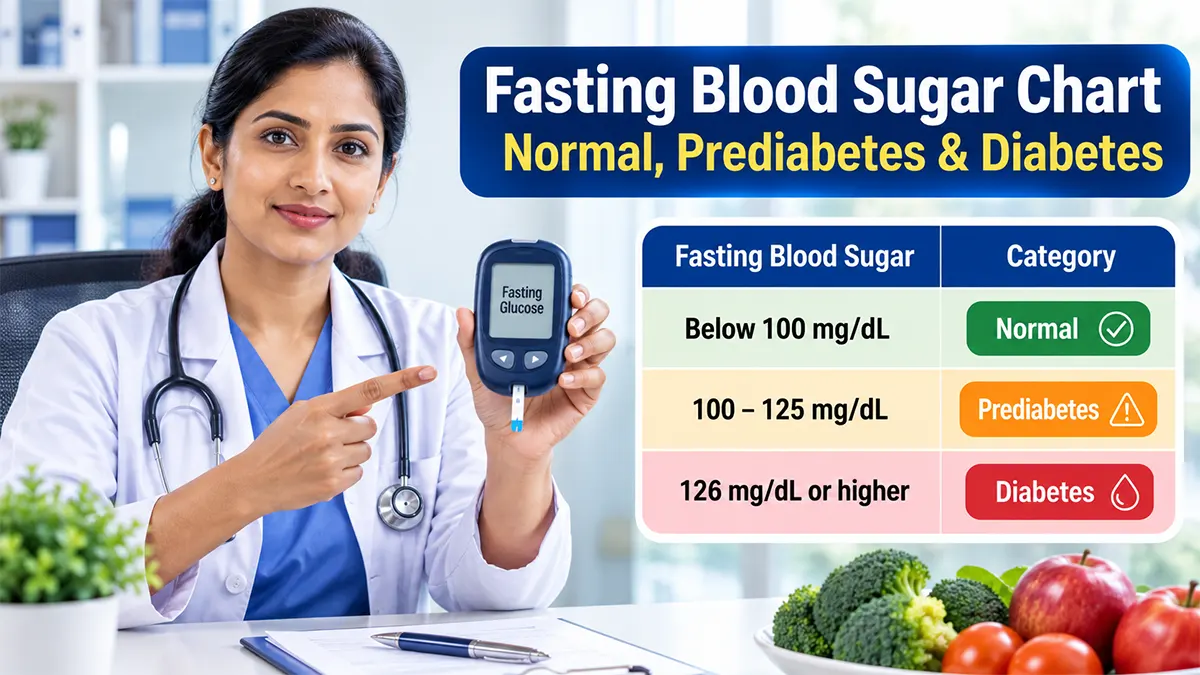
View Doctor Profile →Fasting Blood Sugar Chart can help you understand what a glucose reading may mean when it is measured after fasting. However, it is important to distinguish between a diagnostic blood sugar range and an individualized treatment target for someone who already has diabetes.
For nonpregnant people, standard diagnostic categories for fasting plasma glucose are:
| Fasting Blood Sugar | What It Generally Means |
|---|---|
| Below 100 mg/dL | Normal |
| 100–125 mg/dL | Prediabetes range |
| 126 mg/dL or higher | Diabetes diagnostic range |
A diabetes-range result generally requires appropriate confirmation unless there is clear evidence of hyperglycemia or classic symptoms. A home glucose-meter reading should not be used by itself to diagnose diabetes.
Table of Contents
What Is Fasting Blood Sugar?
Fasting blood sugar, also called fasting plasma glucose (FPG), measures the amount of glucose in your blood after you have gone without food or caloric beverages for a specified fasting period.
For a standard fasting plasma glucose test, fasting is generally at least 8 hours. Water is usually permitted.
The test is commonly performed in the morning before breakfast.
Fasting glucose is one of the laboratory tests healthcare professionals use when evaluating for prediabetes and diabetes.
Fasting Blood Sugar Chart
The basic diagnostic chart for nonpregnant people is:
| Fasting Plasma Glucose | Category |
|---|---|
| <100 mg/dL | Normal |
| 100–125 mg/dL | Prediabetes |
| ≥126 mg/dL | Diabetes diagnostic range |
Normal: Below 100 mg/dL
A fasting plasma glucose below 100 mg/dL falls within the normal diagnostic category.
For example:
92 mg/dL → Normal category
This does not mean that every glucose reading during the day needs to remain below 100 mg/dL. Blood glucose naturally rises after meals.
Prediabetes: 100–125 mg/dL
A fasting plasma glucose from 100 to 125 mg/dL falls within the prediabetes range.
For example:
112 mg/dL → Prediabetes range
Prediabetes does not mean that a person definitely has diabetes. It indicates glucose levels above the normal diagnostic range and an increased risk of developing type 2 diabetes.
Diabetes: 126 mg/dL or Higher
A fasting plasma glucose of 126 mg/dL or higher is within the diabetes diagnostic range.
For example:
132 mg/dL → Diabetes diagnostic range
However, a single result should not automatically be treated as a confirmed diagnosis. A healthcare professional may repeat the test or use another diagnostic test depending on the circumstances.
Normal Blood Sugar Levels by Age: What Is a Healthy Range?
Does Fasting Blood Sugar Change With Age?
A common misconception is that there is a completely different fasting blood sugar range for every age.
For diabetes diagnosis, the standard fasting glucose thresholds are generally not simply changed because someone is a child, teenager, adult, or older adult.
What can change with age is the individual treatment target for someone who already has diabetes.
For example, an older adult with multiple health conditions may have a different glucose-management goal from a healthy younger adult.
Therefore, an online “blood sugar chart by age” should not be used to change insulin or diabetes medication without professional guidance.
Fasting Blood Sugar in Children
Children can develop diabetes, particularly type 1 diabetes, and they may also develop type 2 diabetes.
When diabetes is suspected, healthcare professionals use appropriate diagnostic testing rather than relying on an age-based internet chart.
Parents should pay attention to symptoms such as:
- Excessive thirst
- Frequent urination
- New bedwetting
- Unexplained weight loss
- Increased hunger
- Fatigue
- Blurred vision
If these symptoms appear rapidly, particularly with vomiting, abdominal pain, unusual breathing, or severe drowsiness, the child needs prompt medical evaluation.
When High Blood Sugar Becomes an Emergency: Warning Signs, DKA & HHS (2026)
Fasting Blood Sugar in Teenagers
Teenagers without diabetes are generally assessed using established diagnostic criteria when diabetes is suspected.
However, teenagers who already have diabetes may have individualized glucose targets.
The appropriate target can depend on:
- Type of diabetes
- Insulin or medication regimen
- Risk of hypoglycemia
- Other medical conditions
- Overall diabetes management
Parents should not adjust insulin based solely on a generic fasting blood sugar chart.
Diabetes Symptoms in Children: Early Warning Signs Every Parent Should Know
Fasting Blood Sugar in Adults
For a nonpregnant adult without diabetes, the standard fasting categories are:
Below 100 mg/dL: normal
100–125 mg/dL: prediabetes range
126 mg/dL or higher: diabetes diagnostic range
If repeated laboratory testing shows elevated fasting glucose, a healthcare professional can determine whether additional testing is needed.
Fasting Blood Sugar in Older Adults
Older adults do not automatically have a separate diagnostic definition of normal fasting glucose.
However, treatment goals for older adults who have diabetes may be individualized according to:
- Overall health
- Other medical conditions
- Functional status
- Cognitive status
- Hypoglycemia risk
- Medications
- Life expectancy
This is why a person should not assume that a fasting glucose target found on a general website applies to every older adult.
Signs of Diabetes in Men: 12 Early Warning Symptoms You Shouldn’t Ignore
Fasting Blood Sugar vs After-Meal Blood Sugar
These measurements should not be interpreted in the same way.
Fasting glucose is measured after fasting.
Post-meal glucose is measured after eating.
Blood glucose normally increases after food because carbohydrates are digested and glucose enters the bloodstream.
For many nonpregnant adults who already have diabetes, commonly used treatment targets include 80–130 mg/dL before meals and less than 180 mg/dL at 1–2 hours after the beginning of a meal. These are treatment targets, not diagnostic definitions of normal glucose.
Fasting Blood Sugar vs A1C
Fasting glucose is only one way to evaluate blood sugar.
An A1C test estimates average blood glucose over roughly the previous 2–3 months.
Common diagnostic categories are:
| A1C | Category |
|---|---|
| Below 5.7% | Normal |
| 5.7–6.4% | Prediabetes |
| 6.5% or higher | Diabetes diagnostic range |
Using both fasting glucose and A1C can sometimes provide a broader picture of glucose regulation.
Signs of Diabetes in Women: 12 Early Warning Symptoms You Shouldn’t Ignore (2026)
Important: Don’t Diagnose Yourself From One Reading
If your home glucose meter shows an unexpectedly high fasting value, don’t immediately assume that you have diabetes.
Possible factors affecting a reading include:
- Testing technique
- Food or caloric drinks before testing
- Illness
- Stress
- Medication
- Meter or strip problems
Persistent abnormal readings should be discussed with a healthcare professional.
For diagnosis, laboratory testing is preferred over relying solely on a personal glucose meter.
Fasting Blood Sugar Chart by Reading
A fasting glucose result is most useful when you know how the test was performed and whether it was a laboratory test or a home meter reading.
For nonpregnant people, the standard fasting plasma glucose categories are: below 100 mg/dL = normal, 100–125 mg/dL = prediabetes range, and 126 mg/dL or higher = diabetes diagnostic range.
| Fasting Blood Sugar | General Interpretation |
|---|---|
| 70–99 mg/dL | Normal diagnostic range |
| 100–109 mg/dL | Prediabetes range |
| 110–119 mg/dL | Prediabetes range |
| 120–125 mg/dL | Prediabetes range |
| 126 mg/dL or higher | Diabetes diagnostic range |
Important: These are diagnostic categories for fasting plasma glucose, not individualized treatment targets.
10 Silent Symptoms of High Blood Sugar You Shouldn’t Ignore (2026 Guide)
Is 100 mg/dL Fasting Blood Sugar Normal?
A laboratory fasting plasma glucose of 100 mg/dL is not in the normal category. It falls at the beginning of the prediabetes range.
The standard categories are:
- Below 100 mg/dL: normal
- 100–125 mg/dL: prediabetes
- 126 mg/dL or higher: diabetes diagnostic range
So a fasting result of exactly 100 mg/dL should not be described as normal fasting glucose.
Is 110 mg/dL Fasting Blood Sugar Normal?
A fasting laboratory glucose of 110 mg/dL falls within the prediabetes range.
It does not, by itself, establish that a person has diabetes.
Prediabetes can be identified using fasting plasma glucose, A1C, or an appropriate oral glucose tolerance test.
If this result is repeated, discuss it with a healthcare professional.
Is 120 mg/dL Fasting Blood Sugar Normal?
No. For a person who is not pregnant and does not already have a diabetes diagnosis, a laboratory fasting plasma glucose of 120 mg/dL is within the prediabetes range.
It is below the 126 mg/dL diabetes diagnostic threshold, but it is above the normal range.
Is 125 mg/dL Fasting Blood Sugar Diabetes?
A fasting plasma glucose of 125 mg/dL is still within the prediabetes range.
The diabetes diagnostic threshold begins at 126 mg/dL.
However, diagnosis should not be made from a single borderline result without appropriate clinical evaluation and confirmation.
Is 126 mg/dL Fasting Blood Sugar Diabetes?
A laboratory fasting plasma glucose of 126 mg/dL or higher is within the diabetes diagnostic range.
However, a single abnormal test generally needs confirmation when there is not clear evidence of severe hyperglycemia or classic symptoms. NIDDK states that diagnosis generally requires two abnormal test results, either from the same sample or from separate samples.
Therefore:
126 mg/dL = diabetes diagnostic threshold, not automatically a confirmed diagnosis from one reading.
Diabetes Guide: Symptoms, Causes, Types, Treatment & Prevention (2026)
What Does 130 mg/dL Fasting Blood Sugar Mean?
A fasting laboratory glucose of 130 mg/dL is above the diabetes diagnostic threshold.
If this result occurs on a properly performed fasting laboratory test, your healthcare professional may repeat the test or use another diagnostic test to confirm the result.
Do not diagnose yourself based solely on a home glucose meter.
What Does 140 mg/dL Fasting Blood Sugar Mean?
A fasting glucose of 140 mg/dL is well above the diabetes diagnostic threshold.
If confirmed through appropriate laboratory testing, it is consistent with the diabetes diagnostic range.
A healthcare professional should evaluate the result rather than relying on an online chart.
Fasting Blood Sugar vs Random Blood Sugar
These tests are different.
Fasting Blood Sugar
The fasting plasma glucose test is performed after at least 8 hours without food or caloric drinks, with water generally permitted.
Random Blood Sugar
A random plasma glucose test can be performed at any time.
A random glucose of 200 mg/dL or higher, together with classic symptoms of hyperglycemia or a hyperglycemic crisis, can be used to diagnose diabetes.
Therefore, a 140 mg/dL fasting result and a 140 mg/dL random result cannot be interpreted in exactly the same way.
Fasting Blood Sugar vs A1C
Fasting glucose provides a measurement of blood glucose at a particular point in time.
A1C provides an estimate of average blood glucose over approximately the previous 2–3 months.
The commonly used A1C categories are:
| A1C | Category |
|---|---|
| Below 5.7% | Normal |
| 5.7–6.4% | Prediabetes |
| 6.5% or higher | Diabetes diagnostic range |
Because these tests measure different aspects of glucose regulation, their results do not always identify exactly the same people.
Why Can Fasting Blood Sugar Be High?
A higher-than-expected fasting glucose can have several possible explanations.
Factors can include:
- Prediabetes or diabetes
- Illness or infection
- Physical or emotional stress
- Certain medications
- Poor sleep
- Changes in physical activity
- Hormonal effects
- Overnight changes in glucose regulation
One abnormal reading does not tell you which factor is responsible.
Repeated abnormal laboratory results deserve professional evaluation.
What Is the Dawn Phenomenon?
Some people with diabetes notice that glucose rises during the early morning hours.
This can happen because hormones released toward morning can increase glucose production and reduce insulin sensitivity.
This pattern is sometimes called the dawn phenomenon.
If you repeatedly have high morning glucose despite following your treatment plan, discuss the pattern with your healthcare professional rather than changing medication or insulin doses on your own.
How to Prepare for a Fasting Blood Sugar Test
For a standard fasting plasma glucose test:
- Follow your healthcare professional’s instructions.
- Fast for at least 8 hours unless instructed otherwise.
- Do not eat during the fasting period.
- Water is generally allowed.
- Take medications only according to your healthcare professional’s instructions.
- Have the blood sample collected at the recommended time.
NIDDK specifies that the fasting plasma glucose test is performed in the morning after an 8-hour fast.
Can a Home Glucose Meter Diagnose Diabetes?
No.
A home glucose meter is useful for monitoring blood glucose, but NIDDK states that meter results are not suitable for diagnosing diabetes. Diagnosis requires appropriate laboratory testing.
For example, if your home meter repeatedly shows fasting readings above 126 mg/dL, don’t assume you have diabetes solely from those readings. Arrange appropriate medical testing.
When Should You Talk to a Doctor?
Consider discussing your results with a healthcare professional if:
- Your fasting readings are repeatedly elevated.
- A laboratory result is in the prediabetes range.
- A laboratory fasting glucose reaches the diabetes diagnostic range.
- You have symptoms such as excessive thirst or frequent urination.
- You have unexplained weight loss.
- You have blurred vision or unusual fatigue.
- You are already taking diabetes medication and your glucose is repeatedly outside your prescribed target.
If you have vomiting, confusion, severe weakness, difficulty breathing, or loss of consciousness together with very high glucose or suspected ketones, seek urgent medical care.
Fasting Blood Sugar and Prediabetes
A fasting plasma glucose of 100–125 mg/dL falls within the prediabetes range for nonpregnant people. Prediabetes means blood glucose is higher than the normal diagnostic range but not high enough to meet the laboratory threshold for diabetes.
For example:
- 100 mg/dL: Prediabetes range
- 110 mg/dL: Prediabetes range
- 120 mg/dL: Prediabetes range
- 125 mg/dL: Prediabetes range
Prediabetes does not mean that type 2 diabetes is inevitable. Healthcare professionals may recommend lifestyle changes and follow-up testing based on the person’s overall risk.
Fasting Blood Sugar and Diabetes
A fasting plasma glucose of 126 mg/dL or higher is within the diabetes diagnostic range. However, an isolated abnormal result does not necessarily establish a confirmed diagnosis. Diabetes diagnosis generally requires confirmation with repeat testing or another appropriate diagnostic test when there is not unequivocal hyperglycemia.
For example:
Fasting glucose: 128 mg/dL
This is in the diabetes diagnostic range, but the person should undergo appropriate medical evaluation rather than self-diagnosing.
What If Fasting Blood Sugar Is Normal but A1C Is High?
It is possible for different diabetes tests to produce different results.
For example, someone may have:
- Fasting glucose in the normal range
- A1C in the prediabetes range
The reverse can also occur.
NIDDK explains that different tests do not always identify exactly the same people, and healthcare professionals may repeat testing when results do not agree.
This is one reason a complete diabetes assessment should not rely on a single number.
Fasting Blood Sugar vs. A1C
These tests measure different things.
Fasting Plasma Glucose
Measures blood glucose at a specific point in time after fasting.
A1C
Reflects average blood glucose over approximately the previous 3 months.
The commonly used diagnostic A1C categories are:
| A1C | Category |
|---|---|
| Below 5.7% | Normal |
| 5.7–6.4% | Prediabetes |
| 6.5% or higher | Diabetes diagnostic range |
A1C does not require fasting, although certain medical conditions can affect its accuracy.
How Often Should Fasting Blood Sugar Be Checked?
There is no single testing schedule that applies to everyone.
The appropriate frequency depends on whether you:
- Have diabetes
- Have prediabetes
- Take glucose-lowering medication
- Use insulin
- Have symptoms
- Have other risk factors
- Are pregnant
- Have been advised to monitor glucose by your healthcare professional
People without diabetes generally should not repeatedly test themselves at home simply to create an “age-based” chart unless their healthcare professional has recommended monitoring.
Can Stress Affect Fasting Blood Sugar?
Yes. Blood glucose can be affected by short-term factors such as stress and illness. NIDDK notes that fasting plasma glucose can vary because of short-term lifestyle and biological factors.
Therefore, an unexpectedly elevated result should be interpreted in context.
If elevated fasting glucose continues to appear on properly performed laboratory tests, medical evaluation is appropriate.
Can Poor Sleep Affect Blood Sugar?
Sleep and daily routines can influence glucose regulation, particularly in people who already have diabetes or insulin resistance.
However, one night of poor sleep should not be used to explain away repeatedly abnormal fasting laboratory results.
Persistent abnormalities deserve appropriate testing.
Does Exercise Lower Fasting Blood Sugar?
Regular physical activity can support healthy glucose regulation and is an important component of diabetes prevention and management.
However, exercise should not be viewed as a substitute for medical evaluation when laboratory testing indicates possible diabetes.
If you already use insulin or medications that can cause hypoglycemia, discuss exercise and medication adjustments with your healthcare professional.
Fasting Blood Sugar Chart: Quick Reference
| Fasting Plasma Glucose | Interpretation |
|---|---|
| Below 100 mg/dL | Normal |
| 100–125 mg/dL | Prediabetes range |
| 126 mg/dL or higher | Diabetes diagnostic range |
These categories apply to nonpregnant people. Pregnancy has different glucose-testing criteria.
When Is Fasting Blood Sugar Concerning?
A single mildly elevated result does not necessarily mean an emergency.
However, repeated abnormal laboratory results should be discussed with a healthcare professional.
Seek urgent medical attention if very high glucose occurs with serious symptoms such as:
- Repeated vomiting
- Confusion
- Severe weakness
- Difficulty breathing
- Severe dehydration
- Loss of consciousness
These symptoms can indicate a serious hyperglycemic complication and should not be managed using an internet blood sugar chart alone.
Important Note About Home Glucose Meters
A home glucose meter can be useful for monitoring blood glucose, especially for people with diagnosed diabetes.
It should not be used as the sole method for diagnosing diabetes.
NIDDK specifically states that blood glucose meters purchased over the counter cannot diagnose diabetes.
If your meter repeatedly shows elevated fasting values, arrange appropriate laboratory testing.
Fasting Blood Sugar During Pregnancy
Pregnancy requires a separate approach.
The fasting glucose thresholds in this article are intended for nonpregnant people.
Gestational diabetes screening may use glucose challenge tests and oral glucose tolerance testing with pregnancy-specific criteria. Therefore, pregnant people should follow the testing schedule and interpretation provided by their obstetric or diabetes care team.
Frequently Asked Questions
Is 99 mg/dL fasting blood sugar normal?
Yes. A fasting plasma glucose of 99 mg/dL or below is within the normal diagnostic category for nonpregnant people.
Is 100 mg/dL fasting blood sugar normal?
No. A fasting plasma glucose of 100 mg/dL is at the lower boundary of the prediabetes range.
Is 110 mg/dL fasting blood sugar bad?
A laboratory fasting glucose of 110 mg/dL is within the prediabetes range. It does not by itself confirm diabetes.
Is 120 mg/dL fasting blood sugar diabetes?
No. A fasting plasma glucose of 120 mg/dL is within the prediabetes range, not the diabetes diagnostic range.
Is 125 mg/dL fasting blood sugar diabetes?
No. 125 mg/dL is still within the prediabetes range. The fasting plasma glucose threshold for the diabetes diagnostic category begins at 126 mg/dL.
Is 126 mg/dL fasting blood sugar diabetes?
It is within the diabetes diagnostic range, but appropriate confirmation is generally required before a diagnosis is established.
Can a glucose meter diagnose diabetes?
No. A home glucose meter can monitor glucose but should not be used alone to diagnose diabetes.
How long should you fast before a fasting glucose test?
For a standard fasting plasma glucose test, you generally need to fast for at least 8 hours. Water is generally permitted.
Final Takeaway
The most important numbers in a Fasting Blood Sugar Chart are:
Below 100 mg/dL → Normal
100–125 mg/dL → Prediabetes range
126 mg/dL or higher → Diabetes diagnostic range
These values are intended for interpreting laboratory fasting plasma glucose in nonpregnant people. They should not be confused with personalized blood glucose targets for people who already have diabetes.
If your fasting glucose is repeatedly abnormal, speak with a healthcare professional about appropriate laboratory testing, A1C testing, and follow-up.
Medical sources: National Institute of Diabetes and Digestive and Kidney Diseases (NIDDK) and American Diabetes Association (ADA).
How to Read Your Fasting Blood Sugar Result
A fasting glucose result should be interpreted according to how the test was performed and whether it was a laboratory plasma glucose test or a home glucose-meter reading.
For nonpregnant individuals, the 2026 ADA criteria classify fasting plasma glucose as:
- Below 100 mg/dL: normal
- 100–125 mg/dL: prediabetes range
- 126 mg/dL or higher: diabetes diagnostic range
A fasting test means no caloric intake for at least 8 hours.
Fasting Blood Sugar: Common Examples
| Fasting Result | General Interpretation |
|---|---|
| 85 mg/dL | Normal |
| 95 mg/dL | Normal |
| 99 mg/dL | Normal |
| 100 mg/dL | Prediabetes range |
| 110 mg/dL | Prediabetes range |
| 120 mg/dL | Prediabetes range |
| 125 mg/dL | Prediabetes range |
| 126 mg/dL | Diabetes diagnostic threshold |
| 140 mg/dL | Diabetes diagnostic range |
These categories describe diagnostic fasting plasma glucose, not personalized glucose targets for someone already living with diabetes.
What If Your Fasting Blood Sugar Is 100–125 mg/dL?
A fasting plasma glucose between 100 and 125 mg/dL is classified as impaired fasting glucose, commonly called prediabetes.
This range does not mean that diabetes is inevitable.
However, it indicates a higher risk of developing type 2 diabetes and should prompt appropriate follow-up.
A healthcare professional may consider:
- A1C testing
- Repeat fasting glucose
- Oral glucose tolerance testing
- Weight and lifestyle assessment
- Other diabetes risk factors
NIDDK recognizes fasting glucose, A1C, and the 2-hour oral glucose tolerance test as appropriate tests for identifying prediabetes.
What If Your Fasting Blood Sugar Is 126 mg/dL or Higher?
A laboratory fasting plasma glucose of 126 mg/dL or higher meets the ADA’s diabetes diagnostic threshold.
However, one result does not necessarily confirm diabetes.
If there is no unequivocal hyperglycemia, the ADA recommends confirmatory testing. This can involve repeating the same test or using another accepted diagnostic test.
For example:
First laboratory fasting glucose: 130 mg/dL
A healthcare professional may repeat the fasting test or use A1C or another appropriate diagnostic test.
Do not diagnose yourself based solely on a home glucose-meter reading.
Why Your Fasting Blood Sugar May Be Different From Your A1C
Fasting glucose and A1C measure different aspects of glucose regulation.
Fasting glucose reflects your blood glucose at the time of the test after fasting.
A1C reflects average glucose exposure over a longer period.
Because the tests measure different things, their results may not always fall into the same diagnostic category. The ADA notes that different screening tests can identify different groups of people.
For example, someone may have:
- Normal fasting glucose but A1C in the prediabetes range, or
- Fasting glucose in the prediabetes range but A1C below 5.7%.
When results conflict, a healthcare professional may repeat or further evaluate the abnormal test.
Fasting Blood Sugar Chart vs Diabetes Treatment Targets
This distinction is extremely important.
A diagnostic chart helps determine whether someone may have normal glucose, prediabetes, or diabetes.
A treatment target helps a person who already has diabetes manage blood glucose safely.
They are not the same thing.
For example, a fasting glucose of 120 mg/dL is within the prediabetes diagnostic range for someone without diabetes. But a person who already has diabetes may have an individualized treatment target that allows a different range.
Therefore, don’t change insulin or medication simply because your number differs from an internet chart.
Can Fasting Blood Sugar Be Normal With Prediabetes?
Yes.
Prediabetes can be identified through different tests, including:
- Fasting plasma glucose
- A1C
- 2-hour oral glucose tolerance test
These tests do not always identify exactly the same people. NIDDK specifically notes that a person can have a normal fasting glucose while another test, such as A1C, indicates prediabetes.
This is one reason a comprehensive assessment can be more informative than relying on a single measurement.
How Often Should Prediabetes Be Tested?
The ADA’s 2026 guidance recommends that people with prediabetes generally be tested at least annually.
For people whose initial testing is normal, the ADA says repeat screening at a minimum of every three years is reasonable, with more frequent testing depending on risk factors and changes in health.
Your healthcare professional may recommend a different schedule based on your individual risk.
Who Should Consider Diabetes Screening?
The ADA’s 2026 recommendations advise considering testing in adults with overweight or obesity who have one or more diabetes risk factors.
Examples include:
- A first-degree relative with diabetes
- History of cardiovascular disease
- High blood pressure
- Abnormal cholesterol or triglycerides
- Other recognized diabetes risk factors
For adults without these additional risk factors, the ADA recommends that screening begin at age 35 years.
When Is Fasting Blood Sugar an Emergency?
A mildly elevated fasting result does not automatically constitute an emergency.
However, very high blood glucose accompanied by symptoms such as:
- Repeated vomiting
- Severe dehydration
- Confusion
- Difficulty breathing
- Severe weakness
- Loss of consciousness
can indicate a serious hyperglycemic complication.
If these symptoms occur, seek urgent medical care rather than relying on a fasting blood sugar chart.
Fasting Blood Sugar Chart: Final Quick Reference
Fasting plasma glucose categories
Standard diagnostic categories for nonpregnant individuals.0mg/dL35mg/dL70mg/dL105mg/dL140mg/dLNormalPrediabetesDiabetes threshold
These are diagnostic categories, not individualized treatment targets.
Normal: below 100 mg/dL
Prediabetes: 100–125 mg/dL
Diabetes diagnostic threshold: 126 mg/dL or higher
Frequently Asked Questions — Fasting Blood Sugar Chart
1. What is a normal fasting blood sugar level?
For nonpregnant people, a fasting plasma glucose below 100 mg/dL is considered normal for diabetes diagnostic purposes.
2. Is 100 mg/dL fasting blood sugar normal?
No. A fasting plasma glucose of 100 mg/dL falls within the prediabetes range.
3. Is 110 mg/dL fasting blood sugar normal?
No. 110 mg/dL is within the prediabetes range when measured as laboratory fasting plasma glucose.
4. Is 120 mg/dL fasting blood sugar diabetes?
No. A fasting plasma glucose of 120 mg/dL falls within the prediabetes range. The diabetes diagnostic threshold starts at 126 mg/dL.
5. Is 125 mg/dL fasting blood sugar diabetes?
No. 125 mg/dL is still within the prediabetes range. A fasting plasma glucose of 126 mg/dL or higher is in the diabetes diagnostic range.
6. Is 126 mg/dL fasting blood sugar diabetes?
A laboratory fasting plasma glucose of 126 mg/dL or higher meets the diabetes diagnostic threshold. However, confirmation with repeat testing or another appropriate diagnostic test is generally needed when there is no unequivocal hyperglycemia.
7. Can a home glucose meter diagnose diabetes?
No. Home glucose meters are useful for monitoring blood glucose but should not be used alone to diagnose diabetes. Appropriate laboratory testing is recommended.
8. How long should you fast before a fasting blood sugar test?
A standard fasting plasma glucose test generally requires at least 8 hours of fasting. Water is generally allowed.
9. What is the difference between fasting blood sugar and random blood sugar?
Fasting blood sugar is measured after fasting for at least 8 hours. Random blood glucose can be measured at any time, regardless of when the person last ate.
10. What is a normal fasting blood sugar for adults?
For nonpregnant adults without diabetes, a fasting plasma glucose below 100 mg/dL is in the normal diagnostic category.
11. Does fasting blood sugar change with age?
The standard diagnostic thresholds generally do not change simply because a person is older or younger. However, glucose treatment targets for people with diabetes may be individualized according to age, health, and hypoglycemia risk.
12. Can you have prediabetes with normal fasting blood sugar?
Yes. Prediabetes can be identified using different tests, including A1C, fasting plasma glucose, and the 2-hour oral glucose tolerance test. Results from these tests do not always identify exactly the same people.
13. What A1C level is considered prediabetes?
An A1C of 5.7% to 6.4% is within the prediabetes range.
14. Can stress raise fasting blood sugar?
Yes. Stress and illness can affect blood glucose. However, repeatedly elevated fasting laboratory results should still be evaluated rather than automatically attributed to stress.
15. When should high fasting blood sugar be treated as an emergency?
A high fasting glucose reading alone does not necessarily indicate an emergency. However, very high glucose accompanied by vomiting, severe dehydration, confusion, difficulty breathing, severe weakness, or loss of consciousness requires urgent medical attention.
16. Can fasting blood sugar be normal while A1C is high?
Yes. Fasting glucose and A1C measure different aspects of glucose regulation, so their results can sometimes fall into different diagnostic categories. A healthcare professional may repeat or perform additional testing when results are inconsistent.
17. Is fasting blood sugar the same during pregnancy?
No. Pregnancy has different glucose-testing considerations and diagnostic criteria. Pregnant people should follow the testing and interpretation provided by their obstetric or diabetes care team.
18. How often should someone with prediabetes be tested?
The ADA’s 2026 guidance recommends that people with prediabetes generally be tested at least annually, although the appropriate schedule can vary according to individual risk.
19. Can fasting blood sugar return to a normal range after prediabetes?
It can. Lifestyle changes such as increased physical activity, healthier eating patterns, and appropriate weight management can improve glucose regulation and reduce the risk of progression to type 2 diabetes. Individual results vary.
20. What are the main fasting blood sugar ranges to remember?
Below 100 mg/dL → Normal
100–125 mg/dL → Prediabetes range
126 mg/dL or higher → Diabetes diagnostic range
These categories apply to nonpregnant people undergoing appropriate fasting plasma glucose testing and should not be confused with individualized treatment targets.
Conclusion
A Fasting Blood Sugar Chart is useful for understanding the standard diagnostic categories, but it should not replace medical evaluation.
For nonpregnant people:
Below 100 mg/dL → Normal
100–125 mg/dL → Prediabetes range
126 mg/dL or higher → Diabetes diagnostic range
A diabetes-range result generally requires appropriate confirmation when there is no unequivocal hyperglycemia.
If your fasting glucose is repeatedly elevated, discuss the results with a healthcare professional. They may recommend laboratory fasting glucose, A1C, an oral glucose tolerance test, or other evaluation depending on your situation.
Medical sources: American Diabetes Association, Standards of Care in Diabetes—2026, and National Institute of Diabetes and Digestive and Kidney Diseases (NIDDK).
References
This article is based on current recommendations from internationally recognized medical organizations and peer-reviewed evidence, including:
- American Diabetes Association (ADA) Standards of Care
- Centers for Disease Control and Prevention (CDC)
- National Institute of Diabetes and Digestive and Kidney Diseases (NIDDK)
- World Health Organization (WHO)
Medically Reviewed By
Dr. Ch. Srujith, MBBS, MD (General Medicine)
General Physician & Diabetologist | 15+ Years of Clinical Experience | Hyderabad, India
This article has been medically reviewed for medical accuracy and reflects current evidence-based recommendations available as of 2026. It is intended for educational purposes only and should not replace personalized medical advice, diagnosis, or treatment. For concerns about diabetes or blood sugar management, consult a qualified healthcare professional.
Author
Yamanandan Reddy
Health Content Writer & Frontend Developer
Yamanandan Reddy is a health content writer and frontend developer with over 4 years of experience in website design and digital content creation. He writes research-based health articles to help readers understand symptoms, causes, treatments, and prevention methods related to common health conditions.
⚠️ Medical Disclaimer
This content is for informational purposes only and does not replace professional medical advice. Always consult a qualified healthcare provider for diagnosis and treatment.
4 thoughts on “Fasting Blood Sugar Chart: Normal, Prediabetes & Diabetes Ranges (2026)”