
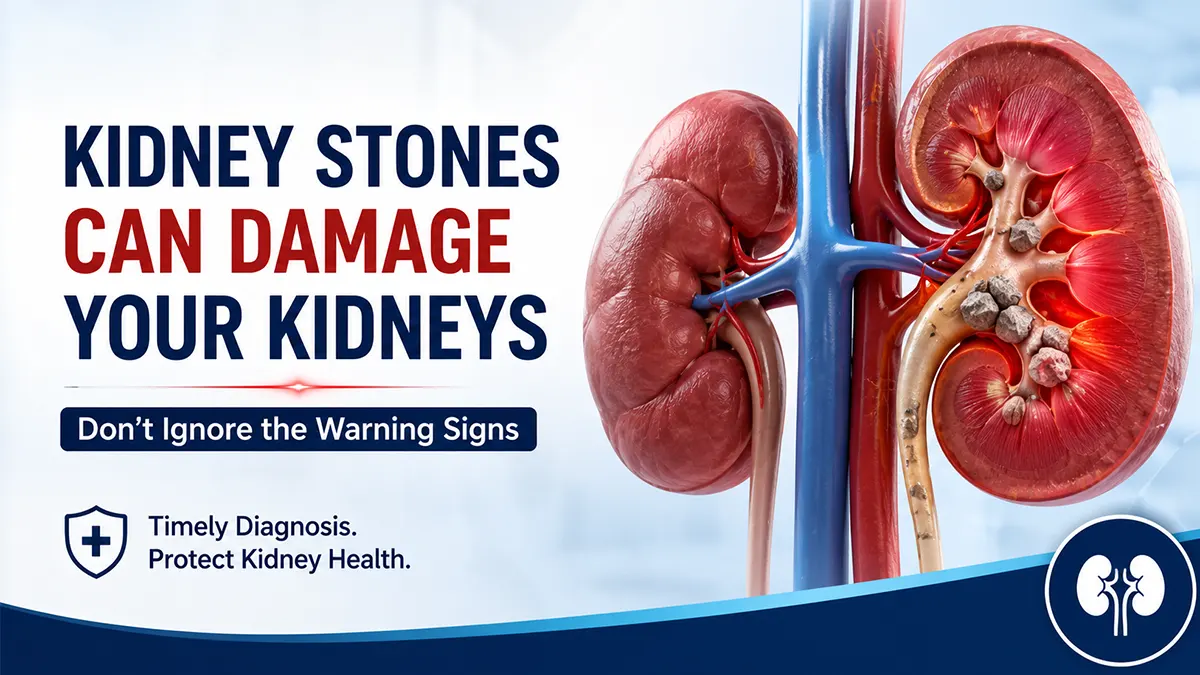
The Fear Most Kidney Stone Patients Don’t Talk About
Can a Kidney Stone Cause Permanent Kidney Damage? The answer might surprise you.
Many people assume that once the pain stops, the kidney stone is gone. But in some cases, the pain disappears while the stone remains stuck, quietly blocking urine flow and putting the kidney at risk.
Most kidney stones won’t cause permanent damage. Yet a prolonged blockage can lead to kidney swelling, infection, and even irreversible loss of kidney function if left untreated.
Before you decide to “wait and watch,” here’s what every kidney stone patient needs to know.
Can a Kidney Stone Cause Permanent Kidney Damage? This concern is common among kidney stone patients who are worried about long-term kidney health. While most stones pass without causing serious harm, prolonged blockage can increase the risk of permanent kidney damage.
Table of Contents
The Danger Zone: When a Kidney Stone Becomes a Threat
Most kidney stones cause pain because they move through the urinary tract.
The real danger begins when a stone gets stuck and creates a blockage.
Think of your kidney like a water tank connected to a pipe.
Your urine is supposed to flow continuously through that pipe.
Now imagine a stone acting like a plug inside the pipe.
The urine has nowhere to go.
Pressure starts building up behind the blockage.
This condition is called Hydronephrosis.
What Is Hydronephrosis?
Hydronephrosis is the swelling of a kidney caused by trapped urine.
Instead of draining normally, urine backs up into the kidney.
Over time, this increased pressure can squeeze and damage delicate kidney tissue.
The longer the blockage remains, the greater the risk of losing kidney function.
Signs a Kidney Stone May Be Causing Hydronephrosis
- Persistent flank or back pain
- Nausea and vomiting
- Reduced urine output
- Blood in urine
- Recurrent urinary tract infections
- Fever with chills (medical emergency)
Many people assume the pain itself is the problem.
In reality, the blockage is often the bigger threat.
Many patients ask, Can a Kidney Stone Cause Permanent Kidney Damage when urine flow is blocked. The answer depends on how long the obstruction remains untreated and whether kidney function is affected.
Kidney Stone Recovery Mistakes to Avoid After Surgery or Passing a Stone
How Long Is Too Long?
This is one of the most common questions urologists hear.
Unfortunately, there is no exact countdown clock.
The risk depends on:
- Size of the stone
- Location of blockage
- Whether one or both kidneys are affected
- Presence of infection
- Existing kidney health
What Medical Evidence Shows
A complete blockage lasting a few days usually does not cause permanent damage.
A blockage lasting several weeks becomes more concerning.
When obstruction continues for 4–6 weeks or longer, the risk of irreversible kidney damage increases significantly.
Some patients may lose part of their kidney function even after the blockage is removed.
In severe untreated cases, a kidney can become permanently weakened.
That is why urologists focus not only on pain relief but also on preserving kidney function.
Why Timing Matters
The kidney is remarkably resilient.
However, it cannot tolerate prolonged pressure forever.
Early treatment often means full recovery.
Delayed treatment can mean permanent loss of healthy kidney tissue.
Does Protein Powder Increase Kidney Stone Risk? A Doctor-Reviewed 2026 Guide for Gym-Goers
The Silent Killer: When the Pain Stops but the Stone Doesn’t
This is perhaps the most dangerous misconception surrounding kidney stones.
Many patients think:
“My pain disappeared, so the stone must have passed.”
Sometimes that is true.
But not always.
Why Pain Can Suddenly Stop
Pain occurs when the ureter contracts against a blockage.
Eventually, the kidney may stretch and adapt to the pressure.
When that happens, pain can decrease.
The blockage may still be there.
The urine may still be trapped.
The kidney may still be under stress.
In other words:
No pain does not automatically mean no problem.
The Hidden Risk
A silent obstruction can continue damaging the kidney without obvious symptoms.
Patients often discover the problem only after:
- Ultrasound scans
- CT scans
- Kidney function tests
- Recurrent infections
By then, some kidney function may already be lost.
This is why follow-up imaging is often recommended, even when symptoms improve.
One reason people search Can a Kidney Stone Cause Permanent Kidney Damage is because symptoms sometimes disappear even though the blockage remains. This silent obstruction can continue harming the kidney without obvious warning signs.
Why Some People Get Kidney Stones Repeatedly: 7 Hidden Causes Doctors Want You to Know in 2026
Can a Kidney Stone Cause Complete Kidney Failure?
In most people, a single kidney stone does not cause complete kidney failure.
The opposite kidney usually continues working normally.
However, serious complications can occur when:
- Both kidneys are blocked
- A person has only one functioning kidney
- Severe infection develops
- Treatment is delayed for months
These situations require urgent medical attention.
Warning Signs That Need Immediate Evaluation
- Fever with kidney stone pain
- Chills or shaking
- Inability to urinate
- Severe vomiting
- Persistent pain despite medications
- Sudden decrease in urine output
Never ignore these symptoms.
They may indicate an emergency that threatens kidney health.
Worst Foods to Eat During a Kidney Stone Attack
Hospital Insights: What Urologists Commonly See in Clinical Practice
A Patient Who Thought the Problem Was Gone
One common scenario involves patients who experience severe kidney stone pain for a few days and then suddenly feel better. Believing the stone has passed, they skip follow-up scans and continue with daily life.
Months later, they return for unrelated symptoms or a routine health check-up, only to discover that the stone remained stuck in the ureter, causing prolonged obstruction and reduced kidney drainage.
Kidney Function Decline Found During Follow-Up
Urologists occasionally encounter patients whose blood tests reveal worsening kidney function despite minimal symptoms. Further evaluation often shows that a previously diagnosed stone continued blocking urine flow for several weeks or months.
In many of these cases, the patient delayed treatment because the pain became manageable or disappeared completely.
Silent Hydronephrosis Detected on Ultrasound
Another important observation is the discovery of hydronephrosis during ultrasound examinations in patients who report little or no pain.
The kidney may appear swollen due to trapped urine, even though the patient believes the stone is no longer causing problems. This highlights why imaging tests remain crucial after a kidney stone diagnosis.
Recovery After Timely Stone Removal
The encouraging news is that many patients experience significant recovery when obstruction is identified early and treated promptly.
After procedures such as ureteroscopy, laser stone removal, or stent placement, kidney drainage often improves, pressure within the kidney decreases, and kidney function may return to normal if permanent damage has not yet occurred.
Lessons Patients Commonly Learn Too Late
Many patients later admit they assumed that:
- No pain meant no stone.
- Painkillers had solved the problem.
- Small stones could not damage the kidney.
- Follow-up scans were unnecessary.
- Delaying treatment for a few months was harmless.
Unfortunately, these assumptions can sometimes lead to preventable kidney injury.
Clinical Experience Shared by Urologists
According to practicing urologists, one of the most important messages for kidney stone patients is simple:
Pain is not always the best indicator of danger.
The true concern is whether the stone is obstructing urine flow and affecting kidney drainage.
That is why follow-up imaging, kidney function testing, and specialist evaluation remain essential even after symptoms improve.
Clinical experience shows that Can a Kidney Stone Cause Permanent Kidney Damage becomes a real concern when patients delay follow-up scans after their pain improves.
How Long Does It Take to Pass a 4mm, 5mm, or 6mm Kidney Stone? (Size Guide)
Who Is Most at Risk for Kidney Damage?
Some patients have a higher chance of complications.
These include people with:
- Large kidney stones
- Ureteric stones causing obstruction
- Recurrent kidney stones
- Chronic kidney disease
- Diabetes
- High blood pressure
- Solitary kidney
- Repeated urinary tract infections
If you fall into any of these groups, regular monitoring becomes even more important.
Kidney Stones in Young Adults: A Rising Crisis
Expert Urologist Verdict
A Medical Warning Every Kidney Stone Patient Should Read
A kidney stone is not dangerous simply because it causes pain.
It becomes dangerous when it blocks urine flow and remains untreated.
Pain may come and go.
The blockage may not.
That is why symptom improvement should never replace proper medical evaluation.
Clinical Recommendation
Any patient with a suspected kidney stone should undergo appropriate imaging and kidney function assessment.
If a blockage is identified, timely treatment is essential to prevent hydronephrosis, infection, and permanent kidney damage.
Most patients recover completely when intervention occurs before significant obstruction-related injury develops.
Do not wait for worsening symptoms.
Protecting kidney function is always easier than restoring it.
So, Can a Kidney Stone Cause Permanent Kidney Damage? Usually no, but if a kidney stone causes prolonged obstruction, hydronephrosis, or infection, permanent kidney damage can occur. Early diagnosis and treatment remain the best way to protect kidney function.
Kidney Stone Emergency: 5 Signs to Go to the ER Now
Reviewed & Recommended By
Dr. Jayanth Reddy
Consultant Urologist
My Health Hospitals
(Clinical review and approval section can be added before publication.)
Can a Kidney Stone Cause Permanent Kidney Damage?
Yes, a kidney stone can cause permanent kidney damage if it blocks urine flow for a prolonged period and treatment is delayed. Most kidney stones do not cause lasting harm, but untreated obstruction can increase pressure inside the kidney and reduce kidney function.
How Long Can a Kidney Stone Block the Ureter Before Causing Damage?
A complete blockage lasting several weeks can increase the risk of irreversible kidney damage. The longer the obstruction remains untreated, the greater the chance of permanent loss of kidney function. Early diagnosis and treatment help prevent complications
Can Kidney Damage Occur Even If Kidney Stone Pain Stops?
Yes. One of the biggest misconceptions is that pain relief means the stone has passed. In some cases, the pain subsides while the stone remains stuck, continuing to block urine flow and potentially causing silent kidney damage.
What Is Hydronephrosis and Why Is It Dangerous?
Hydronephrosis is a condition where urine backs up into the kidney due to a blockage, causing the kidney to swell. If left untreated, the increased pressure can damage kidney tissue and affect its ability to function normally.
What Are the Warning Signs of a Blocked Kidney Stone?
Common warning signs include severe back or flank pain, blood in the urine, nausea, vomiting, fever, chills, reduced urine output, and recurrent urinary tract infections. These symptoms require prompt medical evaluation.
Can a Small Kidney Stone Cause Permanent Kidney Damage?
Yes, even a small kidney stone can cause permanent kidney damage if it becomes lodged in a narrow part of the ureter and creates a long-term blockage. The size of the stone is less important than whether it obstructs urine flow.
Is Permanent Kidney Damage From Kidney Stones Reversible?
If treatment is provided early, kidney function often recovers completely. However, damage that occurs after prolonged obstruction may not be fully reversible. This is why timely medical intervention is essential.
When Should I See a Urologist for a Kidney Stone?
You should consult a urologist if your pain is severe, symptoms persist, you develop fever or chills, notice blood in the urine, have difficulty passing urine, or if imaging confirms a kidney stone causing obstruction.
How Can I Prevent Kidney Damage From a Kidney Stone?
The best way to prevent kidney damage is to seek medical evaluation, follow your doctor’s treatment plan, attend follow-up imaging appointments, stay hydrated, and avoid delaying treatment when a blockage is present.
What Is the Most Important Thing Kidney Stone Patients Should Remember?
The most important thing to remember is that the disappearance of pain does not always mean the stone has passed. Follow-up scans and medical assessment are crucial to ensure the kidney is draining properly and remains healthy.
Final Takeaway
Can a kidney stone cause permanent kidney damage?
Usually no.
But if the stone blocks urine flow for weeks and remains untreated, the answer can become yes.
The biggest mistake is assuming that the disappearance of pain means the problem is gone.
If you have been diagnosed with a kidney stone, follow up with your doctor, complete recommended scans, and make sure the blockage has truly cleared.
Your kidney may be quietly depending on it.
Medical Expert Review
Dr. Jayanth Reddy
Consultant Urologist | My Health Hospitals, Hyderabad
This content has undergone medical review to ensure it reflects current clinical evidence, accepted urological practices, and patient-centered healthcare guidance.
Author
Yamanandan Reddy
Health Content Writer & Frontend Developer
Yamanandan Reddy is a health content writer and frontend developer with over 4 years of experience in website design and digital content creation. He writes research-based health articles to help readers understand symptoms, causes, treatments, and prevention methods related to common health conditions.
His articles are written using information from trusted medical sources such as the World Health Organization (WHO), Mayo Clinic, and the Centers for Disease Control and Prevention (CDC).
Sources
The information in this article is researched and verified using trusted medical resources, including:
• World Health Organization (WHO)
• Mayo Clinic
• National Institutes of Health (NIH)
• Centers for Disease Control and Prevention
⚠️ Medical Disclaimer
This content is for informational purposes only and does not replace professional medical advice. Always consult a qualified healthcare provider for diagnosis and treatment.
4 thoughts on “Can a Kidney Stone Cause Permanent Kidney Damage? The Hidden Risks”