
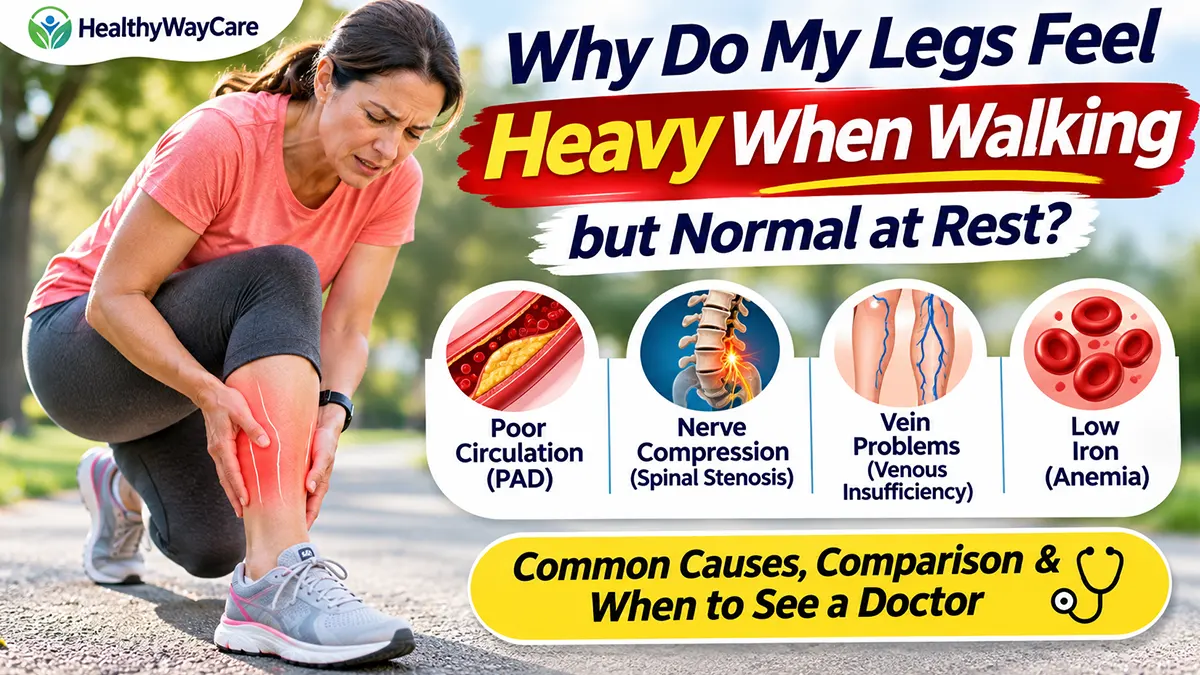
Legs feel heavy when walking but normal at rest? That pattern can happen when working muscles need more blood than narrowed arteries can deliver, when nerves in the lower back become irritated by standing upright, or when muscles and joints are overworked. The way symptoms begin, where they occur, and what makes them stop can offer important clues. They cannot establish a diagnosis on their own.
Some causes are manageable, but repeated walking-related leg heaviness should not automatically be blamed on aging or being out of shape. In particular, peripheral artery disease (PAD) can cause heaviness, aching, fatigue, or cramping during walking that improves with rest. PAD also matters because it is associated with cardiovascular risk. This guide explains the main possibilities, what a clinician may check, and when to seek urgent help.
Medical note: This is general educational information for adults, not a personal diagnosis or a substitute for medical assessment. Have a qualified clinician review medical content before publication.
Table of Contents
Quick Answer: Why Do My Legs Feel Heavy When Walking?
When you walk, leg muscles require additional oxygen and energy. If blood supply is limited by PAD, discomfort may start after a fairly predictable distance and ease within several minutes of stopping. If the problem involves lumbar spinal stenosis, standing and walking may trigger heaviness, weakness, tingling, or pain that improves more noticeably when you sit or bend forward. Venous problems, joint conditions, muscle deconditioning, and other medical issues can also contribute. The distinction between resting and sitting or bending is particularly useful to report to a clinician.
What Does Heavy Legs When Walking Feel Like?
People use the phrase “heavy legs” in different ways. One person means their calves feel weighed down after a few blocks. Another notices aching thighs, tightness, or legs that seem to tire sooner than expected. Others describe weakness, burning, pins and needles, or a need to stop and lean on something. These descriptions can overlap, and a person can have more than one cause.
- A dragging, tired, or lead-like sensation in one or both legs
- Cramping or aching in the calves, thighs, hips, or buttocks during activity
- Tingling, numbness, or leg weakness with walking or standing
- Swelling, tightness, or an uncomfortable full feeling in the legs
- Symptoms that improve after stopping, sitting, or changing posture
Pay attention to whether the sensation occurs at a similar walking distance each time, whether hills or stairs make it worse, and whether you can stand still comfortably. Also notice whether one foot feels colder, whether skin color changes, or whether you have persistent back pain. These observations are more useful than trying to diagnose yourself from one symptom.
1. Peripheral Artery Disease (PAD): Reduced Blood Flow to the Legs
PAD develops when arteries supplying the legs become narrowed, most often by atherosclerotic plaque. Walking raises the oxygen demand of leg muscles. If narrowed arteries cannot supply enough blood during activity, the muscles may ache, cramp, tire, or feel heavy. This activity-related discomfort is called intermittent claudication. It commonly affects the calves but may occur in the thighs, buttocks, or feet.
A typical pattern is discomfort that appears after walking a certain distance, becomes worse if you continue, and improves after a few minutes of rest. However, not everyone with PAD has classic calf pain. Some have atypical heaviness or fatigue, and others have no noticeable symptoms. Having no pain at rest does not rule out PAD. The National Heart, Lung, and Blood Institute describes leg heaviness and cramping with walking as possible PAD symptoms.
PAD risk is higher in people who smoke or previously smoked and in those with diabetes, high blood pressure, high cholesterol, chronic kidney disease, or increasing age. A clinician may check leg pulses and order an ankle-brachial index (ABI), a test comparing ankle and arm blood pressure. PAD is not something to self-diagnose from a symptom checklist because back and joint problems can look similar.
2. Lumbar Spinal Stenosis: Nerve-Related Heaviness When Upright
Lumbar spinal stenosis is a narrowing of spaces around nerves in the lower spine. It may cause pain, weakness, numbness, tingling, or heaviness in the buttocks and legs during standing or walking. This is often called neurogenic claudication. A person may find that sitting down or leaning forward over a shopping cart relieves symptoms more than simply standing still.
Unlike classic vascular claudication, the distance you can walk may vary with posture. Walking uphill or leaning forward can sometimes feel easier than walking downhill or standing upright because spinal position changes the space available to nerves. Not everyone with spinal stenosis experiences the same pattern, and an MRI finding alone does not prove that it explains the symptoms. Examination and history remain essential.
The South Tees Hospitals NHS lumbar spinal stenosis guide describes leg heaviness with walking and relief from sitting or bending forward as common features. New bladder or bowel dysfunction with saddle numbness or rapidly worsening leg weakness is an emergency, not a routine back-pain symptom.
3. Chronic Venous Insufficiency and Varicose Veins
Veins carry blood back toward the heart. When vein valves do not work efficiently, blood may pool in the legs and contribute to aching, fullness, swelling, or a heavy feeling. Venous symptoms often become more noticeable after prolonged standing or toward the end of the day, rather than after a predictable walking distance. Visible varicose veins, ankle swelling, itching, or skin changes can provide clues.
Walking may sometimes improve venous return because calf muscles help push blood upward, so venous heaviness is not identical to PAD. If you have chronic swelling, your clinician may assess venous disease and other causes such as heart, kidney, or medication-related problems. Compression stockings can help selected patients, but they are not automatically appropriate for someone who may also have significant arterial disease. Ask for an assessment before starting strong compression.
4. Muscle Fatigue, Deconditioning, and Overuse
After a period of inactivity, a return to long walks or steep hills can make leg muscles fatigue earlier than usual. Poorly fitting shoes, sudden increases in exercise, and inadequate recovery may add to discomfort. Muscle fatigue generally improves with appropriate rest and gradual conditioning, and it may follow a recent change in activity rather than a fixed walking distance over months.
Still, a new pattern of leg heaviness should not be dismissed as deconditioning when it is reproducible, worsening, or accompanied by cold feet, wounds, weakness, or neurological symptoms. People sometimes reduce their walking without realizing it because the discomfort has become predictable. A healthcare professional can help distinguish ordinary exercise fatigue from a circulation or nerve problem.
5. Arthritis and Other Joint or Tendon Problems
Hip, knee, ankle, and foot problems can change the way you walk and make your legs feel tired or heavy. Osteoarthritis may produce stiffness, joint pain, and reduced mobility, often with discomfort localized to a joint. Tendon problems can also worsen with repeated movement. Swelling around a joint, restricted motion, or pain with specific movements may point toward a musculoskeletal cause.
A joint problem and PAD can occur together, especially in older adults. If the main complaint is a heavy calf rather than joint pain, or if discomfort consistently disappears after a few minutes of stopping, mention that pattern rather than assuming arthritis is responsible. The examination may include checking joint range of motion, muscle strength, gait, sensation, and circulation.
6. Peripheral Neuropathy and Other Nerve Conditions
Peripheral neuropathy can cause burning, numbness, tingling, altered sensation, or weakness in the feet and legs. Diabetes is one possible cause, but vitamin deficiencies, some medicines, and other conditions can also affect nerves. Neuropathy symptoms may occur even at rest or at night, rather than only when walking, although activity can make some sensations more noticeable.
If burning or tingling is most prominent at bedtime, our related guide to burning feet at night explains additional possibilities. This is background reading, not a way to confirm neuropathy. A clinician may examine reflexes, strength, sensation, and foot health, then choose laboratory or nerve tests when appropriate.
7. Anemia and Other Whole-Body Causes of Exercise Intolerance
Anemia can reduce the blood’s ability to carry oxygen and may lead to fatigue, weakness, shortness of breath, or reduced exercise tolerance. It usually causes more general tiredness rather than a specific calf cramp after the same walking distance, but some people describe their legs as heavy. Thyroid disorders, significant illness, medication effects, and other medical conditions may also contribute to reduced stamina.
A complete blood count or other laboratory testing may be useful when symptoms suggest anemia or another systemic problem. Do not begin iron supplements solely because your legs feel heavy; too much iron can be harmful and the underlying cause of anemia matters. A clinician should interpret symptoms and results together.
Heavy Legs When Walking: Causes Comparison Table
| Possible cause | Common pattern | Clues to mention | Typical evaluation |
|---|---|---|---|
| Peripheral artery disease | Heaviness, ache, or cramp with walking; improves after resting | Similar distance each time; cool foot; smoking or diabetes history | Pulses, ABI; sometimes vascular ultrasound |
| Lumbar spinal stenosis | Worse with walking or standing upright | Improves with sitting or leaning forward; back or buttock symptoms | Neurological exam; imaging if indicated |
| Venous insufficiency | Heaviness after prolonged standing; swelling may build | Varicose veins, ankle swelling, skin changes | Leg exam; venous ultrasound if needed |
| Muscle fatigue or deconditioning | Tiredness after unusually demanding activity | Recent increase in exercise; improves with recovery | Activity history and exam |
| Joint or tendon disorder | Movement-related pain, stiffness, altered gait | Pain centered at a joint; limited range of motion | Musculoskeletal exam; selective imaging |
| Neuropathy | Burning, numbness, tingling, sometimes weakness | Symptoms at rest or night; reduced sensation | Neurological exam; targeted labs |
| Anemia or systemic condition | General fatigue or reduced stamina | Breathlessness, pallor, broader symptoms | History, exam, selected blood tests |
These are patterns, not diagnostic rules. PAD and spinal stenosis can coexist, and some people do not fit the typical description. Persistent or recurring walking-related leg symptoms deserve a clinician’s assessment.
Circulation Problems vs. Nerve Problems: How Can You Tell?
Two commonly confused conditions are vascular claudication from PAD and neurogenic claudication from spinal stenosis. In PAD, exercise increases demand for blood and stopping the activity often brings relief, even if you remain standing. In lumbar stenosis, bending forward or sitting may matter more because changing spinal position reduces nerve pressure. Neither distinction is perfect, but it helps guide testing.
| Question | More suggestive of PAD | More suggestive of spinal stenosis |
|---|---|---|
| What triggers it? | Walking or climbing stairs | Standing upright and walking |
| What helps? | Stopping activity and resting | Sitting or leaning forward |
| Where is discomfort? | Often calf; may be thigh or buttock | Back, buttocks, thighs, or calves |
| Other clues | Cool foot, reduced pulses, vascular risk factors | Tingling, numbness, posture sensitivity |
| Common initial assessment | Pulse exam and ankle-brachial index | Neurological and spine assessment |
If symptoms are new or severe, do not test these differences by forcing yourself to walk until you are in pain. A clinician can take a history and perform appropriate examinations safely.
Why Do My Legs Feel Normal When I Sit or Rest?
Rest can lower muscle oxygen demand, so symptoms from reduced arterial blood flow may ease when you stop walking. Sitting also changes the position of the lower spine, which can reduce symptoms from lumbar stenosis. Resting can ease muscle fatigue or joint stress as well. Therefore, feeling better at rest is useful information but does not prove that the problem is harmless.
Try to describe exactly what “rest” means for you. Do symptoms disappear if you stand still? Do you need to sit? Does leaning on a countertop help? How many minutes does recovery take? Is it always the same leg? The answers can guide a more focused examination and avoid unnecessary assumptions.
What Tests May a Doctor Recommend?
A clinician will usually start with questions about the walking pattern, medical history, smoking, medicines, diabetes, and any associated swelling or numbness. They may examine skin temperature, color, pulses, strength, reflexes, sensation, joints, and gait. Not everyone needs every test, and the best choice depends on the examination.
- Ankle-brachial index (ABI): compares systolic pressure at the ankle and arm; a resting ABI of 0.90 or less is generally abnormal for PAD. Some people need exercise ABI or toe pressure testing.
- Arterial Doppler ultrasound: may help locate reduced blood flow when indicated.
- Spine imaging: may be considered when history and examination suggest nerve compression and results would change management.
- Venous ultrasound: can assess selected vein problems or suspected blood clots.
- Blood tests: may assess anemia, glucose, kidney function, thyroid status, or other suspected contributors.
The NHLBI guide to PAD diagnosis explains the ABI and how it differs from additional vascular tests. An ABI can be misleadingly high when arteries are difficult to compress, particularly in some people with diabetes or kidney disease; clinicians may use toe-brachial measurements in those cases.
What Can You Safely Do While Waiting for an Appointment?
If symptoms are mild and stable, avoid pushing through severe discomfort. Stop and rest when you need to, wear comfortable supportive footwear, and make a note of how far you can walk before symptoms begin. Stay hydrated as appropriate for your health conditions and avoid smoking. Do not start aspirin, high-dose supplements, or compression treatment solely on the basis of this article.
For people diagnosed with PAD, structured or supervised exercise therapy can improve walking ability and quality of life. This is different from telling an undiagnosed person with new severe leg pain to keep walking. A healthcare professional can advise whether exercise is safe, whether vascular evaluation is needed first, and what program fits your condition. See the American Heart Association treatment guidance.
- Track which leg is affected and whether symptoms involve the calf, thigh, buttock, or foot.
- Note whether standing still is enough for relief or whether you must sit or bend forward.
- Record any new numbness, weakness, swelling, skin discoloration, or slow-healing wounds.
- Bring a current medication list and information about diabetes, blood pressure, cholesterol, and smoking history.
- Avoid prolonged immobility when possible, but seek professional guidance before increasing exercise if circulation problems are suspected.
When Should You See a Doctor for Heavy Legs?
Book a medical appointment if heaviness returns repeatedly with walking, limits daily activities, appears at shorter distances over time, or is accompanied by numbness, swelling, or weakness. Seek earlier assessment if you have diabetes, smoke, have known vascular disease, or notice changes in foot temperature or skin color. Recurrent leg discomfort during activity can be a sign of PAD even if it stops quickly when you rest.
A clinician may recommend lifestyle changes, treatment of cardiovascular risk factors, supervised exercise, physical therapy, medication, or further testing depending on the diagnosis. Treatments for PAD, spinal stenosis, and venous insufficiency are different, which is why identifying the cause matters more than choosing a generic “leg circulation remedy.”
Emergency Warning Signs: When Heavy Legs Are Not Safe to Ignore
Call 911 in the United States or seek emergency care for a leg that suddenly becomes severely painful, cold, pale or blue, numb, or weak, especially if you cannot move it normally. This can signal an abrupt loss of blood flow. Sudden inability to walk, new major weakness, or new loss of bladder or bowel control with numbness around the groin or saddle area also requires emergency evaluation.
New one-sided leg swelling, warmth, redness, or tenderness can indicate a deep vein thrombosis and needs prompt medical assessment, even if it is not very painful. If those symptoms occur with sudden shortness of breath, chest pain, fainting, or coughing blood, call emergency services because a pulmonary embolism is possible. The CDC explains DVT and pulmonary embolism warning signs.
Do not massage a newly swollen, painful leg or rely on home remedies while waiting for evaluation. A suddenly cold or discolored leg, or symptoms suggesting a blood clot in the lungs, are time-sensitive emergencies.
Questions to Ask Your Healthcare Professional
- Does my walking pattern suggest PAD, spinal stenosis, a vein problem, or another cause?
- Should I have an ankle-brachial index or another circulation test?
- Do my symptoms and examination suggest nerve compression in the lower back?
- Would blood tests for anemia, glucose, or another condition be useful?
- Is a walking program appropriate now, or should I complete testing first?
- Are compression stockings safe for me, and what warning signs require urgent care?
Frequently Asked Questions About Heavy Legs When Walking
1. Why do my legs feel heavy after walking a short distance?
One possibility is PAD, in which reduced arterial blood flow cannot fully meet the muscles’ increased oxygen needs during walking. Spinal stenosis, muscle fatigue, joint disease, and other conditions can produce similar sensations. A reproducible short walking distance followed by relief is worth discussing with a clinician.
2. Can poor circulation make my legs feel heavy when I walk?
Yes. PAD can cause aching, cramping, fatigue, or heaviness with walking that improves with rest. But heaviness alone does not prove poor circulation. A clinician can check pulses and consider an ankle-brachial index or other tests.
3. Why do my legs feel better when I sit down?
Sitting reduces the effort required from leg muscles and also bends the lower spine. It can therefore ease symptoms from several causes, including PAD, spinal stenosis, and ordinary muscle fatigue. Whether standing still also helps is a useful detail.
4. Is heavy legs when walking a sign of spinal stenosis?
It can be. Lumbar spinal stenosis may cause leg heaviness, weakness, tingling, or pain during standing and walking, often relieved by sitting or leaning forward. Diagnosis requires a clinical history and examination, with imaging when appropriate.
5. Can diabetes cause heavy legs while walking?
Diabetes increases the risk of PAD and can also cause peripheral neuropathy. Either may affect comfort or walking ability, but not every person with diabetes and heavy legs has these conditions. Ask a clinician about foot care, circulation assessment, and glucose management. For background, see our normal blood sugar levels by age guide; glucose numbers alone cannot identify the cause of leg heaviness.
6. Does leg heaviness mean I have a blood clot?
Not necessarily. DVT more often raises concern when one leg develops new swelling, pain or tenderness, warmth, or discoloration. These signs require prompt assessment. Sudden chest pain or shortness of breath with possible clot symptoms is an emergency.
7. Should I keep walking if my legs feel heavy?
Do not force yourself through severe, new, or worsening pain. If PAD has been diagnosed, a clinician may recommend supervised or structured walking therapy. The safest exercise plan depends on the cause, symptoms, and whether urgent circulation problems have been excluded.
8. What is the first test for suspected PAD?
A resting ankle-brachial index is a common first-line test. It compares ankle and arm blood pressures. A clinician may also recommend an exercise ABI, toe-brachial index, or vascular ultrasound depending on the situation.
Final Takeaway
If your legs feel heavy when walking but normal at rest, pay attention to the exact pattern rather than assuming the cause. Heaviness that begins after a predictable walking distance and settles with rest can be a sign of peripheral artery disease. Symptoms that improve particularly with sitting or leaning forward may point toward lumbar spinal stenosis. Vein problems, joint conditions, nerve symptoms, anemia, and muscle fatigue can also contribute.
Repeated symptoms deserve a medical assessment, especially when walking distance is shrinking or you have vascular risk factors. Sudden severe leg pain with a cold or pale foot, rapidly progressing weakness, or signs of a possible pulmonary embolism require emergency care. The right treatment depends on identifying the underlying cause.
Medical References
- NHLBI — Peripheral Artery Disease: Symptoms
- NHLBI — Peripheral Artery Disease: Diagnosis
- American Heart Association — 2024 PAD Guideline: Top Things to Know
- American Heart Association — PAD Treatment and Exercise
- South Tees Hospitals NHS — Lumbar Spinal Stenosis Guide (PDF)
- CDC — Venous Thromboembolism (Blood Clots)
Medical Disclaimer
This article is intended for general health education only. It does not replace diagnosis, treatment, or individualized advice from a licensed healthcare professional. It has not been represented as physician-reviewed. Seek urgent care for severe or rapidly worsening symptoms and have a qualified clinician review the article before publication.