
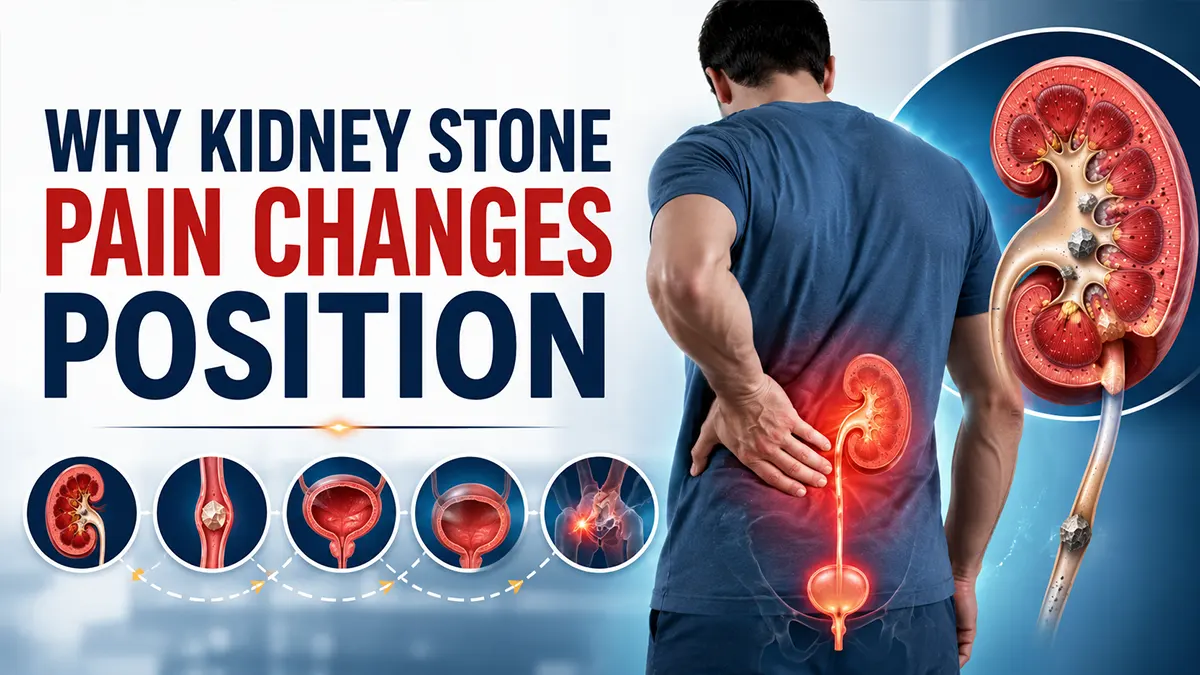
Why kidney stone pain changes position is one of the most common questions people ask during a kidney stone attack. Many patients notice the pain moving from the lower back to the abdomen, groin, or bladder area as the stone travels through the urinary tract.
Doctors explain that shifting kidney stone pain usually happens because the stone is moving through the ureter and affecting different nerves along the way. Understanding these pain stages can help you recognize whether the stone may be passing naturally or causing a dangerous blockage.
In most cases, shifting kidney stone pain happens because the stone is moving through the urinary tract. As it travels from the kidney into the ureter and closer to the bladder, the pain location changes too.
Understanding these pain stages can help you know:
- Where the kidney stone may be located
- Whether the stone could be passing
- When symptoms may become dangerous
- When you should go to the ER or A&E
Table of Contents
Why Kidney Stone Pain Changes Position During Passing Stages
The Main Reason: The Stone Is Moving
Doctors explain that kidney stone pain moving from one area to another usually means the stone is traveling through different parts of the urinary tract.
Pain changes because:
- Different nerves are affected
- The ureter spasms (peristalsis)
- Urine flow becomes temporarily blocked
- Pressure builds inside the kidney
This intense wave-like pain is called renal colic.
Learn the complete kidney stone pain stages explained guide.
Understanding Kidney Stone Pain Locations
1. Kidney Area Pain (Early Stage)
Common Symptoms
- Dull ache in the flank
- Pain in the side or lower back
- Pressure under the ribs
This stage often happens when the stone is still inside the kidney.
Medical Explanation
Pressure stretches the kidney covering (renal capsule distension), causing discomfort.
2. Kidney Stone Pain Moving From Back to Front
As the stone enters the ureter, many patients feel:
- Flank pain radiating to lower abdomen
- Sharp cramping pain
- Pain that comes and goes in waves
This is one of the most common kidney stone pain locations.
Why Pain Comes in Waves
The ureter muscles contract repeatedly to push the stone downward. These muscle spasms are called peristalsis.
3. Kidney Stone Pain Moving to Groin
When the stone travels lower:
- Pain may shift toward the groin
- Lower abdominal pressure increases
- Urinary urgency may begin
Male-Specific Symptoms
- Testicular pain kidney stone moving
- Pain near the inner thigh
Female-Specific Symptoms
- Labial pain kidney stone moving
- Pelvic pressure or discomfort
Doctors say this stage often means the stone is getting closer to the bladder.
4. Pain Changes When Kidney Stone Drops Into Bladder
Many people suddenly notice:
- Reduced flank pain
- Pressure in the bladder
- Frequent urination
- Burning while urinating
This usually means the stone has reached the bladder or the ureterovesical junction (UVJ).
5. Kidney Stone Pain Shifting Down Leg
Some patients experience:
- Pain radiating into the thigh
- Groin discomfort
- Leg pain near the hip area
This happens because nerves in the urinary tract share pathways with nearby muscles and pelvic structures.
This is known as referred pain.
Read about the early signs of kidney stone symptoms.
Does Moving Pain Mean the Kidney Stone Is Passing?
In many cases, yes.
Signs the Stone May Be Passing
- Pain changes location
- Pain gradually moves downward
- Increased urination
- Temporary pain relief between waves
However, moving pain does not always mean the stone will pass naturally.
Large stones may still become stuck.
See the warning signs a kidney stone is stuck in the ureter.
Why Does Kidney Stone Pain Come and Go in Waves?
This is one of the most searched kidney stone questions online.
Doctors Explain:
Pain comes in waves because:
- The ureter tightens around the stone
- Pressure rises and falls
- Muscle spasms occur repeatedly
Pain intensity can change within minutes.
Tracking Kidney Stone Pain by Location
| Pain Location | Possible Stone Position |
|---|---|
| Side or back | Kidney or upper ureter |
| Lower abdomen | Middle ureter |
| Groin | Lower ureter |
| Bladder pressure | Near bladder |
| Burning urination | Stone entering urethra |
How Long Does Pain Last After Kidney Stone Reaches the Bladder?
Pain usually improves significantly once the stone reaches the bladder.
However, some people still experience:
- Bladder spasms
- Burning urination
- Mild pelvic discomfort
Smaller stones may pass within hours or days afterward.
Why Kidney Stone Pain Changes Position Near the Groin
One important reason why kidney stone pain changes position is because the stone continues moving lower through the ureter. As it gets closer to the bladder, pain often shifts from the lower back toward the groin, pelvis, or lower abdomen.
Doctors say why kidney stone pain changes position also depends on nerve pathways connected to the urinary tract. This is why some people experience testicular pain, labial pain, bladder pressure, or discomfort down the inner thigh during kidney stone movement.
In many patients, why kidney stone pain changes position becomes easier to understand once the stone reaches the bladder. At this stage, flank pain may improve while urinary urgency, burning urination, or pelvic pressure become more noticeable.
When to Go to the ER for Moving Kidney Stone Pain
Seek emergency care immediately if you have:
- Fever or chills
- Vomiting
- Blood in urine
- Severe uncontrollable pain
- Inability to urinate
When to Go to A&E for Moving Kidney Stone Pain
Visit A&E or call 111 if you develop:
- Severe renal colic
- Fever
- Persistent vomiting
- Difficulty passing urine
- Signs of infection
How Doctors Track Kidney Stone Movement
Common Tests Include
- CT scan for kidney stone location
- CT KUB scan
- Ultrasound kidney imaging
- Urine tests
- X-rays in some cases
These tests help determine:
- Stone size
- Exact location
- Blockage severity
Treatment Options for Moving Kidney Stones
Treatment depends on:
- Stone size
- Pain severity
- Location
- Infection risk
Small Stones
Doctors may recommend:
- Hydration
- Pain medications
- Alpha blockers
Larger Stones
Advanced treatments include:
- Laser ureteroscopy
- Shock wave lithotripsy (ESWL)
- Ureteral stent placement
Why does kidney stone pain change position?
Kidney stone pain changes position because the stone moves through different parts of the urinary tract. As the stone travels from the kidney toward the bladder, it irritates different nerves and causes pain in the back, abdomen, groin, or bladder area.
Why is my kidney stone pain moving?
Moving pain usually means the stone is traveling through the urinary tract.
Does moving pain mean the kidney stone is passing?
Often yes, especially if the pain moves downward toward the groin or bladder.
Why does kidney stone pain come and go?
Pain occurs in waves because the ureter muscles repeatedly contract around the stone.
How do you know where a kidney stone is by the pain?
Back pain often indicates an upper stone, while groin or bladder pain may suggest the stone is lower.
How long does pain last after the stone reaches the bladder?
Pain often improves significantly, though mild burning or bladder pressure may continue briefly.
Conclusion
Understanding why kidney stone pain changes position can help patients recognize the normal stages of kidney stone movement through the urinary tract. Pain moving from the back to the abdomen, groin, or bladder area is often a sign the stone is progressing downward.
However, severe symptoms such as fever, vomiting, blood in urine, or inability to urinate may indicate a dangerous blockage. If symptoms worsen, seek urgent medical attention immediately.
Dr. Jayanth Reddy – Consultant Urologist
My Health Hospitals, Hyderabad
This content has been medically reviewed for accuracy and reliability based on current urology treatment guidelines.
According to the kidney stone symptoms NHS guide, severe flank pain can worsen during rest or nighttime.
Author
Yamanandan Reddy
Health Content Writer & Frontend Developer
Yamanandan Reddy is a health content writer and frontend developer with over 4 years of experience in website design and digital content creation. He writes research-based health articles to help readers understand symptoms, causes, treatments, and prevention methods related to common health conditions.
His articles are written using information from trusted medical sources such as the World Health Organization (WHO), Mayo Clinic, and the Centers for Disease Control and Prevention (CDC).
Sources
The information in this article is researched and verified using trusted medical resources, including:
• World Health Organization (WHO)
• Mayo Clinic
• National Institutes of Health (NIH)
• Centers for Disease Control and Prevention
⚠️ Medical Disclaimer
This content is for informational purposes only and does not replace professional medical advice. Always consult a qualified healthcare provider for diagnosis and treatment.