
If you’ve ever experienced the sharp, unbearable pain of a kidney stone, you know how urgently you want answers. A sudden pain in the back, side, or lower abdomen can leave you wondering what is causing it and how quickly it can be treated.
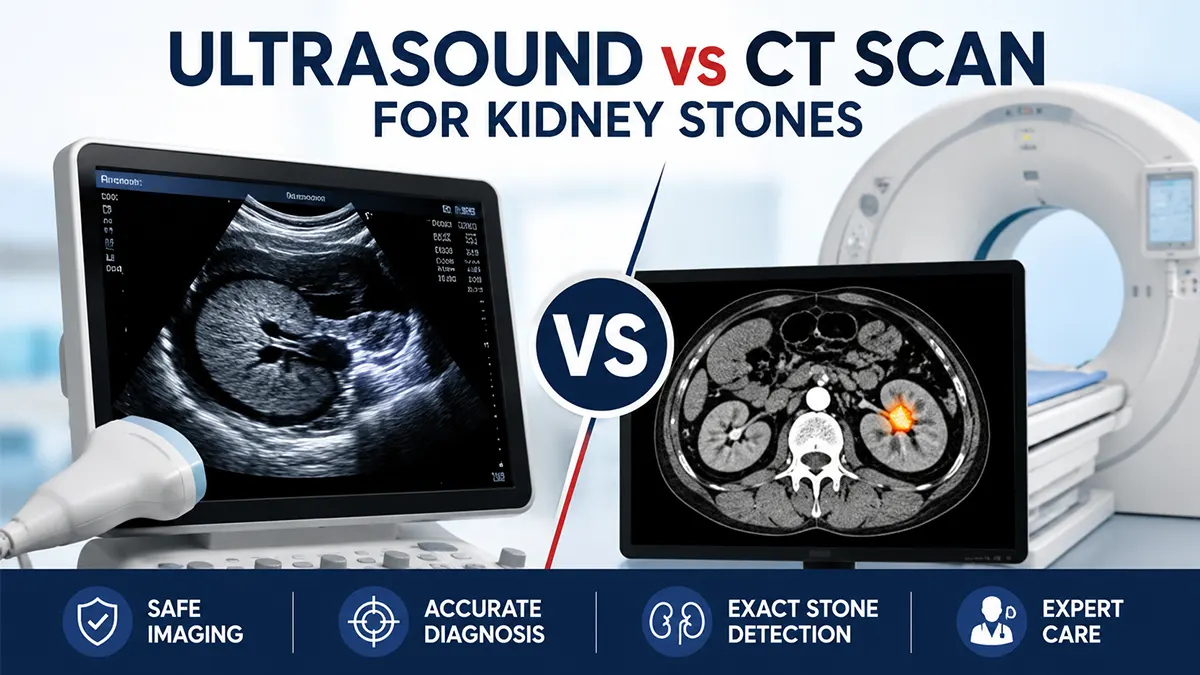
When it comes to diagnosing kidney stones, many patients are confused about Ultrasound vs CT Scan for Kidney Stones and which test provides the most accurate results. Both imaging tests play an important role in detecting stones, but they differ significantly in accuracy, safety, and clinical applications.
Understanding the differences between ultrasound and CT scans can help you feel more confident about your diagnosis and treatment plan. In this guide, we’ll explain the benefits, limitations, and ideal uses of each test so you can better understand your doctor’s recommendation.
Table of Contents
Understanding Why Imaging Tests Matter for Kidney Stones
Kidney stones can vary significantly in size, shape, and location. Some stones remain inside the kidney, while others travel through the ureter and cause severe pain.
Imaging tests help doctors:
- Confirm whether a kidney stone is present
- Determine the stone’s size
- Identify the exact location of the stone
- Detect blockage of urine flow
- Plan the most appropriate treatment
The two most commonly used imaging tests are Ultrasound and Non-Contrast CT Scan (NCCT).
How Long Does It Take to Pass a 4mm, 5mm, or 6mm Kidney Stone? (Size Guide)
Ultrasound for Kidney Stones
How Does an Ultrasound Work?
An ultrasound uses high-frequency sound waves to create images of the kidneys and urinary tract. A small handheld device called a transducer is moved over the skin to generate images in real time.
Unlike CT scans, ultrasound does not use radiation.
Advantages of Ultrasound
No Radiation Exposure
One of the biggest benefits of ultrasound is that it is completely free from radiation.
Safe During Pregnancy
Ultrasound is the preferred imaging method for pregnant women with suspected kidney stones because it poses no risk to the developing baby.
Quick and Non-Invasive
The procedure is painless and usually takes only a few minutes.
Widely Available
Most hospitals and diagnostic centers offer ultrasound examinations, making them easily accessible.
Lower Cost
Ultrasound is generally less expensive than a CT scan.
Limitations of Ultrasound
May Miss Small Stones
Very small kidney stones can sometimes go undetected.
Less Accurate for Ureter Stones
Stones located in the ureter are often difficult to visualize clearly.
Operator Dependent
The accuracy of ultrasound can vary depending on the experience of the technician and the quality of the equipment.
Reduced Accuracy in Certain Patients
Obesity, bowel gas, and anatomical variations can make imaging more challenging.
When Doctors Prefer Ultrasound
Doctors often recommend ultrasound for:
- Pregnant women
- Children
- Initial screening of suspected kidney stones
- Patients requiring repeated follow-up imaging
- Individuals who should avoid radiation exposure
When comparing Ultrasound vs CT Scan for Kidney Stones, ultrasound is often chosen first for pregnant women and patients who need a radiation-free imaging test.
Kidney Stone Emergency: 5 Signs to Go to the ER Now
CT Scan (NCCT) for Kidney Stones
What Is a Non-Contrast CT Scan (NCCT)?
A Non-Contrast Computed Tomography (NCCT) scan uses X-rays and advanced computer technology to produce detailed cross-sectional images of the urinary tract.
Today, NCCT is considered the gold standard for diagnosing kidney stones.
Why Is CT Scan the Gold Standard?
CT scans can identify nearly all types of urinary stones with exceptional accuracy. They provide detailed information that helps urologists make faster and more precise treatment decisions.
Advantages of CT Scan
Highly Accurate
CT scans detect even tiny kidney stones that may be missed on ultrasound.
Exact Stone Size Measurement
Knowing the precise size of a stone helps determine whether it can pass naturally or requires treatment.
Precise Stone Location
CT imaging clearly shows where the stone is located within the urinary tract.
Detects Multiple Stones
Patients may have more than one stone, and CT scans can identify all of them.
Identifies Other Causes of Pain
Sometimes flank pain is not caused by kidney stones. CT scans can reveal other conditions affecting the abdomen or pelvis.
Fast Results During Emergencies
In patients experiencing severe pain, CT scans can provide rapid and accurate diagnosis.
Limitations of CT Scan
Radiation Exposure
CT scans involve exposure to radiation, which is why doctors carefully consider when they are necessary.
Higher Cost
CT scans are generally more expensive than ultrasound examinations.
Not Usually the First Choice During Pregnancy
Due to radiation exposure, CT scans are typically avoided in pregnant women unless absolutely necessary.
When Doctors Prefer CT Scan
CT scans are commonly recommended when:
- Severe kidney stone symptoms are present
- Ultrasound results are inconclusive
- Precise stone measurement is required
- Emergency treatment planning is needed
- Surgical intervention is being considered
The debate of Ultrasound vs CT Scan for Kidney Stones often ends with CT scan being preferred when precise stone size and location information is required.
Latest Kidney Stone Treatment Options in 2026 (USA Guide)
Ultrasound vs CT Scan for Kidney Stones: Direct Comparison
| Feature | Ultrasound | CT Scan (NCCT) |
|---|---|---|
| Radiation Exposure | No | Yes |
| Pregnancy Safety | Excellent | Usually Avoided |
| Accuracy | Moderate | Very High |
| Detects Small Stones | Limited | Excellent |
| Detects Ureter Stones | Less Reliable | Excellent |
| Cost | Lower | Higher |
| Emergency Diagnosis | Good | Excellent |
| Treatment Planning | Limited | Comprehensive |
| Time for Scan | Short | Short |
| Gold Standard Status | No | Yes |
A detailed Ultrasound vs CT Scan for Kidney Stones comparison helps patients understand why doctors recommend different imaging tests in different situations.
Which One Should You Choose?
The answer depends on your specific situation.
If you are pregnant, a child, or require a radiation-free examination, your doctor may recommend an ultrasound first.
However, if symptoms strongly suggest a kidney stone and a precise diagnosis is needed, a CT scan often provides the most accurate information.
Many patients undergo ultrasound initially and then receive a CT scan if additional details are required.
The goal is not simply to find a stone. The goal is to understand its size, location, and potential complications so the best treatment plan can be developed.
Ultimately, the choice between ultrasound and CT scan is made based on:
- Your symptoms
- Age
- Pregnancy status
- Previous stone history
- Severity of pain
- Need for emergency intervention
- Clinical judgment of the treating urologist
Kidney Stone Treatment Without Surgery – Effective Non-Surgical Options
Hospital Insights (Customize with Your Daily Experience)
Real-World Observations from Our Hospital
Replace the points below with your own hospital-specific observations and workflow insights.
- Average waiting time for ultrasound:
- Average waiting time for emergency CT scan:
- Typical turnaround time for ultrasound reports:
- Typical turnaround time for CT scan reports:
- Common scenarios where ultrasound is sufficient:
- Situations where CT scan changes treatment decisions:
- Examples of stones missed on ultrasound but detected on CT:
- Emergency department imaging workflow:
- Patient preference trends observed in practice:
- Clinical observations regarding diagnostic accuracy:
Expert Urologist Perspective
Final Verdict from the Urology Team
When evaluating suspected kidney stones, both ultrasound and CT scans have important roles.
Ultrasound remains an excellent first-line investigation for selected patients because it is safe, affordable, and free from radiation. It is particularly valuable for pregnant women, children, and follow-up assessments.
However, when the highest level of diagnostic accuracy is required, Non-Contrast CT Scan (NCCT) remains the gold standard for kidney stone diagnosis. It provides precise information about stone size, location, obstruction, and overall urinary tract anatomy, helping urologists make faster and more confident treatment decisions.
The best imaging test is not necessarily the most advanced one—it is the test that best matches the patient’s clinical situation. A qualified urologist will recommend the most appropriate investigation based on symptoms, medical history, and treatment goals.
Clinical Review & Expert Opinion
Dr. Jayanth Reddy
Consultant Urologist
My Health Hospitals, Hyderabad
This section is reserved for official clinical review and endorsement.
FAQs About Ultrasound vs CT Scan for Kidney Stones
Which is better for diagnosing kidney stones, ultrasound or CT scan?
When comparing Ultrasound vs CT Scan for Kidney Stones, a CT scan is generally more accurate because it can detect even very small stones and determine their exact location. Ultrasound is commonly used as an initial screening test and for patients who should avoid radiation exposure.
Can an ultrasound miss a kidney stone?
Yes. Ultrasound may miss small kidney stones or stones located in the ureter. If symptoms strongly suggest a kidney stone but the ultrasound findings are unclear, your doctor may recommend a CT scan for a more accurate diagnosis.
Why is CT scan considered the gold standard for kidney stone diagnosis?
A non-contrast CT scan (NCCT) provides detailed images of the kidneys, ureters, and bladder. It accurately identifies the size, number, and location of kidney stones, making it the gold standard for diagnosis and treatment planning.
Is a CT scan safe for diagnosing kidney stones?
Yes. CT scans are generally safe and widely used for diagnosing kidney stones. However, because they involve radiation exposure, doctors carefully consider the benefits and risks before recommending the test.
Is ultrasound safe during pregnancy for kidney stone diagnosis?
Yes. Ultrasound uses sound waves rather than radiation, making it the preferred imaging test for pregnant women with suspected kidney stones. It provides valuable diagnostic information without exposing the mother or baby to radiation.
How long does it take to get kidney stone scan results?
The time required varies by hospital and imaging center. In most cases, ultrasound and CT scan reports are available within a few hours, while emergency CT scan results can often be reviewed immediately for urgent treatment decisions.
When should I get a CT scan instead of an ultrasound for kidney stones?
A CT scan may be recommended when symptoms are severe, ultrasound results are inconclusive, or detailed information about stone size and location is required before deciding on treatment.
Can a CT scan detect all kidney stones?
CT scans can detect nearly all types of kidney stones, including very small stones that may not be visible on ultrasound. This high level of accuracy makes CT scans particularly useful in emergency situations.
What is the best scan for kidney stone diagnosis?
For the highest diagnostic accuracy, a non-contrast CT scan is generally considered the best scan for kidney stone diagnosis. However, ultrasound remains an excellent option for pregnant women, children, and patients who require radiation-free imaging.
Why would a doctor order a CT scan after an ultrasound?
A doctor may recommend a CT scan after an ultrasound if the ultrasound findings are inconclusive, symptoms persist, or more detailed imaging is needed to determine the most appropriate treatment plan.
Conclusion
Kidney stone pain can be frightening, but modern imaging technology makes diagnosis faster and more accurate than ever before.
Ultrasound offers a safe, radiation-free option for many patients, while CT scans provide the most detailed and reliable assessment when precision matters most.
If you are experiencing severe back pain, flank pain, blood in the urine, or symptoms suggestive of kidney stones, consult a qualified urologist promptly. Early diagnosis can prevent complications and help you receive the most effective treatment.
Ultimately, the decision between Ultrasound vs CT Scan for Kidney Stones should be guided by a qualified urologist based on your individual condition and diagnostic needs.
Medical Expert Review
Dr. Jayanth Reddy
Consultant Urologist | My Health Hospitals, Hyderabad
This content has undergone medical review to ensure it reflects current clinical evidence, accepted urological practices, and patient-centered healthcare guidance.
Author
Yamanandan Reddy
Health Content Writer & Frontend Developer
Yamanandan Reddy is a health content writer and frontend developer with over 4 years of experience in website design and digital content creation. He writes research-based health articles to help readers understand symptoms, causes, treatments, and prevention methods related to common health conditions.
His articles are written using information from trusted medical sources such as the World Health Organization (WHO), Mayo Clinic, and the Centers for Disease Control and Prevention (CDC).
Sources
The information in this article is researched and verified using trusted medical resources, including:
• World Health Organization (WHO)
• Mayo Clinic
• National Institutes of Health (NIH)
• Centers for Disease Control and Prevention
⚠️ Medical Disclaimer
This content is for informational purposes only and does not replace professional medical advice. Always consult a qualified healthcare provider for diagnosis and treatment.
1 thought on “Ultrasound vs. CT Scan: Which is Best for Diagnosing Kidney Stones?”