
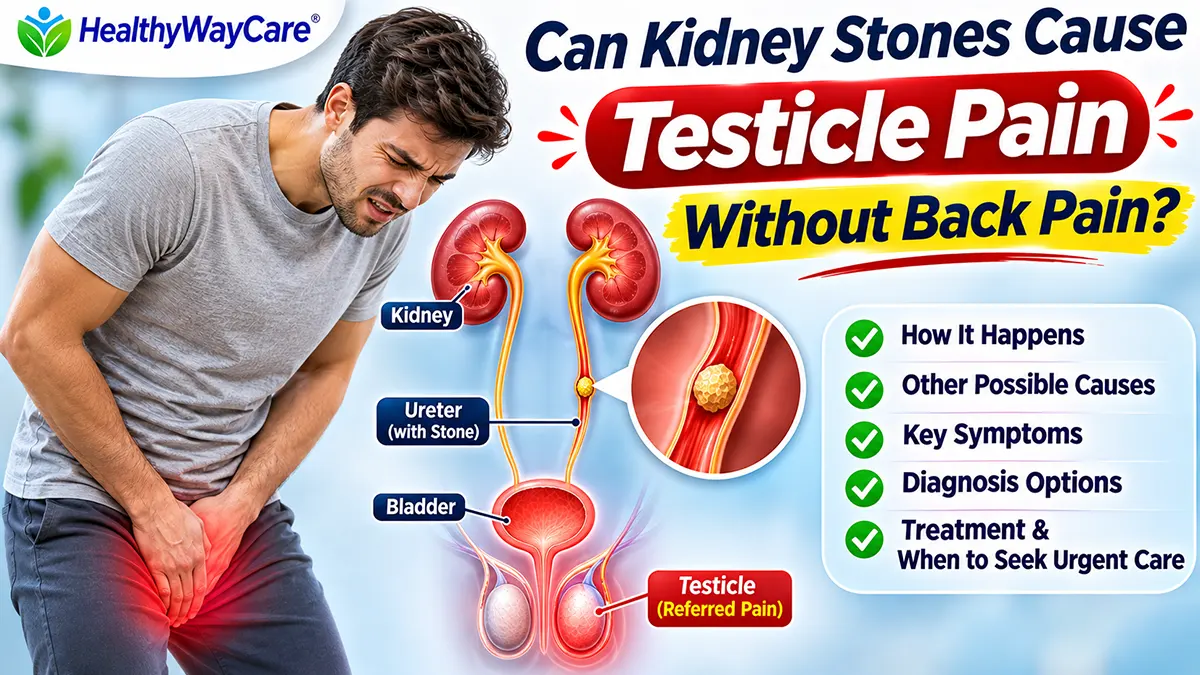
Kidney stone testicle pain without back pain can happen because pain from a stone in the ureter may be felt in the groin or testicle instead of only in the back. However, new or sudden testicular pain needs urgent medical evaluation: testicular torsion, a problem that can cut off blood supply to the testicle, must be ruled out quickly. Do not assume a kidney stone is the cause based on pain location alone.
Quick answer: Yes, a ureteral stone can cause referred pain toward one testicle even when back pain is absent or barely noticeable. But this pattern is not specific to kidney stones. Sudden, severe, or unexplained testicular pain should be assessed in an emergency department immediately, even if it improves or you have had stones before.
This guide explains why referred pain happens, how kidney stone symptoms differ from problems arising in the testicle itself, which tests doctors may use, and what treatment and follow-up can involve. It is general health information for readers in the United States, not a way to diagnose a painful testicle at home.
Table of Contents
Kidney Stone Testicle Pain Without Back Pain: Why It Happens
Kidneys make urine, which travels through narrow tubes called ureters to the bladder. A stone may form in a kidney and later move into a ureter. As the ureter contracts around a stone, irritation, pressure, and sometimes blockage can produce pain. Although the familiar description is flank or back pain, discomfort can be felt lower down, including the groin and testicle. The NHS kidney stone guide specifically notes that stone pain can spread to the testicles.
This is called referred pain. The source of the pain is in one location, but the nervous system interprets some of its signals as coming from another. Nerves carrying sensation from parts of the urinary tract overlap with pathways involved in the groin and genital region. The result can feel surprisingly local: a person may point to a testicle even though the stone is not inside it.
Referred pain does not mean the testicle is being scratched by a kidney stone. The stone travels through the urinary tract, not through the testicle or scrotum. Pain can be felt there because of shared nerve pathways. This distinction matters, because swelling, redness, or a very tender testicle may suggest a separate scrotal condition that needs prompt assessment.
Why Might There Be No Back Pain?
Pain from a moving stone is not a fixed sequence that everyone experiences. Some people feel a strong ache near the ribs first and then discomfort farther down. Others notice the lower abdominal or groin area most. A stone may be relatively low in the ureter when symptoms become obvious, or the person may simply perceive the referred pain more intensely than the flank discomfort.
The absence of back pain neither proves that a stone has reached the bladder nor rules out obstruction. A clinician needs to consider the examination, urine findings, and imaging when appropriate. A history of stones makes another stone possible, but it does not make every new episode of genital pain a stone.
Can a Kidney Stone Cause Pain in Only One Testicle?
Yes. A stone in one ureter may produce pain mainly on the same side of the lower abdomen, groin, or testicle. One-sided pain is common in many other conditions too, including torsion, epididymitis, hernia, injury, and other scrotal problems. Side alone is not a reliable way to identify the cause.
For example, a person might notice right-sided groin discomfort with waves of nausea and urinary urgency. Those features can fit a ureteral stone, but they do not exclude a testicular emergency. If the testicle itself suddenly hurts, an urgent in-person examination is safer than waiting to see whether urinary symptoms develop.
Kidney Stone Pain vs Testicular Torsion vs Epididymitis
The table below describes possible patterns, not diagnostic rules. Symptoms overlap, and a person with torsion may not have every textbook feature. Do not use the table to decide to wait at home if testicular pain begins suddenly.
| Feature | Ureteral kidney stone | Testicular torsion | Epididymitis |
|---|---|---|---|
| Typical pain | Side, lower abdomen, groin or referred testicular pain; may come in waves | Often sudden, intense pain in one testicle; may involve abdomen | Often develops over hours or longer, with scrotal tenderness |
| Scrotal findings | May be absent; a normal scrotum does not prove a stone | Swelling or unusually positioned testicle may occur; not always present | Tenderness, swelling or warmth may occur |
| Other clues | Nausea, urinary urgency, blood in urine or flank pain may occur | Nausea or vomiting may occur; no urinary symptoms required | Urinary burning, discharge or fever may occur depending on cause |
| Priority | Prompt assessment; emergency if severe symptoms, fever or obstruction suspected | Emergency evaluation immediately | Prompt medical evaluation; torsion must be excluded when appropriate |
The MedlinePlus testicle pain guide identifies sudden or severe testicular pain as a reason for immediate medical care. The CDC guidance on epididymitis also emphasizes urgent evaluation for torsion when the diagnosis is uncertain. An ultrasound may be used, but imaging should not delay emergency surgical assessment when torsion is strongly suspected.
What Does Referred Testicle Pain From a Stone Feel Like?
Descriptions vary. Some people report a dull ache in the groin or scrotal area, while others describe sharp pain that rises and falls. The discomfort may move or be accompanied by lower abdominal pressure. Restlessness, nausea, and an urge to urinate may appear at the same time. But the intensity, character, and location of pain cannot establish a diagnosis by themselves.
Kidney stone pain may be intermittent as pressure changes in the ureter. It is also possible for pain to lessen even while a stone remains present. Improvement should not be treated as proof that a stone has passed. Similarly, testicular torsion can sometimes twist and untwist, causing episodes that improve temporarily while still requiring emergency assessment.
Other Symptoms That May Accompany a Kidney Stone
- Pain in the side, back, lower abdomen, or groin that can fluctuate.
- Nausea or vomiting during a painful episode.
- Pink, red, or brown urine, although visible blood may be absent.
- Urinary frequency, urgency, or discomfort during urination.
- Difficulty passing urine, which may signal an important urinary problem.
- Fever or chills, which can suggest infection and require urgent attention.
The NIDDK symptoms overview lists pain, urinary changes, nausea, vomiting, and possible fever or chills. None of these symptoms alone confirms a stone. If you are noticing burning or frequency, our related guides on burning urination with possible kidney stones and frequent urination without pain explain other causes that clinicians consider.
When Testicle Pain Is an Emergency
Go to an emergency department immediately for sudden testicular pain, especially if it is severe or accompanied by nausea, vomiting, swelling, or an unusually positioned testicle. Do not wait for back pain to appear, do not rely on pain medicine to test whether it is serious, and do not delay because you think you have another kidney stone. Testicular torsion can threaten the testicle within hours.
Also seek emergency care for suspected kidney stone symptoms with fever or shaking chills, inability to urinate, severe uncontrolled pain, persistent vomiting, or feeling faint or very ill. A blocked urinary tract combined with infection can rapidly become dangerous. People with a single functioning kidney, kidney disease, or immune suppression may need particularly urgent assessment.
Call emergency services if you are too unwell to travel safely. If the pain is not sudden but is persistent, unexplained, or accompanied by a lump or swelling, arrange prompt in-person medical assessment. A new scrotal symptom should not be managed solely through an online symptom checklist.
Other Causes of Testicular Pain That Can Resemble a Kidney Stone
Testicular torsion
Torsion occurs when the spermatic cord twists and restricts blood supply. Pain often starts abruptly, but presentations vary. It may occur in adolescents or adults. Even pain that disappears can reflect intermittent torsion. Because treatment is time-sensitive, suspected torsion requires emergency assessment, not a routine appointment.
Epididymitis and orchitis
Inflammation of the epididymis or testicle may cause tenderness, swelling, and pain. Some cases are related to sexually transmitted infections; others are linked to urinary bacteria or different causes. Testing and treatment depend on age, exposure history, examination, and laboratory results. Antibiotics are appropriate only when a clinician identifies or suspects a bacterial cause.
Inguinal hernia
An inguinal hernia may produce groin discomfort or a bulge that becomes more noticeable with standing, coughing, or lifting. Pain can extend toward the scrotum. A painful bulge that cannot be pushed back, especially with vomiting or abdominal symptoms, may indicate a surgical emergency.
Injury, varicocele, and other scrotal conditions
A recent injury, enlarged veins around the testicle, fluid collections, and other scrotal problems can cause pain or heaviness. A new lump, swelling, or change in testicle size deserves examination even if the discomfort is mild. The correct diagnosis depends on history and physical findings, not a single symptom.
How Doctors Diagnose Kidney Stone Testicle Pain Without Back Pain
The first clinical priority is deciding whether the pain could come from the testicle itself and whether torsion needs emergency surgical evaluation. A healthcare professional asks when the pain began, whether it was sudden, whether the scrotum looks different, and whether nausea, fever, urinary symptoms, injury, or prior stones are present.
The examination may include the abdomen, groin, and scrotum. When a testicular cause is possible, clinicians may use a Doppler scrotal ultrasound to assess blood flow and other findings. However, a highly suspicious examination may require immediate urologic action rather than waiting for imaging.
If a urinary stone remains a possibility after urgent scrotal conditions have been addressed, the clinician may order a urinalysis to look for blood and signs of infection, a urine culture when indicated, and blood tests to evaluate kidney function. Imaging may include ultrasound or a noncontrast CT scan depending on the situation, age, pregnancy considerations, and the need to assess obstruction.
| Test or assessment | What it helps evaluate | Important limitation |
|---|---|---|
| Physical examination | Scrotal tenderness, swelling, hernia and abdominal findings | Findings may be subtle; torsion can still require urgent action |
| Doppler scrotal ultrasound | Blood flow and some scrotal causes of pain | Should not delay treatment when torsion is strongly suspected |
| Urinalysis / culture | Blood, infection clues and possible bacteria | Normal urine does not rule out a stone or torsion |
| Kidney/urinary ultrasound | Hydronephrosis and some stones | May miss small ureteral stones |
| Noncontrast CT when appropriate | Stone size, position and urinary obstruction | Radiation exposure; not always the first test for every patient |
A test result has to be interpreted in context. Blood in urine may be absent even when a stone is present; conversely, blood in urine does not automatically mean a stone. Imaging decisions should be individualized rather than ordered solely because an article mentions a particular scan.
How Are Ureteral Stones Treated?
Treatment depends on stone size, location, symptoms, kidney function, and whether infection or blockage is present. A small stone may pass without a procedure under medical supervision. The care plan can include appropriate pain relief, anti-nausea treatment, hydration advice, and follow-up to confirm that symptoms and obstruction have resolved.
Some patients with suitable ureteral stones may be offered a prescribed medication, such as an alpha blocker, to help passage. It is not appropriate for every patient or every stone, and the clinician should discuss expected benefits, side effects, and whether observation is safe. Do not start leftover prescriptions or use supplements marketed as guaranteed stone dissolvers.
If a stone is unlikely to pass, causes persistent obstruction, uncontrolled pain, impaired kidney function, or infection, a urologist may recommend procedures such as ureteroscopy or shock wave treatment. Infected obstruction requires urgent drainage and treatment; waiting for a stone to pass is unsafe. The NIDDK kidney stone treatment guide describes these options.
Drinking water supports normal hydration, but forcing very large amounts during severe pain or suspected obstruction does not reliably push a stone out and can worsen discomfort. Follow a clinician’s advice, particularly if you have heart or kidney conditions that limit fluid intake.
What to Do While Waiting for Medical Advice
If the pain is sudden or centered in a testicle, do not wait: seek emergency care. If a clinician has already assessed you, excluded an urgent scrotal condition, and recommended outpatient care for a confirmed stone, follow that plan closely. Take medicines only as prescribed or recommended, keep track of fever and urinary changes, and attend scheduled imaging or urology follow-up.
If asked to strain your urine, use the provided strainer and save any stone fragments for analysis. Write down the timing of pain episodes and whether symptoms change. Do not assume that the disappearance of pain proves that a stone has passed; follow-up may be necessary to confirm that urine is draining normally.
Can You Prevent Another Kidney Stone?
After an acute episode is addressed, prevention can be tailored to the type of stone and personal risk factors. Clinicians may analyze a passed stone or recommend urine and blood testing, especially when stones recur. Many people benefit from adequate daily fluid intake, reducing excess sodium, and following a balanced eating pattern, but specific recommendations depend on the stone type and medical history.
Do not eliminate all dietary calcium without medical guidance. Normal dietary calcium can be important even for people who form calcium oxalate stones. Certain people need more specific advice about oxalate, animal protein, citrate, or prescribed prevention medicines. Your healthcare team can explain which changes are relevant to your test results.
For additional background, HealthyWayCare has a kidney stone pain location chart showing why pain can be experienced in different areas. The chart is educational; it cannot distinguish torsion from a stone in an individual patient.
Frequently Asked Questions About Kidney Stone Testicle Pain
Can a kidney stone cause testicle pain without any back pain?
Yes. A ureteral stone can cause referred pain toward the testicle even when back pain is not noticeable. But sudden testicular pain requires emergency evaluation to exclude torsion and other urgent conditions.
Does a kidney stone cause pain in the left or right testicle?
Either side may be affected depending on the side of the urinary tract involved. One-sided pain also occurs with torsion, infection, injury, and hernia, so the side does not identify the cause.
Can testicle pain mean a kidney stone is close to the bladder?
Pain may be felt in the groin or testicle with a lower ureteral stone, but pain location cannot reliably pinpoint a stone. Imaging may be needed to establish its position.
How can I tell kidney stone pain from testicular torsion?
You cannot safely distinguish them at home. Torsion often causes sudden testicular pain and may include swelling or nausea, but symptoms vary. Go to the emergency department immediately for sudden testicular pain.
Can kidney stones cause testicle pain without blood in urine?
Yes. Visible blood may be absent, and even a urine test without blood does not completely exclude a stone. Other causes of testicular pain must still be considered.
Will testicle pain stop once a kidney stone passes?
Referred pain may improve after a stone passes, but improvement alone does not confirm passage. Persistent or recurrent pain needs follow-up, and sudden testicular pain needs emergency assessment regardless of stone history.
What scan checks kidney stone pain that reaches the testicle?
A clinician may use scrotal Doppler ultrasound to investigate a testicular cause and urinary ultrasound or noncontrast CT when a stone is suspected. The order and urgency depend on the examination; imaging must not delay torsion care.
When should I go to the ER for kidney stone testicle pain?
Go immediately for sudden or severe testicular pain, especially with nausea or swelling. Also seek emergency care for suspected stones with fever, chills, inability to urinate, persistent vomiting, or uncontrolled pain.
Key Takeaways
- A kidney stone in the ureter can cause referred pain in a testicle without obvious back pain.
- Testicular pain has several possible causes; symptoms alone cannot identify a stone.
- Sudden testicular pain is an emergency because torsion must be ruled out promptly.
- Urine testing, examination, and selected imaging help clinicians determine the cause.
- Stone treatment depends on size, location, obstruction, infection, and overall health.
Medical References
- NIDDK — Symptoms & Causes of Kidney Stones.
- NIDDK — Treatment for Kidney Stones.
- NHS — Kidney Stones.
- MedlinePlus — Testicle Pain.
- CDC — Epididymitis Clinical Guidance.
- EAU Patient Information — Kidney and Ureteral Stones.
Medical disclaimer: This article is for general education and is not a diagnosis or a substitute for medical care. New sudden testicular pain warrants immediate emergency evaluation. A qualified clinician should review this draft before publication; no medical-review credentials are claimed here.