Understanding the link between contrast dye and kidney damage can protect your kidney filters before you ever step inside a radiology suite. Every day, millions of patients undergo CT scans, heart angiograms, or MRI tests to check for blood vessel blockages, tumors, or abdominal pain. Before these scans, a nurse often injects a special liquid called contrast dye into your vein to make your internal organs “light up” clearly on screen. While this dye is safe for most healthy adults, clinical guidelines from the National Kidney Foundation warn that certain intravenous dyes can trigger sudden kidney stress—especially if you already have chronic kidney disease (CKD), diabetes, dehydration, or take specific daily medications.
Because intravenous contrast dye must be filtered out of your bloodstream by your kidneys and flushed into your urine, planning ahead with your doctor is essential when your estimated glomerular filtration rate (eGFR) is reduced.
Below, we explain how different imaging dyes affect your kidneys, break down the science of contrast dye and kidney damage, and share five critical safety rules to follow before and after a CT scan or MRI.
Key Takeaways: Contrast Dye and Kidney Damage
- Not all imaging dyes are the same: Iodinated contrast dye (used in CT scans and angiograms) carries the highest risk of contrast dye and kidney damage, whereas newer MRI gadolinium agents (ACR Group 2 or 3) carry very low kidney risk, and barium or ultrasound microbubbles do not harm the kidneys.
- What is CA-AKI? Kidney injury caused by CT dye is known medically as contrast-associated acute kidney injury (CA-AKI)—a sudden drop in kidney filtration within 48 to 72 hours of an imaging test.
- Kidney stone scans rarely need dye: If you are being checked for a moving kidney stone, a non-contrast CT scan or kidney ultrasound is the standard test and requires zero intravenous dye.
- Medication holds matter: Temporarily pausing metformin, NSAID painkillers (ibuprofen, naproxen), or diuretics (water pills) before a contrast scan—under your doctor’s written guidance—prevents dangerous complications.
Table of Contents
How Does Imaging Dye Trigger Contrast Dye and Kidney Damage?
On Healthy Way Care, many readers ask why a single 10-minute CT scan can cause a spike in serum creatinine or a drop in eGFR. Understanding contrast dye and kidney damage starts with how your kidneys clear the dye after the scan finishes.
When a radiology technician injects iodinated contrast dye into your arm vein (IV), the dye travels rapidly through your bloodstream to highlight arteries, veins, and organs. Your body does not absorb or burn this dye for energy—instead, 100% of intravenous iodinated contrast must be filtered out of your blood by your kidneys’ tiny blood vessel clusters (glomeruli) and excreted in your urine.
In people with reduced kidney function (low eGFR), diabetes, or dehydration, iodinated contrast can trigger contrast-associated acute kidney injury (CA-AKI) through two mechanisms:
- Temporary Constriction of Kidney Blood Vessels: Right after contrast dye enters the kidneys, it can cause the tiny incoming blood vessels to narrow (vasoconstrict), briefly reducing oxygen delivery to the deep inner kidney tissue (renal medulla).
- Direct Stress on Kidney Tubules: If you are dehydrated, the contrast dye becomes highly concentrated and thick (viscous) inside your microscopic kidney tubules, slowing urine flow and irritating the delicate tubular cells.
Related Guide on Healthy Way Care: Already taking over-the-counter pain pills before your scan? Read our guide on Painkillers and Kidney Damage: 6 Dangerous Mistakes With OTC NSAIDs to see why ibuprofen restricts kidney blood flow.
4 Types of Imaging Dyes Ranked by Kidney Risk
Before worrying about contrast dye and kidney damage, check which exact imaging test and contrast agent your doctor ordered. According to the National Kidney Foundation, the four common imaging agents behave very differently inside your body:
1. Iodinated Contrast Dye (CT Scans & Coronary Angiograms) — Highest Risk
Used for contrast-enhanced CT scans, CT angiograms, and heart catheterizations, these dyes contain iodine. Because they are cleared entirely through the kidneys, iodinated contrast is the primary cause of contrast dye and kidney damage (CA-AKI), particularly when your eGFR is below 30 to 45 or when you have diabetes and dehydration.
2. Gadolinium Contrast Dye (MRI Scans) — Low Risk With Newer Agents
Used during MRI scans (which take 20 to 90 minutes using magnets and radio waves), this dye contains a specialized metal called gadolinium. While older gadolinium dyes carried a rare risk of a serious condition called nephrogenic systemic fibrosis (NSF) in patients with severe kidney failure, newer safer forms—known clinically as ACR Group 2 or Group 3 gadolinium agents—have a very low risk to your kidneys. Your radiologist selects the safest option based on your eGFR.
3. Oral or Enema Barium Sulfate (GI X-Rays & CT) — Zero Kidney Risk
Barium liquid is swallowed or given by enema to outline your esophagus, stomach, small intestine, or colon. Because barium stays entirely inside your digestive tract, passes out in your stool, and never enters your bloodstream, it does not cause contrast dye and kidney damage.
4. Ultrasound Microbubbles (Contrast Ultrasound) — Safe for Kidneys
Special microscopic gas bubbles injected during advanced ultrasound tests highlight blood flow in organs without being filtered as a toxic load by the kidneys, making them a kidney-safe option even in advanced CKD.
Quick Comparison Table: Contrast Dye and Kidney Damage by Scan Type
Use this clinical reference chart to compare contrast dye and kidney damage risks before your appointment:
| Imaging Test & Contrast Type | How the Dye Leaves Your Body | Risk of Contrast Dye and Kidney Damage | Key Safety Precaution |
| CT Scan or Angiogram (Iodinated IV Contrast) | Filtered 100% through kidneys into urine | Moderate to High Risk (CA-AKI) if eGFR is low, diabetic, or dehydrated | Check eGFR blood test first; hydrate with water or IV fluids; hold metformin/NSAIDs |
| MRI Scan (Gadolinium IV Contrast) | Filtered through kidneys into urine | Very Low Risk when newer ACR Group 2 or 3 agents are used | Verify eGFR if you have Stage 4–5 CKD or are on dialysis |
| Digestive Tract Study (Oral/Rectal Barium) | Stays in gut and exits in stool (does not enter blood) | No Kidney Risk | Drink extra water afterward to prevent constipation |
| Ultrasound With Microbubbles | Exhaled/cleared safely without renal toxicity | No Kidney Risk | Excellent alternative for vascular and kidney imaging in CKD |
| Non-Contrast Helical CT or Standard Ultrasound | No contrast dye used at all | Zero Dye Risk | Gold-standard first choice for kidney stones and hydronephrosis |
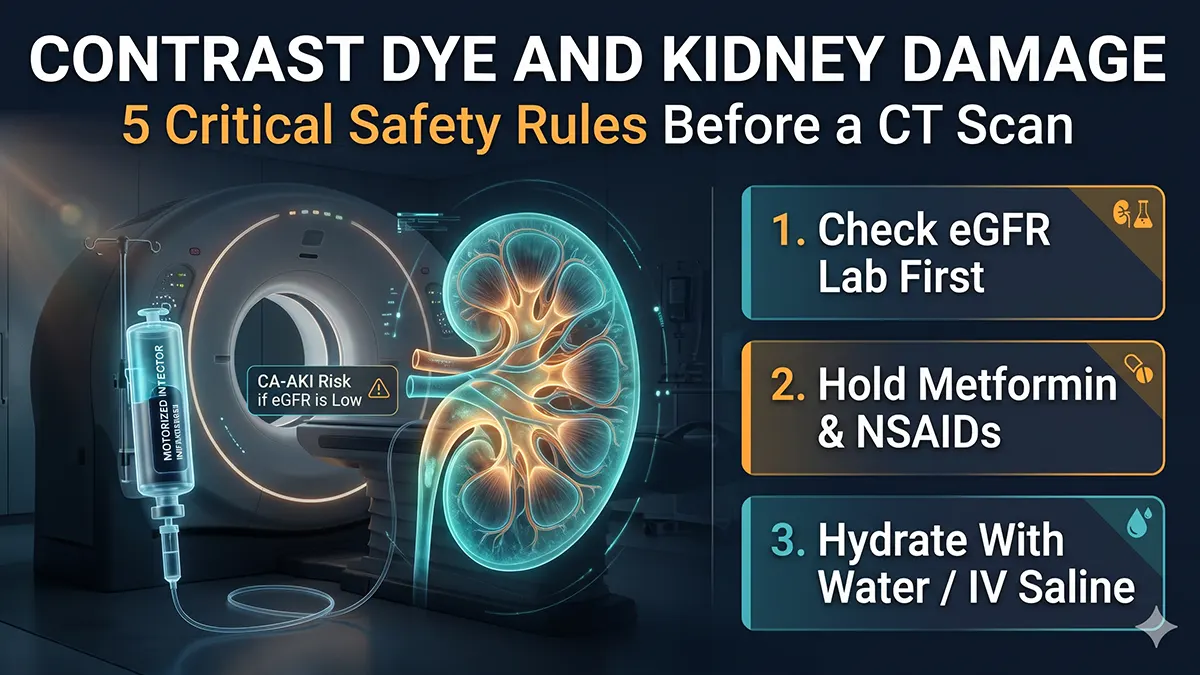
5 Critical Safety Rules to Prevent Contrast Dye and Kidney Damage
1. Always Check Your Recent eGFR Blood Test Before an IV Contrast Scan
Never assume your kidneys are ready for intravenous contrast without knowing your current estimated glomerular filtration rate (eGFR).
- Why it matters: For adults with an eGFR above 60, the risk of contrast dye and kidney damage is extremely low. However, if your eGFR is below 45—and especially below 30—your radiology team needs to know in advance so they can use the lowest effective dye dose, choose an iso-osmolar contrast agent, and give you protective IV fluids before and after the scan.
- What to ask: “Do you have an eGFR blood test from the last 30 days on file for me before we inject IV contrast?”
2. Ask Whether a Non-Contrast Scan Can Answer the Question
Not every CT or MRI scan actually needs contrast dye to give your doctor a clear diagnosis.
- Why it matters: While IV contrast is vital for spotting small tumors or blood vessel clots (where skipping dye could force repeat testing), many conditions show up clearly without dye. For example, if you have sudden flank pain from a suspected stone (see our Kidney Stone Pain Location Chart), a non-contrast helical CT scan or kidney ultrasound is the clinical gold standard—delivering 100% protection against contrast dye and kidney damage.
- What to ask: “Do I truly need contrast dye for this scan, or can a non-contrast CT or ultrasound answer the clinical question?”
3. Temporarily Hold Metformin, NSAIDs, and Diuretics (With Doctor Guidance)
One of the most important ways to prevent severe complications from contrast dye and kidney damage is reviewing your daily medication list with your prescribing doctor at least 48 hours before your scan. According to the NKF Safe Medicine Use Guide, four medication groups often need a temporary pause:
- Metformin (Diabetes medication): Metformin does not directly harm the kidneys, but it is cleared from your blood by your kidneys. If iodinated contrast temporarily slows your kidney filtration (CA-AKI) while you are still taking metformin, the drug can build up in your blood and cause a rare, life-threatening condition called lactic acidosis. Doctors frequently instruct patients with reduced eGFR to pause metformin on the day of an IV iodinated contrast scan and for 48 hours afterward, restarting once kidney function is confirmed stable (read more in Diabetes and Heart Disease: 7 Essential Risks).
- NSAID Painkillers (Ibuprofen, Naproxen, Meloxicam, Celecoxib): NSAIDs clamp down on the incoming blood vessels of your kidneys, multiplying the risk of contrast dye and kidney damage.
- Diuretics (“Water Pills” like Furosemide or Hydrochlorothiazide): Diuretics deplete body fluids and can dehydrate your kidneys right before the dye arrives.
- Certain Nephrotoxic Antibiotics: Tell your team if you are taking aminoglycoside or vancomycin antibiotics.
4. Hydrate Before and After the Scan to Flush the Dye Out Fast
Unless your doctor has placed you on a strict daily fluid restriction for advanced heart failure or dialysis, water is your kidneys’ best shield against contrast dye and kidney damage.
- Why hydration works: Drinking extra plain water during the 12 hours before (as allowed by your scan fasting rules) and 24 hours after your test dilutes the contrast dye inside your kidney tubules and speeds up its exit into your urine.
- Hospital IV hydration protocol: If you have Stage 3b, Stage 4, or Stage 5 CKD and require an urgent CT scan or heart angiogram with iodinated contrast, your doctor will typically give you intravenous (IV) normal saline or sodium bicarbonate fluids for 1 hour before and several hours after the procedure to protect your nephrons.
Read Also on Healthy Way Care: Recovering from stone removal or imaging? Check our guides on Ureteral Stent Pain Relief: 6 Proven Ways to Ease Spasms and Calcium Oxalate Kidney Stones – Causes & Prevention.
5. Coordinate Care If You Have Contrast Allergies, a Kidney Transplant, or Dialysis
Special kidney situations require a quick team huddle between your nephrologist and the radiologist before the test:
- Past contrast dye reactions or asthma: Feeling a brief warm flush or metallic taste during IV contrast injection is normal. However, if you have ever developed hives, itching, or breathing trouble from contrast dye, tell your doctor early—they can prescribe steroid and antihistamine pre-medication 12 hours before the scan to prevent an allergic reaction.
- Kidney transplant recipients: Contrast dye can be used safely with a transplanted kidney when labs are checked first, NSAIDs are avoided, and IV hydration is given.
- Patients on dialysis: Because damaged kidneys cannot clear dye efficiently on their own, your nephrologist and radiology team will schedule your imaging scan alongside your dialysis treatments when needed.
Conclusion
Worrying about contrast dye and kidney damage should never stop you from getting a life-saving medical diagnosis—it simply means taking five smart precautions first. By checking your recent eGFR blood test, asking whether a non-contrast scan or ultrasound will work, temporarily holding medications like metformin and NSAIDs under your doctor’s written instructions, and hydrating well before and after the test, you can get crystal-clear imaging results while keeping your kidneys safe.
Frequently Asked Questions (FAQs)
1. How long does it take for contrast dye to leave your kidneys?
In people with normal kidney function (eGFR above 60) who drink plenty of water after their scan, most intravenous iodinated CT dye or MRI gadolinium dye is filtered out by the kidneys and leaves in the urine within 24 hours. If you have chronic kidney disease (low eGFR), clearing the dye takes longer, which is why extra hydration is so important.
2. What are the warning signs of contrast dye and kidney damage after a CT scan?
Contrast-associated acute kidney injury (CA-AKI) is often silent and detected on a follow-up creatinine/eGFR blood test 48 to 72 hours after the scan. However, call your doctor immediately if you notice a sharp drop in urine output, new swelling in your ankles or around your eyes, unexplained extreme fatigue, nausea, or shortness of breath in the days following a contrast scan.
3. Why do you have to stop taking metformin before CT contrast dye?
Metformin itself does not damage the kidneys, but it is removed from the body exclusively through urine. If intravenous iodinated contrast causes a temporary drop in kidney function (contrast dye and kidney damage), metformin can accumulate in the bloodstream and trigger a dangerous acid buildup called lactic acidosis. Always ask your doctor for written instructions on when to pause and restart metformin.
4. Is MRI gadolinium contrast safer for kidneys than CT iodinated contrast?
Yes. According to the National Kidney Foundation, routine MRI scans using newer ACR Group 2 or Group 3 gadolinium agents carry a very low risk of kidney injury compared to iodinated CT contrast dye. Your radiologist will check your eGFR to select the safest MRI agent.
5. Do you need contrast dye for a kidney stone CT scan?
In almost all cases, no. A non-contrast helical CT scan (or a kidney ultrasound) is the medical gold standard for spotting calcium and uric acid kidney stones because stones naturally show up bright white without needing any intravenous contrast dye.
6. How much water should I drink after a CT scan with contrast dye?
Unless your physician limits your daily fluids due to heart failure or dialysis, aim to drink 6 to 8 glasses (48 to 64 ounces) of plain water over the 24 hours following your contrast scan to help your kidneys flush the dye into your urine quickly.
Author & Editorial Standards
Written by Yamanandan Reddy — Health & Wellness Writer Yamanandan Reddy writes research-backed patient education guides at Healthy Way Care, helping readers understand kidney health, medical imaging safety, urinary symptoms, and diabetes management using official clinical guidelines.
Medical References & Clinical Sources:
- National Kidney Foundation (NKF) — Contrast Dye and Your Kidneys: Uses, Types, Safety & Questions to Ask
- National Kidney Foundation (NKF) — Safe Medicine Use with Chronic Kidney Disease
Medical Disclaimer: The information provided on Healthy Way Care is for educational and informational purposes only and is not a substitute for professional medical advice, diagnosis, or treatment. Never cancel a diagnostic imaging test or stop prescribed medications like metformin without consulting your ordering physician and radiologist.