
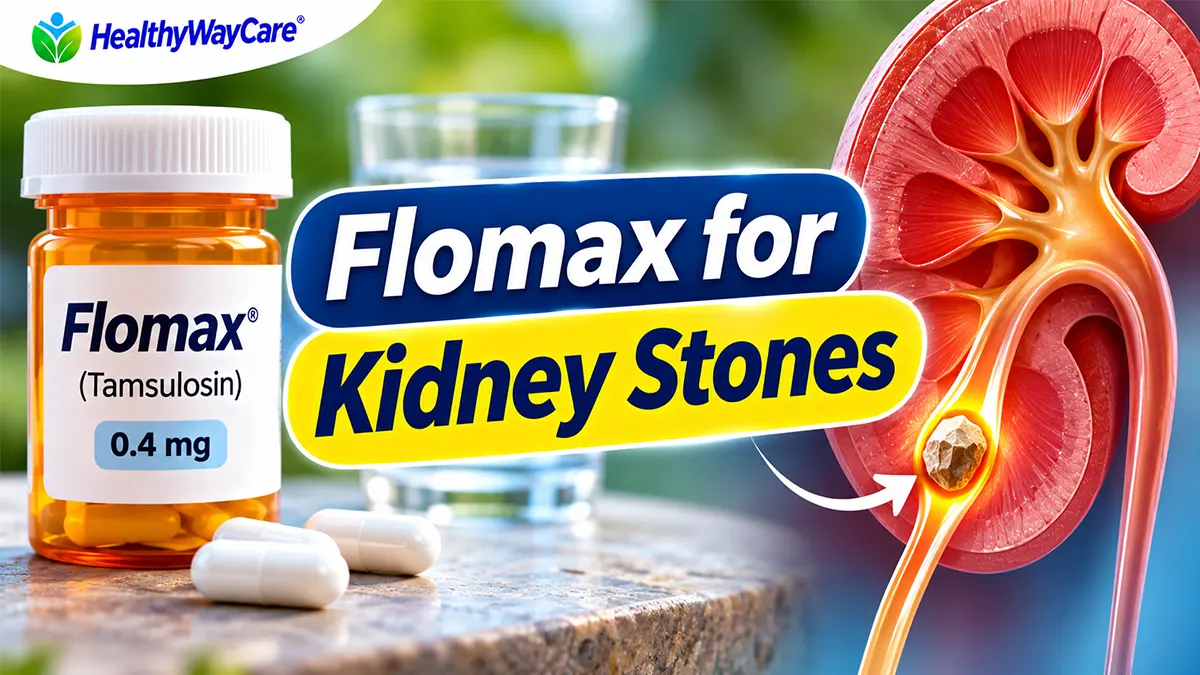
Flomax for Kidney Stones: Does Tamsulosin Help Stones Pass?
Quick answer: Flomax (tamsulosin) may help certain stones pass when they are lodged in the lower (distal) ureter, especially stones approximately 5–10 mm in diameter. It relaxes smooth muscle in the urinary tract; it does not dissolve, shrink, or break apart a kidney stone. Its use to help stones pass is off-label in the United States. Whether it is appropriate depends on imaging, symptoms, infection risk, kidney function, other medications, and clinician assessment. EAU guidance and the AUA surgical guideline support discussing alpha-blockers for appropriately selected ureteral stones.
Medical safety: If you have a suspected stone with fever, shaking chills, inability to urinate, severe uncontrolled pain, persistent vomiting, or a feeling of being seriously ill, seek emergency medical care. A blocked urinary system with infection can be life-threatening and needs urgent treatment rather than waiting for medication to work. This guide is educational, not an individual prescription.
Table of Contents
What Is Flomax, and Why Is It Prescribed for Kidney Stones?
Flomax is the brand name for tamsulosin, a prescription alpha-1 adrenergic blocker. In the United States, the FDA-approved indication is relief of urinary symptoms caused by benign prostatic hyperplasia (BPH), or an enlarged prostate. Urologists sometimes prescribe it for a different reason: to help a suitable ureteral stone move toward the bladder. This approach is called medical expulsive therapy (MET). The stone still needs to pass; the medicine is intended to make passage more likely in selected circumstances.
A kidney stone begins in the kidney, but the key distinction is whether it has entered the ureter, the narrow tube connecting the kidney to the bladder. Much of the evidence for tamsulosin concerns stones in the lower ureter, not stones sitting quietly inside the kidney. This is why the phrase “Flomax for kidney stones” is common in online searches but medically imprecise. Imaging location matters at least as much as the label on a scan report.
Tamsulosin is not an antibiotic, a painkiller, a diuretic, or a stone-dissolving agent. It may be prescribed alongside appropriate pain control, anti-nausea care, and follow-up imaging. Do not borrow someone else’s medication or assume a prior prescription is safe for a new episode.
How Does Tamsulosin Help a Ureteral Stone Pass?
The ureter contains smooth muscle that contracts to transport urine from the kidney to the bladder. Alpha-1 receptors contribute to muscle tone. By blocking these receptors, tamsulosin can reduce ureteral smooth-muscle tension and may make it easier for a stone to move through a tight segment. The effect is not guaranteed: a large stone, significant swelling, unusual anatomy, or a persistent obstruction may prevent passage despite treatment.
The medication does not physically push the stone out and does not change its mineral composition. If a stone is lodged at a location that cannot safely clear, a procedure may be necessary. If the stone is already in the bladder, the clinical question is different; if it remains inside the kidney, the benefit of tamsulosin for spontaneous passage is much less established.
Which Kidney Stones Are Most Likely to Benefit From Flomax?
The European Association of Urology (EAU) 2026 guideline strongly recommends offering alpha-blockers as one option for distal ureteral stones 5–10 mm, explicitly noting that this use is off-label. The American Urological Association (AUA) surgical-management guideline recommends offering observation for uncomplicated ureteral stones 10 mm or smaller and offering alpha-blocker MET for suitable distal ureteral stones of that size. The recommendations are not identical in wording; both require patient selection and monitoring.
Why the focus on 5–10 mm stones? Very small distal stones often pass without assistance, so the added benefit of medication may be modest. Larger stones are less likely to pass without intervention. In between, there is a meaningful opportunity for treatment to improve the odds in some patients. Study results vary because researchers have included different stone sizes, locations, follow-up schedules, and outcome definitions.
| Stone situation | Potential role of Flomax | Important qualification |
|---|---|---|
| Distal ureteral stone, 5–10 mm | Often the clearest candidate for a clinician-supervised trial | Only if infection, uncontrolled symptoms, and other reasons for urgent intervention are absent |
| Distal ureteral stone under 5 mm | May offer limited additional benefit | Many small stones pass spontaneously |
| Mid or upper ureteral stone | Evidence is less consistent | Do not assume the same benefit as lower-ureter stones |
| Stone still inside the kidney | Not an established general stone-removal treatment | Observation or a procedure may be considered based on stone characteristics |
| Large stone or persistent blockage | Often insufficient alone | Urologic intervention may be needed |
| Fever or suspected infected obstruction | Do not rely on MET | Emergency evaluation and drainage may be necessary |
Flomax for a 3 mm, 5 mm, 7 mm, or 10 mm Stone
Patients often search by the exact millimeter measurement on a CT or ultrasound report. Size is useful, but it is not a complete treatment plan. A 3 mm stone in the distal ureter may pass on its own; a 7 mm stone in the same area may have more to gain from a supervised MET discussion. A 10 mm stone can be difficult to pass, and location, symptoms, and kidney drainage may make early intervention preferable. None of these examples guarantees an outcome.
Measurement also has limitations. Ultrasound may estimate stone size differently from CT, and the longest dimension of an irregular stone does not describe every aspect of its shape. The presence or absence of hydronephrosis, infection, kidney impairment, or severe pain can override a simple size-based decision. See our kidney stone pain location chart for background on why ureteral stones may cause flank, abdominal, and groin discomfort.
Does Flomax Actually Work? Understanding the Evidence
Clinical trials and pooled analyses have not all reached the same conclusion. Some trials that enrolled many very small stones found little overall benefit; other analyses identified a clearer improvement in passage for larger distal ureteral stones. The best interpretation is not that Flomax works for everyone or for no one. It is that stone size and position help determine the expected benefit. The EAU recommendation specifically highlights distal ureteral stones greater than 5 mm.
When reading online success rates, ask whether the number describes spontaneous passage without medication, passage with tamsulosin, or passage after a procedure. Also check whether the population had distal stones, whether the study counted symptom improvement as success, and whether imaging confirmed stone clearance. A percentage from one trial should not be presented as your personal probability of success.
Tamsulosin can be a reasonable option when a clinician believes watchful waiting is safe, but it is not a substitute for an appropriate follow-up plan. Persistent obstruction can harm kidney function even if pain temporarily improves. The treatment decision should be shared with a urologist or other qualified clinician.
How Long Does Flomax Take to Help Pass a Kidney Stone?
There is no reliable “works in 24 hours” promise. Passage may occur over days or weeks, and the medication cannot guarantee that a stone will move at all. The EAU guideline reports that spontaneous ureteral stone passage in selected observational data averaged around 17 days, with substantial variation; this is not a prediction of how quickly tamsulosin will work for an individual.
The AUA surgical guideline describes offering definitive treatment in most patients when observation with or without MET has not succeeded after approximately four to six weeks, or sooner when symptoms, complications, or patient preference warrant intervention. That is a clinical management window, not an instruction to take tamsulosin for six weeks without reassessment. Your prescriber should set the duration, follow-up date, and criteria for stopping or escalating care.
Do not interpret less pain as proof of stone passage. A stone may move, pressure may change, or pain medicine may mask symptoms while obstruction persists. Your clinician may ask you to strain urine and save the stone, or recommend imaging when passage is uncertain. Keep appointments even if you feel better.
Flomax Dosage for Kidney Stones: What Patients Should Know
The U.S. prescription label for Flomax describes 0.4 mg once daily for its approved BPH indication, taken approximately 30 minutes after the same meal each day. Clinicians also commonly use this dose in studies of ureteral stone passage, but there is no FDA-approved kidney-stone dosing regimen. Only your prescriber can decide whether tamsulosin is suitable, what dose to use, and how long to continue it. Do not increase the dose to try to speed passage.
The label warns that the drug can cause dizziness, postural blood-pressure drops, and fainting, especially when treatment begins or resumes. Follow the dispensing instructions for your particular product. If you miss doses, have stopped for several days, or are unsure about restarting, ask your pharmacist or prescriber rather than improvising. Avoid driving or hazardous tasks until you know how the medication affects you.
Tell your clinician about blood-pressure medicines, erectile-dysfunction medicines such as sildenafil or tadalafil, other alpha-blockers, and medicines that can alter tamsulosin metabolism. Strong CYP3A4 inhibitors can be especially important. Also disclose prior fainting, significant liver disease, allergies, and planned eye surgery. The official DailyMed Flomax label provides the detailed interaction and warning information.
Common and Serious Flomax Side Effects
Not everyone experiences side effects, but it is important to recognize them before starting treatment. Dizziness and lightheadedness can occur when standing up, and fainting is possible. Other reported effects include headache, nasal symptoms, fatigue, and changes in ejaculation. A rare, prolonged painful erection (priapism) requires emergency treatment. Serious allergic reactions also require urgent care.
| Possible effect | What it may feel like | Recommended response |
|---|---|---|
| Dizziness or low blood pressure | Lightheaded when standing, unsteady, near-fainting | Sit or lie down; contact the prescriber, urgently if severe |
| Headache or nasal symptoms | Headache, runny or stuffy nose | Discuss if persistent or troublesome |
| Ejaculation changes | Reduced or altered ejaculation | Ask the prescriber if concerning |
| Medication interaction | Greater dizziness or low blood pressure after another drug | Have pharmacist review all prescriptions and supplements |
| Serious allergic reaction | Facial or throat swelling, breathing difficulty | Seek emergency care |
| Priapism | Painful erection that does not resolve | Seek emergency care promptly |
An additional precaution matters for people considering cataract surgery: current or past use of tamsulosin can be associated with intraoperative floppy iris syndrome. Tell your ophthalmologist about any history of taking it, even if you stopped. The U.S. label also advises caution for patients with a history of severe sulfonamide (“sulfa”) allergy. A pharmacist can help distinguish drug classes and evaluate your specific allergy history.
Flomax vs Pain Medicine vs Surgery: What Is the Difference?
The three approaches solve different problems. MET aims to improve the likelihood of passage in suitable patients. Pain medication addresses discomfort but does not necessarily remove a blockage. Procedures physically break up or remove a stone or relieve obstruction. The right plan may involve more than one approach and should be based on the risk of waiting.
| Treatment | Main purpose | Typical situation | Limitations |
|---|---|---|---|
| Tamsulosin / Flomax | Relax ureteral smooth muscle to aid selected stone passage | Stable patient with suitable distal ureteral stone | Off-label; cannot dissolve stone or treat infection |
| Clinician-directed pain relief | Control renal colic symptoms | Painful stone episode | May not resolve obstruction; some medicines are unsafe with dehydration or kidney disease |
| Observation with follow-up | Allow spontaneous passage while monitoring | Small uncomplicated stones | Requires a clear return plan and reassessment |
| Ureteroscopy (URS) | Directly remove or fragment the stone | Unlikely passage, persistent obstruction, failed MET or patient preference | Procedure and anesthesia risks; temporary stent sometimes used |
| Shock wave lithotripsy (SWL) | Break selected stones using external shock waves | Appropriate stone location, size and anatomy | May require repeat treatment; fragments still need to pass |
| Urgent drainage (stent or nephrostomy) | Relieve dangerous obstruction | Infected obstructed system or certain high-risk situations | Emergency treatment; definitive stone removal may occur later |
Who Should Not Simply Wait for Flomax to Work?
A trial of MET is appropriate only when a clinician determines that immediate stone removal is not required. An infected obstructed kidney is a urologic emergency. Fever, chills, confusion, worsening weakness, or feeling acutely ill with suspected obstruction should prompt emergency assessment, even if you are already taking antibiotics or tamsulosin. A medication intended to relax the ureter cannot reliably clear an infected blockage.
Other reasons for urgent assessment include inability to urinate, severe pain despite treatment, repeated vomiting that prevents hydration, and concern about reduced kidney function. People with one functioning kidney, a kidney transplant, bilateral obstruction, or important kidney disease need individualized urgency and monitoring. Pregnancy also changes imaging and medication decisions; never assume an adult outpatient MET plan applies during pregnancy.
- Go to an emergency department for fever or shaking chills with suspected kidney stone symptoms.
- Seek urgent care for inability to pass urine, uncontrolled pain, or persistent vomiting.
- Contact your treating clinician promptly for worsening symptoms, medication intolerance, or missed follow-up.
- Do not wait for a scheduled appointment if you feel faint, confused, or severely unwell.
Can Women Take Flomax for Kidney Stones?
Tamsulosin is approved for BPH, a condition affecting people with a prostate, but its off-label use for ureteral stones is not automatically restricted to men. Clinicians may consider it for selected adult women with a suitable ureteral stone after weighing benefits, risks, and evidence. This does not make it a routine recommendation for all women with urinary pain. Symptoms such as burning, frequency, pelvic discomfort, and flank pain can have other causes, including infection.
Pregnancy requires particular caution because the evidence and safety considerations differ from those in the general adult stone population. A pregnant person with suspected stones should be assessed by an obstetric and urologic care team rather than starting tamsulosin independently. Breastfeeding and individual medication history should also be discussed with a qualified clinician.
What About Flomax After Lithotripsy or Ureteroscopy?
Some urologists use alpha-blockers after certain stone procedures to help with fragment passage or ureteral stent symptoms. These are separate treatment decisions from using MET for an untreated distal ureteral stone. The evidence, expected benefit, and duration can differ by procedure and clinical situation. A person recovering from ureteroscopy should follow the surgeon’s specific discharge plan rather than borrowing instructions intended for spontaneous stone passage.
A ureteral stent may cause urinary frequency, urgency, flank discomfort, or blood-tinged urine. Tamsulosin is sometimes part of a clinician-directed symptom-management plan, but it does not mean a stent can be left in place indefinitely or that severe symptoms should be ignored. Contact your urology team for fever, severe pain, heavy bleeding, or difficulty urinating after a procedure.
How Doctors Decide Whether Flomax Is Appropriate
A clinician typically starts by confirming whether a stone is present, where it sits, and whether urine can drain safely. A history and examination help assess pain, vomiting, fever, medication risks, pregnancy possibility, and prior stones. Urinalysis may identify blood or signs of infection; urine culture and blood tests may be indicated to assess infection and kidney function. Imaging such as ultrasound or noncontrast CT can help establish stone size, location, and obstruction.
A useful discussion includes the chance of spontaneous passage, expected incremental benefit from MET, possible adverse effects, alternatives, and what happens if the stone does not pass. Ask when follow-up is planned and whether a repeat scan is necessary. The AUA guideline recommends considering reimaging before surgery when stone passage is suspected or movement would change management, while minimizing unnecessary radiation.
For readers comparing symptoms with a stone diagnosis, the HealthyWayCare groin-pain guide explains why pain location can vary. It is not a replacement for imaging or an in-person evaluation.
What to Do While Waiting for a Stone to Pass
If your clinician has recommended outpatient observation or MET, follow the written plan. Drink fluids normally and avoid dehydration, but do not force large volumes of water during severe renal colic or vomiting in the belief that pressure will push the stone out. Use prescribed or clinician-approved pain medication as directed; kidney function, other illnesses, and medication interactions may change what is safe. Do not combine multiple anti-inflammatory medicines without advice.
Your care team may recommend straining urine through a stone strainer and saving any recovered material for laboratory analysis. Knowing whether a stone is calcium oxalate, uric acid, calcium phosphate, struvite, or cystine can inform future prevention, but composition cannot reliably be guessed from appearance alone. Write down symptom changes and keep the follow-up appointment even if the pain disappears.
For prevention after the acute episode, a clinician may recommend stone analysis, blood tests, or a 24-hour urine collection, especially after recurrent stones. Dietary prevention commonly involves appropriate fluid intake and limiting excess sodium, but the plan should be tailored to stone type and urine chemistry. A drug that helps one ureteral stone pass does not prevent every future stone.
Questions to Ask Your Urologist Before Taking Tamsulosin
- Is my stone inside the kidney, upper ureter, or lower ureter?
- How large is it on imaging, and is there hydronephrosis or impaired drainage?
- Am I a good candidate for medical expulsive therapy, or is a procedure safer?
- What benefit might tamsulosin add compared with observation alone in my case?
- Which side effects or drug interactions are most relevant to my medication list?
- How long should I take it, and when should we reassess?
- How will we confirm that the stone passed and the blockage resolved?
- Which symptoms mean I should stop waiting and seek emergency care?
8 Frequently Asked Questions About Flomax for Kidney Stones
1. Does Flomax dissolve kidney stones?
No. Tamsulosin does not chemically dissolve calcium oxalate, calcium phosphate, or other stones. It may relax ureteral smooth muscle and help certain ureteral stones pass. Some uric acid stones can be dissolved with carefully supervised urine alkalinization, which is a different treatment.
2. Is Flomax FDA-approved for kidney stones?
No. In the United States, Flomax is approved for urinary symptoms associated with benign prostatic hyperplasia. Using it as medical expulsive therapy for ureteral stones is off-label. Off-label prescribing can be evidence-based, but it requires an individualized clinical decision.
3. Does Flomax help a 5 mm kidney stone pass?
It may help when a roughly 5 mm stone is in the lower ureter and observation is safe. The expected benefit depends on exact size, position, symptoms, and the likelihood of spontaneous passage. A stone still inside the kidney is not the same situation.
4. How many days should I take Flomax for a kidney stone?
There is no universal FDA-approved duration for kidney stones. Your prescriber should specify the course and follow-up. AUA guidance discusses reassessing unsuccessful observation or MET within a limited treatment window, often four to six weeks, or intervening sooner if needed.
5. Can Flomax make kidney stone pain worse?
Tamsulosin is not designed to cause renal colic, but pain can fluctuate as a stone moves or remains obstructed. Dizziness or low blood pressure from the medicine can also make you feel unwell. New severe pain, fever, or vomiting should be assessed rather than attributed to normal stone movement.
6. Can I take Flomax and ibuprofen together?
Some clinicians prescribe an alpha-blocker and appropriate pain relief during a stone episode, but whether ibuprofen is safe depends on kidney function, dehydration, bleeding risk, other medicines, and medical history. Ask your prescriber or pharmacist before combining them; do not self-treat an infected or obstructed kidney.
7. Can women use Flomax to pass a kidney stone?
A clinician may consider off-label tamsulosin for selected women with ureteral stones, but it is not appropriate for everyone. Pregnancy, other diagnoses, blood-pressure concerns, and medication interactions require individualized evaluation.
8. How do I know whether the stone has passed while taking Flomax?
Catching a stone in a strainer can provide evidence of passage, but pain relief alone does not prove the ureter is clear. Your clinician may use follow-up assessment or imaging if passage is uncertain, especially when a blockage was previously identified.
Key Takeaways
- Flomax (tamsulosin) is an alpha-blocker used off-label to help selected ureteral stones pass.
- The strongest guideline-supported use is for uncomplicated distal ureteral stones around 5–10 mm.
- It does not dissolve stones, cure infection, or replace necessary surgery.
- Dizziness, postural low blood pressure, fainting, and drug interactions are important safety considerations.
- Follow-up is essential because symptom improvement does not always prove stone passage.
- Fever with suspected obstruction, inability to urinate, uncontrolled pain, or persistent vomiting warrants urgent medical care.
Medical References and Editorial Notes
- European Association of Urology (EAU). Guidelines on Urolithiasis, 2026. Medical expulsive therapy and ureteral stone management.
- EAU Pocket Guidelines on Urolithiasis, 2026 (PDF).
- American Urological Association / Endourological Society. Surgical Management of Stones Guideline. Guideline originally published 2016; cited recommendations should not be mislabeled as a newly issued 2026 AUA guideline.
- DailyMed. FLOMAX (tamsulosin hydrochloride) U.S. prescribing information. Updated 2025.
Editorial transparency: Prepared as a research-based patient education draft using the above clinical guidance and prescribing information. No independent physician review has been completed for this draft; arrange qualified medical review before publishing. Do not add a “medically reviewed” byline unless a named qualified reviewer has actually reviewed it. Guideline recommendations can change; confirm the latest versions during editorial review.
Disclaimer: HealthyWayCare provides general educational information, not personalized medical advice. Tamsulosin is a prescription medicine; do not start, stop, or change it based on this article. If you suspect infection with a blocked urinary tract or have other emergency warning signs, seek immediate medical attention.