
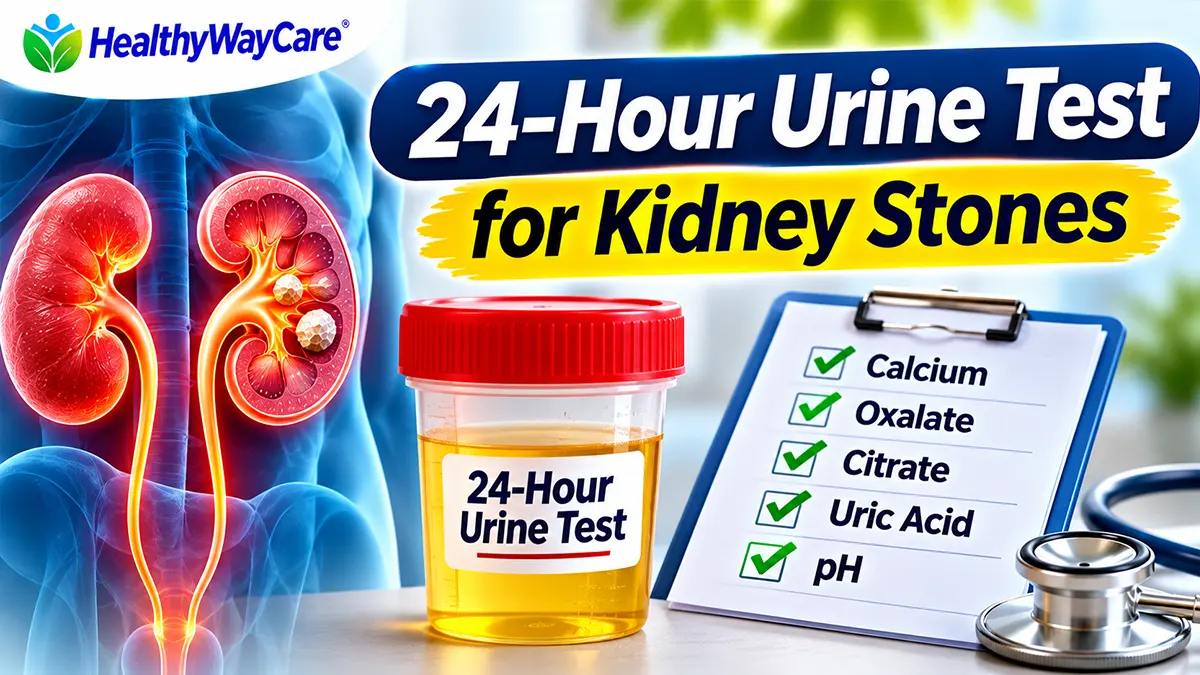
Quick answer: A 24 hour urine test for kidney stones measures how much urine your body produces and how much of several stone-related substances you excrete over an entire day. It can reveal low urine volume, excess calcium or oxalate, low citrate, unusual urine acidity, and other patterns that help your clinician design a prevention plan. It does not diagnose an active obstructing stone, and an abnormal result does not automatically mean you need medication.
If you have had more than one kidney stone, or your clinician believes you are at higher risk of another stone, you may be offered a collection kit to use at home. The process sounds complicated, but the essential task is simple: collect every urine sample over the prescribed 24-hour period, apart from the first urination at the starting time, and follow your laboratory’s storage and return instructions. This guide explains the steps, what the numbers may mean, and which questions to ask at your follow-up appointment.
Table of Contents
What Is a 24 Hour Urine Test for Kidney Stones?
A 24-hour urine collection, sometimes called a kidney stone metabolic evaluation, captures changes in urine chemistry throughout a normal day rather than relying on a single sample. Food, fluid intake, physical activity, and the time of day all affect urine composition. Measuring the total output and dissolved substances helps clinicians understand conditions that favor crystal formation. The test is particularly useful when paired with stone composition analysis, a medical history, blood tests, and imaging when indicated.
For example, a person can drink plenty of water at breakfast yet produce a small total amount of urine over the day. Another person may produce adequate urine but excrete a relatively high amount of calcium or oxalate. Both situations can contribute to stone risk, but the preventive approaches may differ. The purpose of the test is to identify those differences rather than apply the same diet to everyone.
The American Urological Association (AUA) describes metabolic testing with one or two 24-hour collections, including at minimum urine volume, pH, calcium, oxalate, uric acid, citrate, sodium, potassium, and creatinine. Two collections may be preferred because daily results vary. The European Association of Urology (EAU) recommends two consecutive collections for a specific metabolic evaluation. Your urologist will determine which protocol is appropriate.
Who Should Have a 24-Hour Urine Test?
Not everyone who has a single small kidney stone requires an extensive metabolic workup. However, testing is commonly considered for people who form stones repeatedly, have risk factors for recurrence, or want a more individualized prevention strategy after a first stone. Your clinician may also recommend it if stones developed at a young age, there is a strong family history, stones occur in both kidneys, or an unusual stone composition suggests an underlying metabolic condition.
- People with recurrent kidney stones or multiple stones on imaging.
- High-risk or interested first-time stone formers, based on shared decision-making.
- People with known uric acid, cystine, calcium phosphate, or other stone types requiring tailored prevention.
- Patients with bowel disorders, malabsorption, certain metabolic conditions, or relevant medications.
- People starting preventive treatment who need a baseline or follow-up measurement.
A 24-hour urine collection is generally a prevention test, not the urgent test for someone with severe flank pain today. If you have fever or chills with suspected stones, cannot urinate, have uncontrolled pain, or cannot keep fluids down, seek urgent medical evaluation. For symptom patterns, see our kidney stone pain location chart.
When Should the Test Be Done After a Kidney Stone?
Timing matters because an acute stone episode, dehydration, infection, or sudden changes in diet can distort your usual urine chemistry. EAU guidance advises performing the specific metabolic evaluation after the acute episode has settled, no earlier than 20 days and preferably around three months, when you are stable, infection-free, and eating and drinking normally. This is guidance rather than a universal appointment date: your urologist may choose a different schedule for your circumstances.
Do not intentionally restrict fluids, avoid calcium, or begin a new supplement just to produce a “better” result. Unless your care team tells you otherwise, the baseline collection should represent your normal diet and daily routine. If you have started a new medication, are pregnant, have a urinary infection, or have recently undergone stone surgery, ask the ordering clinician whether to proceed or reschedule.
How to Collect a 24-Hour Urine Sample: Step-by-Step
Your laboratory may provide one large container, two containers, a collection hat or urinal, a preservative, and written instructions. Always follow the kit instructions first, especially about preservatives, refrigeration, and return deadlines. Never touch or discard a preservative unless the lab specifically instructs you to do so; some preservatives can be irritating or hazardous.
| Step | What to do | Why it matters |
|---|---|---|
| 1. Choose a normal day | Pick a day when you can collect every sample and follow the storage instructions. | Travel or a disrupted schedule can lead to missed samples. |
| 2. Set a start time | On waking, urinate into the toilet and record the exact time. Do not save this first urine. | This empties the bladder at the beginning of the timed period. |
| 3. Save every subsequent sample | Collect all urine for the next 24 hours, including overnight urination. | Missing even one void may make the measurements unreliable. |
| 4. Include the final sample | At the same clock time the next day, urinate and add that final sample. | This completes the full collection window. |
| 5. Store and return correctly | Keep containers as instructed and deliver them within the lab’s deadline. | Improper storage can affect sample quality. |
Example: If you start at 7:00 a.m. Monday, empty your bladder into the toilet at 7:00 a.m. and record that time. Save every later urination, including during the night. At 7:00 a.m. Tuesday, collect your final urination and stop. If your lab asks for two separate days, label and manage the collections exactly as instructed. Some kits use a separate preservative or special handling for each day.
If you accidentally spill a sample, miss a urination, or collect for the wrong duration, call the laboratory rather than guessing or hiding the error. You may need to repeat the collection. Keep the container away from children and pets. Do not mix stool, toilet paper, or cleaning products with the sample. If you are menstruating or have another possible source of contamination, ask the lab whether to postpone collection.
What Does a 24-Hour Urine Kidney Stone Test Measure?
Reports vary by laboratory and by the stone panel ordered. Some also provide calcium oxalate, calcium phosphate, and uric acid supersaturation values, which estimate how readily crystals may form under the measured conditions. Supersaturation is a model-based risk indicator, not a prediction that a stone will definitely form. The table below summarizes the most common measurements and how clinicians interpret them in context.
| Measurement | What it tells you | Possible concern |
|---|---|---|
| Urine volume (L/day) | Total urine produced in 24 hours. | Low volume concentrates stone-forming substances. |
| Calcium (mg/day) | Amount of calcium excreted in urine. | Higher calcium can increase calcium stone risk. |
| Oxalate (mg/day) | Oxalate excreted in urine. | Higher oxalate can promote calcium oxalate stones. |
| Citrate (mg/day) | A natural inhibitor of calcium crystal formation. | Low citrate can reduce protection against calcium stones. |
| Uric acid (mg/day) | Total uric acid excreted. | Higher levels can contribute to some stone risks. |
| Urine pH | How acidic or alkaline the urine is. | Very acidic urine favors uric acid stones; higher pH may favor calcium phosphate stones. |
| Sodium (mmol/day or mg/day) | An estimate of sodium excretion. | High sodium intake can raise urinary calcium in some people. |
| Potassium (mmol/day) | A dietary and metabolic marker. | Helps interpret overall diet and urine chemistry. |
| Creatinine (mg/day) | A marker used partly to assess collection completeness. | Unexpected values can suggest missed urine or other factors. |
| Supersaturation indices | Estimated tendency of specific crystals to form. | Higher values may support a targeted prevention plan. |
24-Hour Urine Test Results: Reference Ranges and Important Limits
Do not compare your report with a single internet “normal” chart and diagnose yourself. Laboratories may use different units, thresholds, sex-specific cutoffs, and calculation methods. Your stone composition, medications, kidney function, and collection completeness also matter. The figures below are clinical orientation points, not universal laboratory reference ranges or treatment thresholds.
| Result | Useful orientation | Important caution |
|---|---|---|
| Urine volume | For many adult stone formers, AUA prevention guidance targets at least 2.5 L of urine daily (about 85 US fl oz). | This is a clinician-directed urine-output goal, not a fixed amount of water everyone must drink. |
| Urine pH | Persistently below 5.5 is particularly acidic; persistently above 7 can warrant further evaluation. | A single pH number does not identify stone composition or diagnose infection. |
| Calcium | The EAU lists several values and clinical decision points, including 5 and 8 mmol/day in its adult table. | Interpretation depends on sex, stone type, other risk factors, and local laboratory criteria. |
| Oxalate | EAU flags more than 0.5 mmol/day for consideration of enteric hyperoxaluria. | Units may be mg/day; the laboratory and clinical context determine significance. |
| Citrate | EAU notes sex-specific low-citrate thresholds of less than 1.7 mmol/day in males and 1.9 mmol/day in females. | Other labs may report mg/day and use different decision limits. |
| Uric acid | EAU reference values include 4 mmol/day in females and 5 mmol/day in males. | Urine pH and supersaturation can be more informative than uric acid quantity alone. |
For US readers, results are often expressed in milligrams per day (mg/day), millimoles per day (mmol/day), or liters per day (L/day). A number cannot be compared with another number unless the units match. If your report flags a result in red, ask what it means for your particular stone type rather than treating it as proof of disease. A borderline abnormal value may call for a diet discussion or repeat collection, while a strongly abnormal or unusual pattern may need additional testing.
High Urine Calcium: What Does It Mean?
High urinary calcium, sometimes called hypercalciuria, is a common risk factor for calcium-based kidney stones. It does not automatically mean your blood calcium is high, and it does not mean you should stop eating calcium-rich foods. Urinary calcium can be influenced by dietary sodium, certain medications, hormonal or metabolic conditions, and individual kidney handling of calcium.
For many adults with calcium stones, AUA guidance supports limiting sodium and maintaining normal dietary calcium intake of about 1,000–1,200 mg per day, rather than adopting a very low-calcium diet. Dietary calcium consumed with meals can bind oxalate in the intestine. Your clinician may check blood calcium or other tests if an underlying condition is suspected, and may consider medication in selected recurrent stone formers.
Avoid independently starting or stopping calcium supplements, diuretics, or other prescription drugs based on one report. The correct response depends on why the urine calcium is elevated and whether the person forms calcium oxalate or calcium phosphate stones.
High Urine Oxalate: What Does It Mean?
Oxalate is a naturally occurring substance found in the body and in foods. When too much oxalate reaches the urine, it can combine with calcium and increase the likelihood of calcium oxalate crystals. High urine oxalate may be associated with some high-oxalate foods, high-dose vitamin C supplements, low dietary calcium, or intestinal absorption problems. The source matters because a restrictive diet is not always the answer.
A clinician may recommend pairing normal dietary calcium with meals, reviewing unusually high oxalate intake, and assessing digestive conditions when appropriate. Spinach, rhubarb, and some nuts are examples of foods that can contribute significant oxalate, but most people do not need to eliminate every fruit and vegetable. If oxalate is markedly elevated, specialized evaluation may be needed to rule out uncommon inherited or intestinal causes.
Low Urine Citrate: Why It Matters
Citrate helps reduce calcium crystal formation by binding calcium and interfering with crystal growth. A low urinary citrate result, called hypocitraturia, can occur with certain dietary patterns, acid-base disorders, medications, or other medical conditions. It is particularly relevant for patients with recurrent calcium stones, but treatment still depends on the full urine profile.
A clinician may suggest dietary changes or prescribe potassium citrate in appropriate cases. However, potassium citrate is not suitable for everyone, including some people with impaired kidney function or elevated blood potassium. Increasing urine pH may also have trade-offs for people prone to calcium phosphate stones. Lemon water can be a pleasant way to drink more fluid, but it is not an equivalent replacement for a prescribed citrate dose. See our guide to drinks for kidney stone prevention.
Urine pH: Acidic vs. Alkaline Urine
Urine pH describes acidity. Lower numbers mean more acidic urine; higher numbers mean more alkaline urine. Persistently acidic urine can promote uric acid stone formation, even when total urinary uric acid is not dramatically elevated. More alkaline urine can help prevent or dissolve some uric acid stones under medical supervision, but excessively alkaline conditions may favor certain calcium phosphate stones.
This is why taking baking soda, alkaline supplements, or urinary alkalinizing medication without a diagnosis can be risky. In people with cystine stones or uric acid stones, clinicians may use carefully monitored urine pH targets and home pH checks. A 24-hour average pH cannot always replace measurements taken at different times of day. Urine pH above 7 may also prompt evaluation for infection or other conditions, but pH alone cannot diagnose a urinary tract infection.
High Urine Uric Acid and High Sodium
Uric acid is produced when the body breaks down purines. Higher urine uric acid can contribute to certain stones, especially in combination with acidic urine. A clinician may review intake of large amounts of meat or other animal proteins, metabolic health, and medications. Not everyone with a high uric acid number needs allopurinol or another prescription medicine; the indication depends on the overall findings.
Urine sodium offers a useful window into dietary salt intake. Many processed foods, restaurant meals, sauces, and packaged snacks contain more sodium than expected. In people with calcium stones, higher sodium intake may increase urinary calcium. The AUA supports a sodium target around 2,300 mg per day for appropriate calcium-stone patients. People with other medical conditions may have different recommendations. Ask your care team whether sodium reduction is a priority based on your own results.
What Is Urine Supersaturation?
Some specialized US kidney stone panels report calcium oxalate supersaturation, calcium phosphate supersaturation, and uric acid supersaturation. These calculations combine several measurements, including urine volume, concentrations of relevant minerals, and pH, to estimate the chemical environment in which crystals might form. A higher number can suggest a more favorable environment for that type of crystal, but it is not a diagnosis or a forecast of exactly when another stone will appear.
Supersaturation is useful because it connects several variables. For example, increasing urine volume may lower multiple supersaturation measures even when the absolute amount of calcium excreted stays similar. Conversely, changing urine pH to reduce uric acid supersaturation may increase calcium phosphate supersaturation in some people. Clinicians balance these effects rather than chasing a single number in isolation.
What Can Cause Inaccurate Results?
The most common practical problem is incomplete collection. If one bathroom trip is missed, total volume and the amount of substances measured may appear lower than they really are. Collection periods that are too long or too short can also mislead. Some labs use creatinine excretion and the reported total volume to judge whether a collection seems complete, although creatinine is affected by muscle mass, age, and other factors.
- Missing an overnight sample or forgetting the final sample at the 24-hour mark.
- Changing your usual diet or intentionally drinking far more or less than normal without instructions.
- Incorrect refrigeration, delayed delivery, or mishandling a preservative.
- Mixing samples from different days when separate containers are required.
- Collecting while acutely ill, dehydrated, or experiencing a urinary infection without discussing it with the care team.
- Failing to tell your clinician about supplements, prescription medicines, or recent stone procedures.
If a result does not fit your medical history, the appropriate next step may be a repeat test rather than immediate treatment. Never change a prescribed medication solely to influence the collection unless your ordering clinician specifically directs you to do so.
How Doctors Use the Results to Prevent Another Stone
Your clinician usually interprets the urine panel alongside stone analysis and other clinical information. If a passed stone was saved, laboratory analysis can identify whether it contains calcium oxalate, calcium phosphate, uric acid, cystine, or another material. A urine profile can suggest a risk pattern, but it does not reliably identify the composition of a stone by itself. Blood tests may also be needed to investigate calcium, kidney function, electrolytes, or other concerns.
| Finding | Possible discussion with your clinician | What not to assume |
|---|---|---|
| Low urine volume | A realistic fluid routine and a personalized urine-output target. | That everyone should drink the same amount of water. |
| High urine calcium | Sodium reduction, adequate dietary calcium, further evaluation, or selected medication. | That avoiding all dairy will prevent stones. |
| High urine oxalate | Meal timing, calcium with food, diet review, or gastrointestinal assessment. | That all vegetables must be avoided. |
| Low urine citrate | Diet review, acid-base assessment, or prescribed citrate when appropriate. | That lemon water is equivalent to prescription therapy. |
| Acidic urine | Stone-type assessment and carefully supervised alkalinization if indicated. | That any alkaline product is safe or necessary. |
| High urine sodium | Review packaged foods, restaurant meals, and sodium targets. | That sodium is the only cause of stones. |
For prevention, a higher urine volume is one of the most broadly useful goals. Many adult stone formers are advised to produce at least 2.5 liters of urine daily, but people with heart failure, advanced kidney disease, low sodium, or fluid restrictions require individualized advice. If you want practical beverage ideas, read what to drink to prevent kidney stones and discuss your fluid plan with your clinician.
When Should the Test Be Repeated?
A repeat 24-hour urine test can show whether a new diet or medicine is changing the urine chemistry in the intended direction. According to EAU guidance, a first follow-up collection is often considered eight to twelve weeks after beginning pharmacological prevention. Once risk factors are controlled, an annual evaluation may be sufficient for some people, although evidence for the exact schedule is limited and follow-up is individualized.
Repeat testing is particularly useful when a treatment has competing effects. For instance, raising urine pH may help a person with uric acid stones but could be undesirable if calcium phosphate supersaturation rises substantially. The follow-up appointment is an opportunity to adjust the plan based on results, tolerability, blood tests when necessary, and whether new stones have developed.
How Much Does a 24-Hour Urine Test Cost in the United States?
In the United States, the amount you pay depends on your insurer, laboratory, deductible, network status, and which components are ordered. A comprehensive stone-risk panel may be billed differently from a basic 24-hour urine measurement. Because prices and insurance policies vary, it would be misleading to promise a single national price. Ask the ordering office or laboratory for the relevant test name, billing codes, and an estimate of your out-of-pocket cost before collecting the sample.
Questions worth asking include whether two collection days are covered, whether the lab is in-network, whether prior authorization is needed, and whether a follow-up visit is billed separately. If you do not have insurance, request a self-pay estimate directly from the lab. Cost should not be the only factor in deciding whether testing is appropriate; discuss the expected clinical value with your healthcare professional.
Questions to Ask Your Urologist About Your Report
- Which stone type do I have, and was my actual stone analyzed?
- Were both collections complete and representative of my usual routine?
- Which one or two results are most important for my recurrence risk?
- Should I change my fluid intake, sodium, calcium, oxalate, or protein intake?
- Do I need blood tests or evaluation for another condition?
- Would a prescription medicine help, and what monitoring would it require?
- When should I repeat the 24-hour urine test or have follow-up imaging?
Frequently Asked Questions
Is a 24-hour urine test painful?
No. The test does not involve needles or a procedure. You urinate into a collection device and transfer the urine to the supplied container. Blood tests may be ordered separately.
Can I drink coffee during a 24-hour urine collection?
Usually you should follow your normal diet and drinks unless your lab or clinician gives different instructions. Tell your care team about unusually high caffeine intake or any restrictions.
Do I need to fast before a 24-hour urine test for kidney stones?
Many stone-risk collections are performed while eating a usual diet rather than fasting. However, the ordering clinician and laboratory instructions take priority because some additional tests have special requirements.
What happens if I miss one urine sample?
Call the laboratory. A missed sample can make total volume and chemical excretion appear falsely low. The lab may advise repeating the collection rather than submitting an incomplete sample.
Why do I need two 24-hour urine collections?
Urine chemistry varies from day to day. Two collections can provide a more representative picture and may identify abnormalities missed by one day. Your clinician decides whether one or two are needed.
Does a high urine calcium result mean I should stop eating calcium?
No. Normal dietary calcium is often recommended for calcium stone prevention. Cutting calcium too far can increase intestinal oxalate absorption. Discuss your specific result and diet with your clinician.
Can a 24-hour urine test tell whether I have a kidney stone right now?
No. It evaluates urine chemistry and future stone risk. An active stone may require imaging, urine testing, blood tests, and a clinical assessment.
How long does it take to get 24-hour urine kidney stone test results?
Turnaround varies by laboratory and the number of measurements ordered. Ask your laboratory or urology office for its current estimate, and arrange a follow-up to interpret the report rather than relying only on an automated flag.
Key Takeaways
A 24-hour urine test for kidney stones is most valuable when it changes a prevention plan. The report measures total urine output and factors such as calcium, oxalate, citrate, uric acid, sodium, and pH. Accurate collection matters as much as the laboratory analysis. No single result proves why a stone formed, and no single diet or medicine is appropriate for everyone. Bring your report, medication list, and any stone-analysis results to your appointment so your urologist can explain what matters most for you.
Medical Sources and Further Reading
- American Urological Association: Medical Management of Kidney Stones Guideline — metabolic testing, fluid targets, and dietary prevention.
- European Association of Urology: Metabolic Evaluation and Recurrence Prevention — collection timing, follow-up, and interpretation.
- NIDDK: Diagnosis of Kidney Stones — tests used to evaluate stones and their causes.
- NIDDK: Kidney Stones — symptoms, diagnosis, treatment, and prevention.
About This Article
Publisher: HealthyWayCare. Editorial basis: Publicly available urology guidelines and US government patient information. This article has not been independently reviewed by a licensed clinician; obtain qualified medical review before publication. Last updated: November 19, 2026.
Medical Disclaimer
This information is for education only and is not personal medical advice, diagnosis, or treatment. Laboratory results must be interpreted by a qualified healthcare professional who knows your stone type, kidney function, medical history, and medications. Seek urgent care for fever or chills with suspected stone symptoms, inability to urinate, uncontrolled pain, or persistent vomiting.