
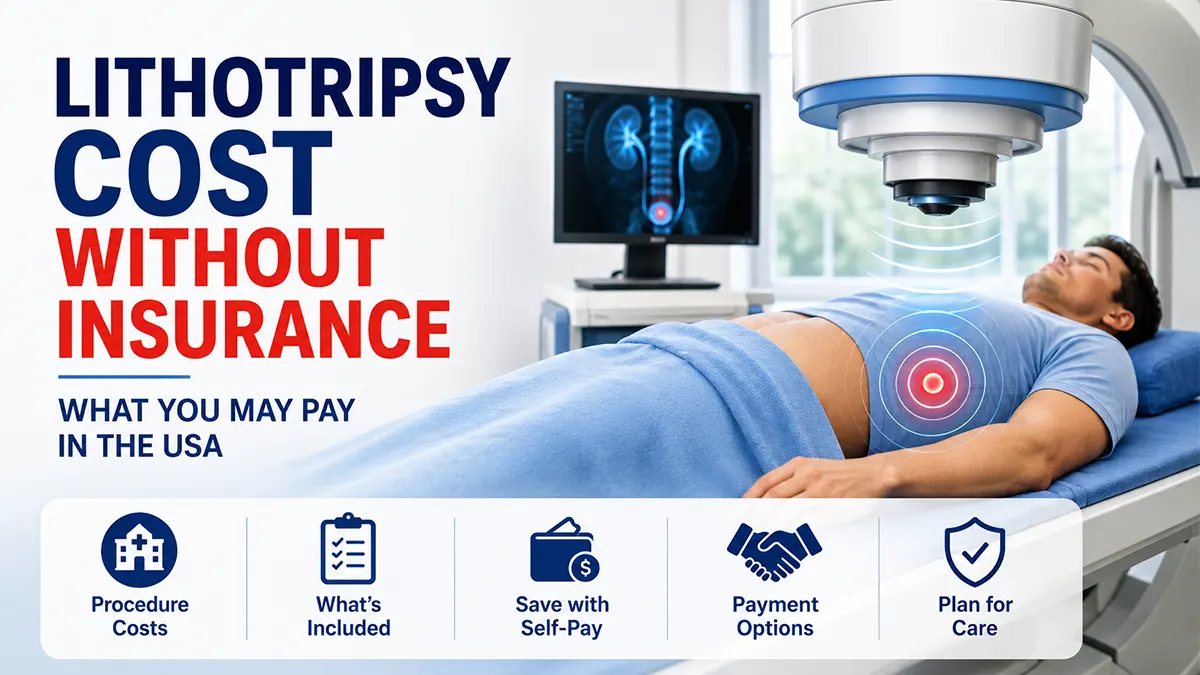
Lithotripsy cost without insurance can vary significantly depending on the type of lithotripsy, kidney stone size and location, hospital or surgery center, geographic area, anesthesia, imaging, and whether additional procedures are required.
For uninsured patients in the United States, shock wave lithotripsy (SWL), also called extracorporeal shock wave lithotripsy (ESWL), may cost roughly $2,500 to $10,000 or more before discounts or financial assistance. Some patients may receive lower self-pay rates, while complex cases or hospital-based treatment can cost considerably more.
The amount you actually pay is not determined by the lithotripsy procedure alone. Your bill may also include the urologist’s fee, facility charges, anesthesia, diagnostic imaging, laboratory testing, medications, ureteral stent placement, and follow-up care.
If you do not have health insurance, asking the healthcare provider for a written self-pay or cash estimate before treatment can help you understand your expected expenses.
Table of Contents
Quick Answer: How Much Does Lithotripsy Cost Without Insurance?
The lithotripsy cost without insurance in the United States can range from several thousand dollars to more than $10,000, depending on the procedure and healthcare setting.
For shock wave lithotripsy, an uninsured patient may commonly encounter an estimated total cost of approximately $2,500 to $10,000 or more.
However, this is only a general planning range.
Your actual self-pay price can be affected by:
- Type of lithotripsy
- Kidney stone size
- Number of stones
- Stone location
- Hospital versus ambulatory surgery center
- Geographic location
- Urologist fees
- Anesthesia or sedation
- Imaging requirements
- Laboratory tests
- Ureteral stent placement
- Number of treatment sessions
- Follow-up imaging
- Complications or additional procedures
A lower advertised procedure price does not necessarily represent the final amount you will owe.
Kidney Stone Treatment Cost Without Insurance: 2026 U.S. Prices, Procedures & Ways to Save
What Is Lithotripsy?
Lithotripsy is a group of procedures used to break kidney stones or urinary tract stones into smaller pieces so they can pass through the urinary system or be removed more easily.
The word lithotripsy comes from terms meaning stone crushing or stone breaking.
One of the most commonly recognized forms is extracorporeal shock wave lithotripsy (ESWL). It uses externally generated shock waves to break a kidney stone into smaller fragments.
Other stone treatments may use a laser or other instruments to break and remove stones from inside the urinary tract.
The appropriate treatment depends on the stone’s size, location, composition, symptoms, anatomy, kidney function, and other clinical factors.
Types of Lithotripsy and Their Costs
The phrase “lithotripsy” can refer to different treatments. Therefore, comparing prices requires knowing exactly which procedure your urologist recommends.
1. Shock Wave Lithotripsy (SWL/ESWL)
Shock wave lithotripsy is a non-invasive or minimally invasive treatment that uses focused shock waves from outside the body to fragment a stone.
The patient may receive pain medication, sedation, or anesthesia depending on the facility and clinical circumstances.
Typical uninsured cost
A broad planning estimate for uninsured patients is approximately:
$2,500 to $10,000 or more
The final price can be lower or higher depending on the provider, location, facility, and services included.
SWL may be performed in a hospital or outpatient setting.
Latest Kidney Stone Treatment Options in 2026 (USA Guide)
2. Laser Lithotripsy
Laser lithotripsy is generally performed during a procedure called ureteroscopy.
A urologist passes a small scope through the urinary tract to reach the stone. A laser can then fragment the stone into smaller pieces, which may be removed using specialized instruments.
The cost may be higher than some shock wave procedures because it can involve:
- Operating room or procedure-room charges
- Anesthesia
- Urologist fees
- Ureteroscopy
- Laser equipment
- Stone extraction
- Ureteral stent placement
- Recovery and follow-up care
For uninsured patients, the total bill can vary substantially, so requesting a bundled self-pay estimate is particularly important.
3. Percutaneous Nephrolithotomy
Large or complicated kidney stones may require percutaneous nephrolithotomy (PCNL) rather than standard lithotripsy.
PCNL involves creating a small access tract through the skin into the kidney so the urologist can remove larger stones.
Because this is a more involved procedure, the cost can be significantly higher than straightforward SWL.
Patients should not assume that a price quoted for ESWL applies to PCNL.
What Is Included in the Lithotripsy Cost?
One of the biggest problems with comparing healthcare prices in the United States is that different providers may include different services in their estimates.
For example, one facility may advertise the procedure fee while another provides a more comprehensive package.
Your total bill may include several separate components.
Urologist’s Fee
The urologist performs or supervises the procedure and may charge a professional fee.
This may be billed separately from the facility.
Facility Fee
Hospitals and ambulatory surgery centers may charge a facility fee for use of the treatment area, equipment, staff, recovery area, and other resources.
Anesthesia or Sedation
Depending on the type of lithotripsy, you may receive:
- Local anesthesia
- IV sedation
- General anesthesia
- Pain medication
Anesthesia charges may be separate from the procedure fee.
Imaging
Imaging may be necessary before treatment to determine the stone’s size and location.
Depending on the case, this could involve:
- Ultrasound
- X-ray
- CT scan
- Other urinary tract imaging
Some patients may also need imaging after treatment to determine whether fragments remain.
Laboratory Testing
Your provider may order blood or urine tests before treatment.
These could include tests related to kidney function, infection, blood counts, or urine analysis.
Ureteral Stent
Some patients require a temporary ureteral stent.
A stent is a small flexible tube that helps urine drain from the kidney to the bladder.
If a stent is inserted or later removed, additional charges may apply.
Follow-Up Care
Follow-up appointments and imaging may add to the overall cost.
Ask whether these services are included in your original self-pay estimate.
Kidney Stone Treatment Without Surgery – Effective Non-Surgical Options
Factors That Affect Lithotripsy Cost Without Insurance
There is no single nationwide price for lithotripsy.
Several factors can substantially change the final bill.
1. Type of Procedure
SWL, ureteroscopy with laser lithotripsy, and PCNL are different procedures with different equipment, staffing, anesthesia, and facility requirements.
2. Size of the Kidney Stone
Larger stones may require more treatment or a different procedure.
A small stone that can be treated during one session may cost less than a large or complex stone requiring multiple interventions.
3. Location of the Stone
A stone located in the kidney may be treated differently from a stone lodged in the ureter.
The stone’s location can influence which procedure is most appropriate.
4. Number of Stones
Treating several stones can require additional procedure time and, in some cases, more than one treatment session.
5. Geographic Location
Healthcare prices can vary considerably across the United States.
Treatment in a major metropolitan area may have a different self-pay price from treatment in a smaller community.
Even facilities within the same city can charge different amounts.
6. Hospital vs. Ambulatory Surgery Center
The location where treatment is performed can affect the total cost.
An outpatient or ambulatory surgery center may have a different pricing structure from a hospital.
However, the cheapest advertised facility is not necessarily the most appropriate option for every patient.
7. Anesthesia
The type and duration of anesthesia can influence the total bill.
Ask whether anesthesia is included in the quoted price.
8. Additional Procedures
If a patient needs ureteral stent placement, stone extraction, ureteroscopy, or another intervention, the final cost may increase.
9. Follow-Up Treatment
Not every stone is completely cleared after one treatment.
Residual fragments may require monitoring or additional treatment.
Lithotripsy Cost Without Insurance by Treatment Type
The following figures are general self-pay planning estimates, not guaranteed prices.
| Treatment | Possible Uninsured Cost Range |
|---|---|
| Shock wave lithotripsy (SWL/ESWL) | Approximately $2,500–$10,000+ |
| Ureteroscopy with laser lithotripsy | Often several thousand dollars and can exceed $10,000 |
| Percutaneous nephrolithotomy (PCNL) | Often substantially higher than uncomplicated SWL |
| Imaging and laboratory tests | Additional |
| Anesthesia | Additional or bundled, depending on facility |
| Ureteral stent | Additional or bundled |
| Follow-up imaging | Additional |
Important: These ranges are intended for general financial planning. Healthcare prices differ by provider, region, procedure complexity, and services included.
Always request a patient-specific estimate before scheduling treatment.
Why Hospital Bills Can Be Higher Than Advertised Prices
A patient may search online for “ESWL cost” and find a relatively low price.
However, that number may represent only one component of the healthcare bill.
For example, a quoted procedure price might exclude:
- Physician charges
- Anesthesia
- Facility fees
- Imaging
- Blood tests
- Urine testing
- Stent placement
- Medications
- Follow-up appointments
- Additional procedures
This is why uninsured patients should ask for a total self-pay estimate rather than simply asking for the procedure price.
A useful question is:
“What is the estimated total amount I would pay out of pocket, including the physician, facility, anesthesia, imaging, and expected follow-up?”
How to Get a Lower Lithotripsy Cost Without Insurance
Being uninsured does not necessarily mean you must accept the first price you receive.
There are several practical steps that may help reduce your out-of-pocket expense.
Ask for the Self-Pay Price
Tell the provider that you are uninsured and ask specifically for their cash-pay or self-pay rate.
The standard billed charge may be different from the amount offered to self-pay patients.
Request an Itemized Estimate
Ask for a written estimate showing individual charges.
Ideally, the estimate should identify:
- Procedure
- Facility
- Urologist
- Anesthesia
- Imaging
- Laboratory testing
- Stent-related services
- Follow-up care
Compare Multiple Facilities
If your urologist says outpatient treatment is medically appropriate, ask whether treatment is available at more than one facility.
You can compare estimates from:
- Hospitals
- Ambulatory surgery centers
- Independent urology centers
Do not choose a facility based solely on price. The provider should be appropriately equipped for your medical needs.
Ask About Prompt-Pay Discounts
Some healthcare providers offer discounts when uninsured patients pay the bill promptly.
Policies vary, so ask before treatment.
Ask About Payment Plans
If paying the entire amount at once is difficult, ask whether the facility offers an interest-free or low-cost payment plan.
Ask About Financial Assistance
Some hospitals have financial assistance programs for eligible patients.
Eligibility can depend on household income, family size, location, and the hospital’s policies.
Check for Charity Care
Nonprofit hospitals may have financial assistance policies that can reduce or eliminate some eligible medical charges for qualifying patients.
Ask the hospital’s financial counseling department whether you qualify.
Questions to Ask Before Scheduling Lithotripsy
Before agreeing to treatment, consider asking the provider the following questions:
- What type of lithotripsy do I need?
- What is the total self-pay price?
- Does the estimate include the urologist’s fee?
- Does it include the facility fee?
- Is anesthesia included?
- Are imaging and laboratory tests included?
- Will I need a ureteral stent?
- If a stent is needed, is that included?
- Are follow-up appointments included?
- Is follow-up imaging included?
- What happens financially if the procedure does not completely break the stone?
- Could I need another procedure?
- Is there a cash-pay discount?
- Does the facility offer a payment plan?
- Is financial assistance available?
Getting answers in writing can prevent unexpected bills.
Does Insurance Affect Lithotripsy Cost?
Yes.
When a patient has health insurance, the amount they personally pay can depend on:
- Deductible
- Copayment
- Coinsurance
- Out-of-pocket maximum
- Network status
- Prior authorization
- Facility participation
- Physician participation
An uninsured patient does not have these insurance-negotiated protections and may therefore need to negotiate or request a self-pay rate directly with the provider.
If you have recently lost insurance, ask whether you may qualify for a new health plan or other coverage before scheduling a non-emergency procedure.
Is Lithotripsy Always Necessary for Kidney Stones?
No.
Not every kidney stone requires lithotripsy.
Some smaller stones may pass naturally without a procedure, depending on their size, location, symptoms, and the patient’s medical situation.
A doctor may recommend observation, medication, lithotripsy, ureteroscopy, or another treatment based on the individual case.
The decision should consider more than cost.
Important factors include:
- Stone size
- Stone location
- Pain severity
- Urinary obstruction
- Infection
- Kidney function
- Stone composition
- Previous stone history
- Patient anatomy
- Likelihood of spontaneous passage
How Lithotripsy Works
During shock wave lithotripsy, the patient is positioned so that the stone can be targeted accurately.
A machine generates focused shock waves that travel through the body toward the stone.
The energy is directed at the stone repeatedly to break it into smaller fragments.
The resulting fragments may then pass through the urine.
Depending on the stone and treatment response, more than one procedure may sometimes be necessary.
What Happens After Lithotripsy?
After SWL, patients may experience:
- Mild to moderate discomfort
- Blood in the urine
- Bruising
- Urinary urgency
- Pain as stone fragments pass
Your healthcare provider may recommend drinking an appropriate amount of fluid and using prescribed or recommended pain medication.
You may also be asked to strain your urine to collect stone fragments for analysis.
Follow-up imaging may be recommended to determine whether the stone has been adequately treated.
Recovery After Lithotripsy
Recovery varies according to the procedure and individual health.
Many patients undergoing outpatient shock wave lithotripsy can return home the same day.
However, the body may need time to pass the fragmented stone material.
You may experience intermittent discomfort during this period.
Your doctor should provide specific instructions regarding:
- Activity
- Fluid intake
- Pain control
- Medications
- Follow-up appointments
- Warning signs
- Returning to work or normal activities
Recovery after ureteroscopy or PCNL can be different from recovery after SWL.
When to Seek Urgent Medical Care
Kidney stones can occasionally cause complications.
Seek prompt medical attention if you develop symptoms such as:
- Fever or chills
- Severe or worsening pain
- Persistent vomiting
- Difficulty urinating
- Very little urine
- Fainting or severe weakness
- Signs of infection
- Heavy or persistent bleeding
A blocked urinary tract combined with infection can be a medical emergency.
Do not delay urgent care because you are concerned about the cost.
Lithotripsy vs. Other Kidney Stone Treatments
Lithotripsy is only one option for treating urinary stones.
Shock Wave Lithotripsy
Advantages may include:
- No surgical incision
- Usually outpatient
- Uses external shock waves
- Recovery can be relatively quick
Limitations may include:
- Some stones respond poorly
- Stone fragments may remain
- Multiple treatments may be necessary
- Effectiveness depends on stone characteristics
Ureteroscopy With Laser Lithotripsy
This approach allows the urologist to directly reach the stone and break it with a laser.
It may be useful for stones that are less suitable for SWL.
However, it is a more invasive procedure and commonly involves anesthesia.
Percutaneous Nephrolithotomy
PCNL is generally used for larger or more complex kidney stones.
It is more invasive than SWL but can provide effective treatment for appropriately selected large stones.
The best treatment is not necessarily the cheapest treatment. It is the option that is medically appropriate for the patient’s stone and overall health.
Can Kidney Stones Be Prevented?
After a kidney stone, prevention is an important part of long-term care.
Your doctor may recommend changes based on your stone type and medical history.
General measures may include:
- Drinking enough fluids
- Following an appropriate dietary pattern
- Limiting excessive sodium
- Maintaining a healthy body weight
- Avoiding excessive intake of certain foods when medically appropriate
- Taking prescribed preventive medication when indicated
- Completing a metabolic evaluation for recurrent stones
The correct diet can vary depending on the type of kidney stone.
For example, prevention strategies for calcium oxalate stones may differ from those used for uric acid stones.
Do not make major dietary restrictions without discussing them with a healthcare professional.
How to Compare Lithotripsy Prices in the USA
When comparing prices, do not simply compare two numbers labeled “ESWL cost.”
Instead, ask each provider for the same information.
For example:
Facility A
- Procedure: Included
- Urologist: Included
- Anesthesia: Included
- Imaging: Included
- Follow-up: Included
- Stent: Additional
Facility B
- Procedure: Included
- Urologist: Separate
- Anesthesia: Separate
- Imaging: Separate
- Follow-up: Separate
- Stent: Separate
Facility B may initially appear cheaper even though the final bill could be higher.
A bundled self-pay estimate makes comparisons more meaningful.
How Much Should You Budget for Lithotripsy Without Insurance?
If you are planning financially for shock wave lithotripsy, a reasonable starting point is to investigate providers within the broad range of $2,500 to $10,000 or more.
However, do not assume that you will pay the midpoint of that range.
Your actual amount could be influenced by:
Procedure + physician + facility + anesthesia + testing + additional treatment + follow-up
The safest approach is to obtain a written estimate based on your specific diagnosis.
If your stone is large or complicated, ask your urologist whether another treatment may be more appropriate and what the estimated self-pay cost would be.
Frequently Asked Questions
What is the average lithotripsy cost without insurance?
There is no single national average because prices vary substantially. For shock wave lithotripsy, uninsured patients may encounter costs of approximately $2,500 to $10,000 or more, depending on location, facility, stone characteristics, anesthesia, and services included.
Is lithotripsy cheaper at a surgery center than a hospital?
It can be, particularly when an outpatient procedure is appropriate, but prices vary. Ask both facilities for a complete self-pay estimate before comparing.
Does the lithotripsy price include anesthesia?
Not always. Anesthesia may be billed separately or included in a bundled estimate. Always ask the provider.
Can uninsured patients negotiate lithotripsy costs?
Sometimes. Healthcare providers may offer self-pay discounts, prompt-payment discounts, financial assistance, or payment plans. Policies differ by facility.
Can a kidney stone pass without lithotripsy?
Yes. Some stones pass naturally, particularly smaller stones. However, the likelihood depends on factors such as stone size and location. Your healthcare provider can determine whether observation is appropriate.
How many lithotripsy sessions are needed?
Some stones can be treated with one session, while others may require additional treatment. The number depends on the stone’s size, location, composition, and response to treatment.
Does lithotripsy remove the entire kidney stone?
Shock waves break the stone into smaller fragments rather than physically removing the entire stone at once. The fragments generally pass through the urinary tract.
Is lithotripsy painful?
Some patients experience discomfort during or after treatment. Pain control and sedation options vary depending on the procedure and facility.
Does lithotripsy require hospitalization?
Shock wave lithotripsy is commonly performed as an outpatient procedure, although individual circumstances can differ. More complex stone procedures may require a different level of care.
What should I ask for if I do not have insurance?
Ask for a written, itemized self-pay estimate covering the procedure, physician, facility, anesthesia, testing, stent-related services, and follow-up care.
Key Takeaways
The lithotripsy cost without insurance in the United States can be several thousand dollars and may reach $10,000 or more, particularly when multiple services or complex treatment are involved.
The most important points to remember are:
- Shock wave lithotripsy may cost approximately $2,500–$10,000+ for uninsured patients.
- Prices vary considerably across the United States.
- The advertised procedure price may not represent your total bill.
- Physician, facility, anesthesia, imaging, laboratory, and follow-up charges may be separate.
- A ureteral stent or additional procedure can increase the total cost.
- Ask for a written self-pay estimate before treatment.
- Compare complete estimates rather than individual procedure prices.
- Ask about cash discounts, financial assistance, and payment plans.
- Treatment choice should be based on medical suitability as well as cost.
- Seek urgent medical attention for severe pain, fever, chills, inability to urinate, or other concerning symptoms.
If you are uninsured and have been advised to undergo lithotripsy, speaking directly with the urology office’s financial counselor can help you understand your expected out-of-pocket cost before treatment.
Medical Disclaimer
This article is for general educational and informational purposes only and should not be considered medical advice, diagnosis, or a substitute for consultation with a qualified healthcare professional. Lithotripsy may not be appropriate for every kidney stone. Treatment decisions should be made with a qualified urologist based on the stone’s size, location, symptoms, medical history, and other individual factors. Healthcare costs are estimates and can vary substantially by provider, location, facility, and services included.
Sources and References
- National Institute of Diabetes and Digestive and Kidney Diseases (NIDDK): Kidney Stones and treatment information.
- NIDDK: Cystoscopy and Ureteroscopy.
- FAIR Health Consumer: Healthcare cost estimates for uninsured patients.
- FAIR Health Consumer: Negotiating medical costs and comparing provider charges.
- FAIR Health Consumer: Total treatment cost estimates.
- OpenDoc: Current direct-pay urology pricing references for kidney stone evaluation, ESWL and ureteroscopy.
Editorial Cost Note
Healthcare prices can change and vary substantially by state, city, provider, facility and clinical complexity. The ranges in this article are intended for general 2026 U.S. cost planning, not as medical quotes or guarantees. A provider’s written self-pay estimate should be considered more relevant to an individual patient’s expected bill than a national or internet-based estimate.
Author
Yamanandan Reddy
Health Content Writer & Frontend Developer
Yamanandan Reddy is a health content writer and frontend developer with over 4 years of experience in website design and digital content creation. He writes research-based health articles to help readers understand symptoms, causes, treatments, and prevention methods related to common health conditions.
His articles are written using information from trusted medical sources such as the World Health Organization (WHO), Mayo Clinic, and the Centers for Disease Control and Prevention (CDC).
Sources
The information in this article is researched and verified using trusted medical resources, including:
• World Health Organization (WHO)
• Mayo Clinic
• National Institutes of Health (NIH)
• Centers for Disease Control and Prevention
1 thought on “Lithotripsy Cost Without Insurance: What You May Pay in the USA”