
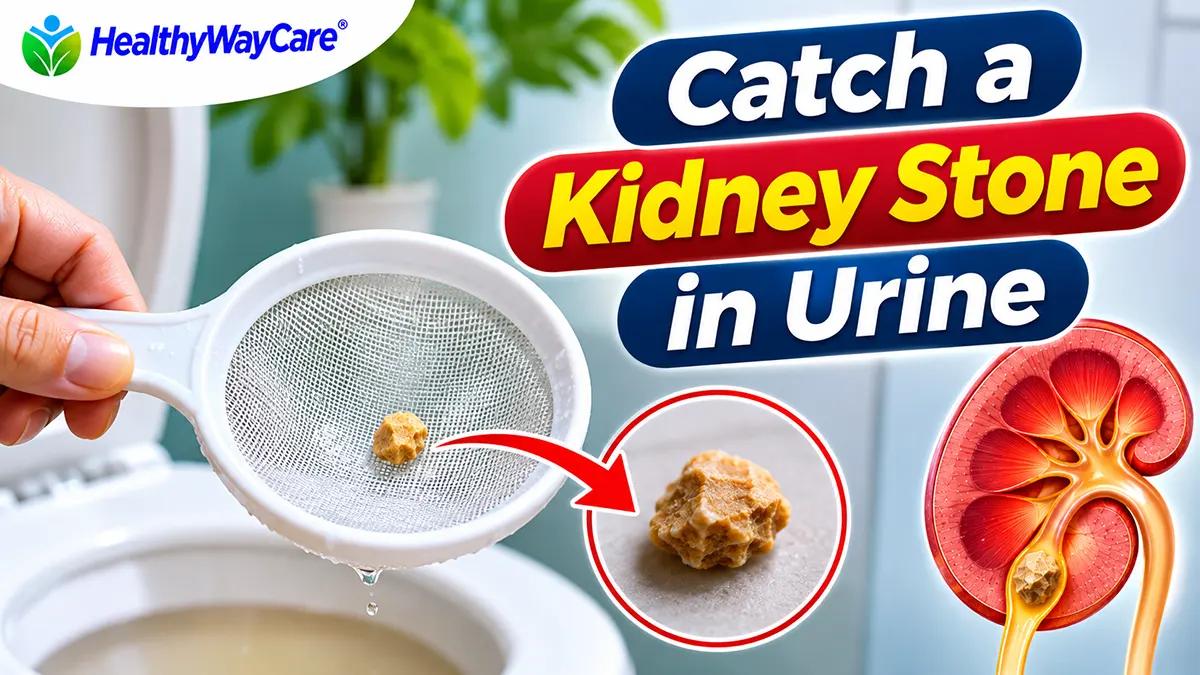
Wondering how to catch a kidney stone in urine? If you have been told that a stone may pass on its own, your doctor might ask you to save it for testing. That sounds straightforward until you are standing in the bathroom wondering what equipment to use, how small a stone can be, and what to do with the fragment afterward. This guide walks through the process in practical steps, explains common mistakes, and tells you when collecting a stone should take a back seat to getting medical care.
Table of Contents
Quick answer: how to catch a kidney stone in urine
If your healthcare professional has asked you to collect a kidney stone, urinate through a clean, fine-mesh stone strainer every time you use the bathroom until your care team tells you to stop. Check the mesh for tiny grains or fragments, transfer any suspected stone to the clean specimen container provided by your clinic, and follow the laboratory’s instructions for drying, storage, and delivery. Do not assume that pain disappearing proves the stone has passed.
A passed stone can be smaller than a grain of rice and easy to miss. The goal is not to collect a large amount of urine. It is to recover the solid fragment so a laboratory can identify its mineral composition. This can help your clinician personalize prevention advice rather than guessing what type of stone you had.
Get urgent medical care if you have fever or chills with suspected stone symptoms, cannot urinate, develop uncontrolled pain, or have persistent vomiting or signs of dehydration. A stone causing obstruction with infection is an emergency. Do not delay care while trying to collect a sample.
Why catching a kidney stone matters
Kidney stones are hard deposits made from minerals and other substances in urine. Different stone types may look similar to the naked eye. A brown or yellow fragment is not automatically a calcium oxalate stone, and a pale fragment is not necessarily uric acid. Color, shape, and texture are unreliable ways to determine composition.
When a stone is retrieved, a laboratory can use methods such as infrared spectroscopy or X-ray diffraction to identify its components. The 2026 European Association of Urology (EAU) guideline recommends stone analysis for first-time stone formers and repeat analysis in selected situations, including recurrence despite preventive treatment. The result may inform whether your doctor investigates urinary calcium, oxalate, citrate, uric acid, infection, or rare inherited conditions.
For example, calcium oxalate stones, uric acid stones, infection-related struvite stones, and cystine stones can require different prevention strategies. A sample therefore may be useful even when the pain has stopped. It does not replace medical assessment, and it cannot by itself tell you whether another stone remains in the urinary tract.
What you need before you start
A purpose-made stone strainer: Ask your urologist, emergency department, clinic, or pharmacy for a urine stone strainer. Some clinics provide a small funnel with fine mesh. If you cannot obtain one immediately, call your care team for an approved alternative rather than relying on a kitchen sieve that may not be clean or fine enough.
A specimen container: Ideally use the labeled, clean container supplied by your clinic or laboratory. Some laboratories request that a recovered stone be dry and sent without liquid; others give different handling instructions. Follow your receiving laboratory’s written requirements instead of assuming one storage method works everywhere.
Clean hands and a practical setup: Keep the strainer and container accessible in the bathroom or in a travel pouch. Good lighting and a white background can make small fragments easier to spot. If you have trouble handling the equipment, ask someone you trust or your clinic about a workable collection method.
Step-by-step: using a kidney stone strainer
Step 1 — Confirm the plan. Ask your healthcare professional whether you should strain every urination, how long to continue, and how to return a sample. Instructions can vary after emergency-department visits, ureteroscopy, or lithotripsy. If you have been told to use a particular collection kit, follow those instructions.
Step 2 — Wash your hands. Prepare the strainer before you feel the urge to urinate. Position it securely over a toilet, collection cup, or other clean setup as directed. The aim is to let urine pass through while the mesh retains any solid particles.
Step 3 — Strain the entire urine stream. Small fragments can appear at any point during urination. Keep the strainer in place throughout the stream if it is safe and practical. If you are using a urine collection cup first, pour the urine through the strainer carefully, avoiding spills. Do not place a dirty strainer in a sterile laboratory cup.
Step 4 — Inspect the mesh. After the urine drains, look for a hard speck, grain, or fragment. A stone may resemble sand, a tiny pebble, or an irregular crystal. Blood clots and ordinary debris can also appear in urine, so visual inspection cannot confirm what a particle is.
Step 5 — Transfer a suspected fragment. Use the clean technique described by your clinic. A clean, dry utensil or gentle tipping of the strainer may help. Avoid crushing, scraping, washing with soap, or applying chemicals to the specimen. If you are uncertain whether a particle is a stone, save it and ask the lab or clinician.
Step 6 — Label and store the specimen. Follow the laboratory’s instructions. Record the date the fragment was recovered and any relevant details your clinic requests. Do not add tap water, alcohol, or preservatives unless the receiving lab specifically instructs you to do so.
Step 7 — Contact your care team. Tell them you recovered a possible stone and ask how to submit it for analysis. Do not stop a prescribed medication or cancel follow-up imaging solely because you found a fragment. A person can pass one stone while another remains.
| Action | Do | Avoid |
|---|---|---|
| During urination | Use the prescribed fine-mesh stone strainer each time | Assuming a single strain is enough |
| When you see a speck | Save possible stone fragments for the laboratory | Deciding stone type from appearance |
| Specimen storage | Follow the receiving lab’s instructions | Adding water, soap, or preservatives without instructions |
| After pain improves | Attend recommended follow-up | Assuming the urinary tract is definitely clear |
What does a passed kidney stone look like?
A kidney stone can be tan, yellow, brown, dark, or pale. It may be smooth or jagged, and a passed fragment can be only a millimeter or two across. Some people notice one distinct pebble; others see multiple sand-like grains. A small speck may be easy to overlook, particularly in a dark toilet bowl or without a strainer.
Appearance alone does not establish stone type. Food particles, sediment, blood clots, and medication-related material may be mistaken for stones. If you find something unusual, do not panic or try to diagnose it at home. Save it when possible and let a laboratory assess it.
Not every stone passes intact. A stone may break into fragments, particularly after a procedure. Recovering one piece can still be useful for composition analysis, although the laboratory may have specimen-size requirements. Ask whether multiple fragments should be placed together or packaged separately.
How long should you keep straining your urine?
There is no one-size-fits-all number of days. Your clinician may ask you to strain urine while a ureteral stone is expected to pass, after a procedure that produces fragments, or until a follow-up appointment. The appropriate duration depends on the stone’s location, size, your symptoms, and whether imaging has confirmed passage.
It is common to want to stop once the pain improves. However, a reduction in pain does not reliably prove that the stone has left the ureter. Some people have intermittent symptoms, and obstruction may occasionally persist despite little pain. The EAU guideline emphasizes confirming stone passage and return of baseline renal function.
If you are still straining without finding anything, contact your care team rather than extending observation indefinitely on your own. A clinician may recommend ultrasound, CT, or other follow-up based on the clinical situation. If you have a solitary kidney, impaired kidney function, pregnancy, or signs of infection, the plan may be more urgent and individualized.
What if you cannot catch the kidney stone?
Missing a stone is common and does not mean you did anything wrong. The fragment may have been extremely small, passed during an unstrained bathroom visit, or been overlooked. It is also possible that the stone has not passed. The next step depends on symptoms and your doctor’s original diagnosis.
Contact your clinician to explain that you did not recover a specimen. Ask whether follow-up imaging or laboratory testing is needed to confirm passage. If you have persistent flank pain, urinary symptoms, or new symptoms, mention them. Never use the absence of visible fragments as proof that no stone exists.
If no stone is available for analysis, your clinician may still assess risk factors using medical history, blood tests, urinalysis, and sometimes 24-hour urine testing. In selected cases, imaging features may provide clues, but imaging is not the same as a laboratory stone-composition report.
How to store a kidney stone for laboratory testing
The most important rule is to follow the exact specimen instructions from the receiving laboratory. Many stone-analysis services prefer a dry specimen in a clean container and do not want formalin or other preservatives, but requirements vary by test and laboratory. Call before mailing a sample if instructions are unclear.
Keep the recovered fragment from being lost or mixed with other material. Avoid using a wet tissue as the final storage container because the stone may stick to fibers or be discarded accidentally. Do not grind the stone into powder. If the clinic gave you a small container, use that container as directed.
Include the requested identification and collection information on the outer container or requisition, not directly on the stone. Ask whether you need a physician’s order, whether the laboratory accepts samples brought from home, and whether insurance covers stone analysis. In the United States, coverage and out-of-pocket charges depend on the health plan and lab network.
| Situation | Practical next step | Why it matters |
|---|---|---|
| You found one tiny fragment | Save it using lab instructions and contact your clinic | Even a small sample may be analyzable |
| You found several fragments | Ask whether to submit together or separately | Samples may represent different stones or procedural fragments |
| You saw sand-like particles | Collect what you can without contamination | The laboratory determines whether material is suitable |
| You found nothing | Ask whether passage needs imaging confirmation | Symptoms alone do not confirm stone clearance |
| You have fever or cannot urinate | Seek urgent medical evaluation | Possible infection or obstruction needs prompt assessment |
What does the laboratory do with your stone?
The laboratory examines the recovered material and identifies the minerals present. Common categories include calcium oxalate, calcium phosphate, uric acid, struvite, and cystine. Some stones contain more than one component. The report may list a mixture with percentages describing composition, not the percentage chance that another stone will develop.
For example, a report that identifies calcium oxalate and calcium phosphate tells the clinician about the material in the submitted stone. It does not automatically reveal the exact dietary cause, whether the stone passed completely, or which medicine you should take. Interpretation requires your clinical history and, when indicated, additional urine or blood testing.
The EAU guideline identifies infrared spectroscopy and X-ray diffraction as preferred analytical methods. Ask your clinician to explain the results in plain language and how they affect your prevention plan. If the report is unclear, request the actual lab document rather than relying on a brief phone summary.
Flomax for Kidney Stones: Does Tamsulosin Help Stones Pass?
Kidney stone analysis versus a 24-hour urine test
These two tests answer different questions. Stone analysis tells you what the recovered stone is made of. A 24-hour urine test measures substances and urine volume that may contribute to stone formation. A clinician may use both, especially if stones recur or there are risk factors for future stones.
A 24-hour urine collection is not the same as straining urine to catch a stone. For the 24-hour test, you collect urine over a specified period into a special container, often with detailed storage instructions. For stone collection, the goal is to retain the solid material while the urine passes through a strainer.
If your doctor orders both, ask for separate instructions. Do not place a stone in a 24-hour urine collection container unless the laboratory specifically tells you to. Mixing collection methods could compromise the test or cause the fragment to be lost.
| Test | What it measures | What it cannot prove |
|---|---|---|
| Stone composition analysis | Minerals in the recovered fragment | That no other stones remain |
| 24-hour urine test | Urine volume and stone-related substances | The composition of a stone you did not collect |
| Ultrasound or CT | Stone location, obstruction, or other anatomy | Exact mineral composition in every case |
| Urinalysis / urine culture | Blood, infection markers, or bacteria | Whether a particular stone has passed completely |
Can you catch a stone after lithotripsy or ureteroscopy?
Yes, some patients are instructed to strain urine after shock wave lithotripsy or certain ureteroscopic procedures because small fragments may pass later. However, the correct plan depends on the procedure and your surgeon’s instructions. Not every patient needs to strain urine after every intervention.
If you have a ureteral stent, you may experience urgency, frequency, or discomfort. Those symptoms can overlap with stone-related symptoms. Follow your discharge instructions for medications, activity, hydration, stent removal, and follow-up. Do not pull on a stent string or change your medication because you think a fragment has passed.
After lithotripsy, several small fragments may pass over time. Save samples only as instructed. If you develop fever, worsening pain, inability to urinate, or persistent vomiting, contact your surgical team urgently or seek emergency care. A cluster of fragments can sometimes obstruct urine flow and needs assessment.
Can you use a coffee filter or household strainer?
A purpose-made urine stone strainer is preferable because it is designed to retain small fragments and can be handled more cleanly. Household items may have holes that are too large, may shed fibers, or may contain detergent residue. A coffee filter may clog or tear, making collection frustrating and increasing the chance of losing a sample.
If a medical strainer is unavailable, ask your clinic or pharmacist for an appropriate substitute. Do not delay urgent evaluation to shop for supplies. For a person already being monitored for an uncomplicated stone, the clinic can help you decide whether a temporary alternative is reasonable.
In the United States, stone strainers may be available through a urology office, emergency department, medical-supply store, or pharmacy. Availability and cost vary, so call ahead if you need one immediately.
How much water should you drink while waiting to pass a stone?
Good hydration is part of many long-term stone-prevention plans, but forcing large volumes of water during an acute painful episode does not reliably push an obstructing stone out faster. Drink normally according to thirst and your clinician’s advice, and avoid dehydration. Individual fluid restrictions may apply if you have heart, kidney, or other medical conditions.
If nausea or vomiting prevents you from keeping fluids down, seek medical advice promptly. Do not attempt to treat severe pain or possible infection by drinking excessive water. The correct management may require medication, imaging, or a procedure rather than home measures.
Once the acute episode has resolved, your clinician may discuss a long-term fluid goal to reduce future stones. That prevention goal is different from managing an active obstruction. Ask what urine-output target is appropriate for you and whether you need individualized dietary advice.
When to seek urgent medical care instead of waiting
Call your healthcare team promptly or seek emergency care for fever or shaking chills with suspected kidney stone symptoms, severe or uncontrolled pain, inability to urinate, persistent vomiting, or signs of dehydration. Infection behind a blocked ureter can become life-threatening and needs urgent treatment.
You should also seek timely evaluation if you have one functioning kidney, known kidney impairment, pregnancy, or worsening symptoms. People who are pregnant should contact their obstetric care team for new severe abdominal or flank pain. Children and medically vulnerable adults may need different thresholds for evaluation.
If you feel faint, confused, extremely weak, or seriously unwell, seek emergency help. In the United States, call 911 for an immediate emergency. Saving a stone for analysis is useful, but it is never more important than treating a potentially dangerous obstruction or infection.
After you catch a stone: what to ask your urologist
Bring the specimen and a short record of your symptoms to the appointment. Useful questions include: Did imaging show one stone or several? Does the stone need laboratory analysis? How will we confirm the ureter is clear? Do I need blood tests or a 24-hour urine evaluation? What should I do if pain returns?
Ask whether your stone type changes your dietary advice. For many people, the basics include adequate fluids and attention to sodium intake, but not all stone types are managed the same way. Avoid eliminating calcium or starting supplements based on internet advice alone; the right approach depends on the stone and your medical history.
If you are prescribed medication, ask about its purpose, expected duration, side effects, and when to stop or seek help. A stone strainer is a collection tool, not a treatment. It helps recover evidence that can guide prevention, but it cannot relieve a blockage or replace follow-up.
Practical checklist for your next bathroom visit
Keep your clean strainer where you can reach it before urinating. Have the laboratory container and collection instructions nearby. Strain the full stream if advised, inspect the mesh in good light, and save any suspected hard fragment. Write down the collection date, then ask your clinic how to submit the specimen.
If nothing appears, continue only for the period your clinician recommends. Do not assume you have failed or that the stone is gone. The important outcome is safe follow-up and, when possible, identification of stone composition so you can make an informed prevention plan.
For readers searching “how to catch a kidney stone in urine,” the simplest answer is also the most useful: use the right strainer, save the solid fragment without contaminating it, follow your lab’s instructions, and keep your medical follow-up.
Frequently asked questions
Can I see a kidney stone when I pee?
Sometimes. A stone may look like a small pebble, crystal, or grain of sand, but tiny fragments are easy to miss. A urine stone strainer increases the chance of collecting one.
Do I have to strain my urine every time?
If your clinician has instructed you to strain urine, generally strain every urination during the advised period. Ask how long to continue and whether any procedure-specific instructions apply.
What if my kidney stone is too small to catch?
Small fragments may pass through or be missed. Tell your clinician if you do not recover a sample. Follow-up imaging or other evaluation may be needed to confirm passage.
Should I keep a kidney stone in water?
Do not add water or other liquids unless the receiving laboratory specifically instructs you to. Many stone-analysis laboratories prefer a dry specimen, but follow the instructions for your actual test.
Can I use a regular kitchen strainer?
A medical urine stone strainer is preferable. Kitchen strainers may not be fine enough or may have contaminants. Ask a pharmacist or clinic about an appropriate alternative.
How long does it take to get stone analysis results?
Turnaround varies by laboratory, specimen handling, and the test ordered. Ask your clinic or laboratory for its current estimate rather than assuming a fixed number of days.
If I catch a stone, does that mean my kidney is clear?
Not necessarily. You may have passed one of several stones, or a fragment rather than the entire stone. Your clinician can decide whether follow-up imaging or kidney-function assessment is needed.
Do I need stone analysis after my first kidney stone?
The 2026 EAU guideline recommends stone analysis for first-time stone formers. Discuss testing with your clinician, especially if a fragment is available or you have risk factors for recurrence.
Key takeaways
To catch a kidney stone, use a purpose-made urine strainer as directed, inspect the mesh after each urination, and save suspected fragments in the container recommended by your laboratory. A small sample may be enough to help identify stone composition.
Stone analysis can support a more personalized prevention plan, but it does not confirm that the ureter is completely clear. Follow-up matters even if pain stops or you recover a stone.
Never wait for a stone to pass at home if you have fever, chills, inability to urinate, uncontrolled pain, or persistent vomiting. Those symptoms need prompt medical assessment.
Medical sources and further reading
- EAU Guidelines on Urolithiasis (2026)
- EAU Metabolic Evaluation and Recurrence Prevention
- NIDDK: Kidney Stones
- AUA: Medical Management of Kidney Stones
Editorial transparency: Prepared as a research-based patient education draft using the above clinical guidance and prescribing information. No independent physician review has been completed for this draft; arrange qualified medical review before publishing. Do not add a “medically reviewed” byline unless a named qualified reviewer has actually reviewed it. Guideline recommendations can change; confirm the latest versions during editorial review.
Disclaimer: HealthyWayCare provides general educational information, not personalized medical advice. Tamsulosin is a prescription medicine; do not start, stop, or change it based on this article. If you suspect infection with a blocked urinary tract or have other emergency warning signs, seek immediate medical attention.