
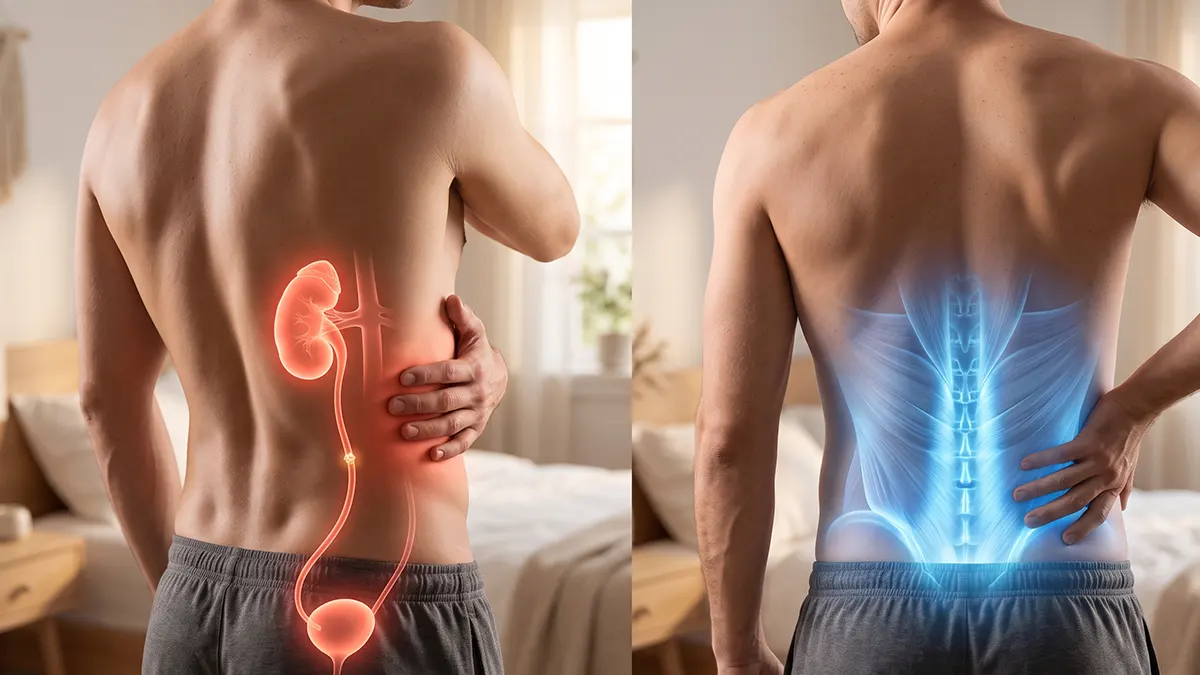
Knowing the difference between flank pain vs lower back strain can save you hours of confusion when you wake up with sudden, unexplained back pain. Many people assume every ache in their back comes from sleeping in an awkward position or lifting something heavy. However, if your morning back pain kidney stone symptoms start deep under your lower ribs on one side and come in intense waves, a stone may be moving through your urinary tract (see our visual Kidney Stone Pain Location Chart).
According to clinical data from the National Institutes of Health (NIH), kidney stones affect roughly 1 in 11 adults and trigger more than 1.2 million emergency room visits every year for acute renal colic. Because overnight dehydration concentrates your urine and slows urinary flow, early morning is one of the most common times for a kidney stone to shift into the ureter and trigger an attack.
Below, we break down how to compare flank pain vs lower back strain using five simple at-home checks, explain the three narrow “bottleneck” points where moving stones get stuck, and show you when to seek immediate medical care.
Table of Contents
Key Takeaways: Flank Pain vs Lower Back Strain
- Height on your back matters: Muscular lower back strain typically sits low across your beltline, tailbone, or hips, whereas kidney stone flank pain starts higher and deeper just under your lower rib cage on one side of your spine.
- The “Pacing vs. Stillness” test: Muscle strain hurts when you bend or twist and improves when you lie still; kidney stone pain (renal colic) does not improve with posture changes, often forcing patients to pace the room restlessly.
- Stone size does not equal pain level: Even a tiny 2- to 3-mm stone can trigger severe flank pain if it blocks urine flow and stretches the kidney capsule.
- The 85% urine clue: Roughly 85% of moving kidney stone cases involve visible or microscopic blood in the urine (hematuria), and over 50% trigger nausea or vomiting due to shared nerve pathways between the kidneys and stomach.
Kidney Stone Pain Location Chart
Why Morning Is Peak Time for a Moving Kidney Stone Attack
On Healthy Way Care, readers frequently ask why kidney stone attacks so often strike between 4:00 AM and 9:00 AM—making it easy to confuse flank pain vs lower back strain from a stiff mattress.
When you sleep for six to eight hours without drinking water, your kidneys conserve fluid and your urine volume drops (read more in our guide on Intermittent Fasting and Kidney Stone Risk). As morning approaches and your body begins moving again, concentrated urine and natural ureter contractions (peristalsis) can nudge a stone out of the renal pelvis into the narrow ureter tube.
Importantly, a kidney stone sitting quietly inside the kidney rarely causes pain. Severe pain—known medically as acute renal colic—begins the moment that stone blocks urine flow in the ureter, causing urine to back up, dilate the ureter, and stretch the sensitive outer capsule of your kidney (Cleveland Clinic).
5 Ways to Tell the Difference: Flank Pain vs Lower Back Strain
1. Exact Pain Location: Under the Ribs vs. Across the Beltline
The fastest way to evaluate flank pain vs lower back strain is to pinpoint where the pain starts on your back.
- Kidney Stone Flank Pain: Your kidneys sit higher up in your back than most people realize—tucked behind your stomach just under the bottom edge of your rib cage on either side of your spine (the costovertebral angle). Stone pain almost always starts on one side only (left or right flank) and feels deep inside your body rather than on the surface.
- Muscular Lower Back Strain: Pulled muscles or spinal disc issues usually ache lower down near the beltline (lumbar spine L1–L5), across both sides of the lower back, or over the upper buttocks.
2. Direction of Pain Radiation: Toward the Groin vs. Down the Leg
As you compare flank pain vs lower back strain, pay close attention to where the pain travels over the next one to three hours:
- Kidney Stone Flank Pain: As a stone travels down the ureter toward your bladder, the pain migrates forward and downward—from your upper flank into your side, lower abdomen, and finally into your groin, testicle (in men), or labia/pelvis (in women).
- Muscular or Spine Back Pain: Lower back muscle strain usually stays localized to the back muscles, or—if a spinal nerve like the sciatic nerve is pinched—shoots down the back of your thigh, calf, or foot. Kidney stones do not cause pain radiating down into the lower leg or foot.
Kidney Stone Pain Stages Explained (Timeline Guide)
Related Guide on Healthy Way Care: Want to see a visual map of how stone pain shifts as it moves? Explore our Kidney Stone Pain Location Chart.
3. The Posture & Movement Test (“The Pacing Sign”)
Doctors in emergency departments often distinguish flank pain vs lower back strain within seconds just by watching how a patient sits or moves:
- Kidney Stone Flank Pain: Because stone pain comes from internal ureteral spasms and pressure buildup inside the kidney capsule, no position brings relief. Patients with acute renal colic typically writhe in bed, curl up, or pace the floor unable to get comfortable.
- Muscular Lower Back Strain: Muscle pain is mechanical. Bending forward, twisting your torso, or lifting a heavy object makes it flare up, while lying flat on your back with your knees supported or applying a warm compress noticeably eases the ache.
4. Wave-Like Colic Peaks vs. Steady Muscular Stiffness
How the pain builds and fades is another classic clue in flank pain vs lower back strain:
- Kidney Stone Flank Pain: Renal colic typically starts suddenly, builds to a peak within 1 to 2 hours, and comes in intense, cramping waves (lasting 20 to 60 minutes at a time) as the ureter squeezes to push the stone forward, often over a dull background ache.
- Muscular Lower Back Strain: Morning back stiffness is usually a dull, continuous ache that feels tightest during your first 15 minutes out of bed and gradually loosens up as your muscles warm up.
5. Associated Stomach and Urinary Clues (The Vagus Nerve Link)
Ordinary back strain affects only your muscles and joints. A morning back pain kidney stone attack almost always triggers urinary or digestive symptoms:
- Nausea and vomiting (Over 50% of stone cases): Your kidneys and digestive tract share nerve pathways through the vagus nerve and celiac axis. When a blocked kidney stretches, it sends nerve signals straight to your stomach, triggering sudden morning nausea or vomiting.
- Blood in urine (85% of stone cases): As a rough calcium oxalate or uric acid stone scrapes the delicate lining of your ureter, it causes pink, red, or tea-colored urine—or microscopic blood detected on a simple dipstick test.
- Sudden bladder urgency: Once the stone nears your bladder, you may feel a burning sensation when urinating (dysuria) or a constant, urgent need to pee every few minutes even when only a few drops come out.
Quick Comparison Table: Flank Pain vs Lower Back Strain at a Glance
Use this side-by-side clinical chart to evaluate flank pain vs lower back strain before your doctor’s visit:
| Symptom or Check | Moving Kidney Stone (Flank Pain / Renal Colic) | Lower Back Muscle Strain or Spine Pain |
| Starting Location | High and deep on one side just below the rib cage (flank) | Lower down across the lumbar spine, beltline, or hips |
| Where Pain Travels | Radiates forward and down to the lower abdomen and groin | Stays in the back muscles or shoots down the back of the leg |
| Response to Resting Still | Does not improve with rest; causes restlessness and pacing | Improves when lying still, resting, or changing posture |
| Pain Rhythm | Sudden onset; comes in sharp, cramping waves peaking in 1–2 hours | Dull, steady stiffness that worsens with bending or twisting |
| Urinary Changes | Pink/brown urine (85%), burning, cloudy urine, or urgent frequent urination | None — urine color and urination frequency remain normal |
| Nausea & Vomiting | Very common (50%+ of cases due to shared vagus nerve pathway) | Rare — muscle strain does not trigger stomach nausea |
| Gentle Back Press Test | Pressing surface muscles feels normal, but a gentle tap over the lower rib cage triggers deep pain | Pressing directly on the knotted lower back muscle feels tender and sore |
The 3 Anatomical “Bottlenecks” Where a Moving Kidney Stone Causes Pain
When comparing flank pain vs lower back strain, understanding the three narrowest points of your ureter explains why stone pain changes location from morning to night:
- Bottleneck #1 — The Ureteropelvic Junction (UPJ): Right where the funnel of your kidney (renal pelvis) narrows to meet the top of the ureter tube. A stone stuck here causes classic, high one-sided flank pain right under your ribs.
- Bottleneck #2 — The Pelvic Brim (Iliac Vessel Crossing): Halfway down the ureter, where the tube makes a sharp turn over your pelvic bone and blood vessels. Pain here shifts downward into your middle and lower side abdomen, often mimicking appendicitis (on the right) or diverticulitis (on the left).
- Bottleneck #3 — The Ureterovesical Junction (UVJ): The narrowest pinch-point in the entire urinary tract, where the ureter tunnels through the muscular wall of your bladder. A stone lodged here causes sharp groin, testicular, or pelvic pain along with nonstop bladder urgency.
Read Also on Healthy Way Care: Once you know your stone type, you can stop new stones from forming! Read our guides on Calcium Oxalate Kidney Stones – Causes & Prevention, Oxalate-Rich Foods List, and Foods That Cause Kidney Stones – Complete Avoid List.
What to Do Next: Safe Relief, Hydration Rules & Emergency Red Flags
If your symptoms point toward kidney stone flank pain rather than flank pain vs lower back strain, taking the right steps protects your kidney function:
- Get the right diagnostic scan: Doctors confirm a moving kidney stone using a urinalysis (to check for blood, infection, and urine pH) paired with a non-contrast helical CT scan (the gold standard with 98% sensitivity) or a kidney ultrasound + KUB X-ray.
- Hydrate smartly once severe nausea subsides: For long-term prevention and helping small stones move, urologists recommend drinking enough water to produce at least 2.0 to 2.5 liters of urine daily—while avoiding sugary sports drinks or alcohol (see our guides on Beer for Kidney Stones: Myth or Dangerous Mistake? and Is Gatorade Good for Kidney Stones?).
- Check with your doctor before taking OTC pain relievers: While prescription anti-inflammatories or alpha-blockers (like tamsulosin) are often prescribed in the clinic to relax the ureter, overusing over-the-counter NSAIDs (like ibuprofen or naproxen) when dehydrated or experiencing kidney blockage can reduce renal blood flow. Ask your physician whether acetaminophen or a prescribed medication is safest for you.
- Strain your urine to catch the stone: Saving a passed stone allows your doctor to run a chemical analysis and a 24-hour urine test—and helps you follow the right nutrition plan, including The Paradox of Calcium: Why You Shouldn’t Stop Dairy to Prevent Stones.
Emergency Red Flags: When to Go to the ER Immediately
Never wait at home to see if a stone passes if your flank or back pain is accompanied by any of these urgent warning signs:
- Fever and chills: A blocked ureter combined with a urinary tract infection (obstructive pyelonephritis) is a medical emergency that requires immediate drainage and antibiotics to protect your kidney and prevent sepsis.
- Inability to urinate (anuria) or complete blockage of urine flow.
- Uncontrolled, excruciating pain or persistent vomiting that prevents you from keeping fluids down.
- You only have one working kidney, have a kidney transplant, or have diabetes or chronic kidney disease (read more in Diabetes and Heart Disease: 7 Essential Risks).
Conclusion
Evaluating flank pain vs lower back strain comes down to location, movement, and accompanying clues. If your morning pain sits low across your beltline and feels better when you lie still, your back muscles likely need rest and gentle care. But if deep, one-sided pain starts under your ribs, comes in restless waves that move toward your groin, or pairs with nausea or pink-tinted urine, treat it as a potential moving kidney stone and get evaluated by a healthcare professional right away.
Frequently Asked Questions (FAQs)
1. What is the fastest way to tell flank pain vs lower back strain apart?
Check the height and posture response of the pain. In flank pain vs lower back strain, kidney stone flank pain sits higher up under the lower rib cage on one side, comes in waves, and does not improve when you lie still—often radiating forward to the groin. Lower back muscle strain sits lower near the beltline, worsens when you bend or twist, and eases when you rest flat.
2. Can a tiny 2 mm or 3 mm kidney stone really cause severe morning back pain?
Yes. According to NIH clinical guidelines, the intensity of kidney stone pain depends on the degree of ureter blockage and capsule stretching, not the size of the stone. A tiny 2- to 3-mm stone that blocks urine flow in a narrow spot of the ureter can cause intense renal colic.
3. Why does kidney stone flank pain cause nausea and vomiting?
More than 50% of patients with acute renal colic experience nausea or vomiting because the kidneys and the gastrointestinal tract share nerve fibers through the vagus nerve and celiac axis. Lower back muscle strain does not activate this nerve pathway.
4. Can you have a moving kidney stone without visible blood in your urine?
Yes. About 85% of patients with acute renal colic have blood in their urine (hematuria), but in many cases it is microscopic (only visible on a doctor’s urine dipstick or lab test), and roughly 15% of stone patients have no blood in their urine at all.
5. How long does acute kidney stone flank pain last?
An acute wave of renal colic typically peaks within 1 to 2 hours of onset and may come and go over 24 hours as the ureter adjusts. However, severe pain or blockage lasting more than 3 days—or any pain paired with fever—requires prompt medical evaluation and possible ureteral drainage or stone removal.
6. Why does kidney stone pain move from the back to the groin?
Your pain shifts because the stone is physically traveling down the ureter tube. It starts high in the flank at the ureteropelvic junction, moves to the lower abdomen as it crosses the pelvic brim, and radiates into the groin, testicles, or labia when it reaches the narrow ureterovesical junction entering the bladder (see our Kidney Stone Pain Location Chart).
Author & Editorial Standards
Written by Yamanandan Reddy — Health & Wellness Writer Yamanandan Reddy writes research-backed patient education guides at Healthy Way Care, helping readers understand kidney stone symptoms, urinary health, diabetes management, and evidence-based prevention using official medical guidelines.
Medical References & Clinical Sources:
- National Institutes of Health (NIH / StatPearls) — Acute Renal Colic: Clinical Presentation, Pathophysiology & Evaluation
- Cleveland Clinic — Kidney Pain vs. Back Pain: Causes, Treatment & When To Call a Doctor
- Cleveland Clinic — Flank Pain: Causes, Symptoms, Diagnosis & Treatment
Medical Disclaimer: The information provided on Healthy Way Care is for educational and informational purposes only and is not a substitute for professional medical advice, diagnosis, or treatment. Always consult a qualified physician or urologist right away if you experience severe flank pain, fever, or urinary symptoms.