
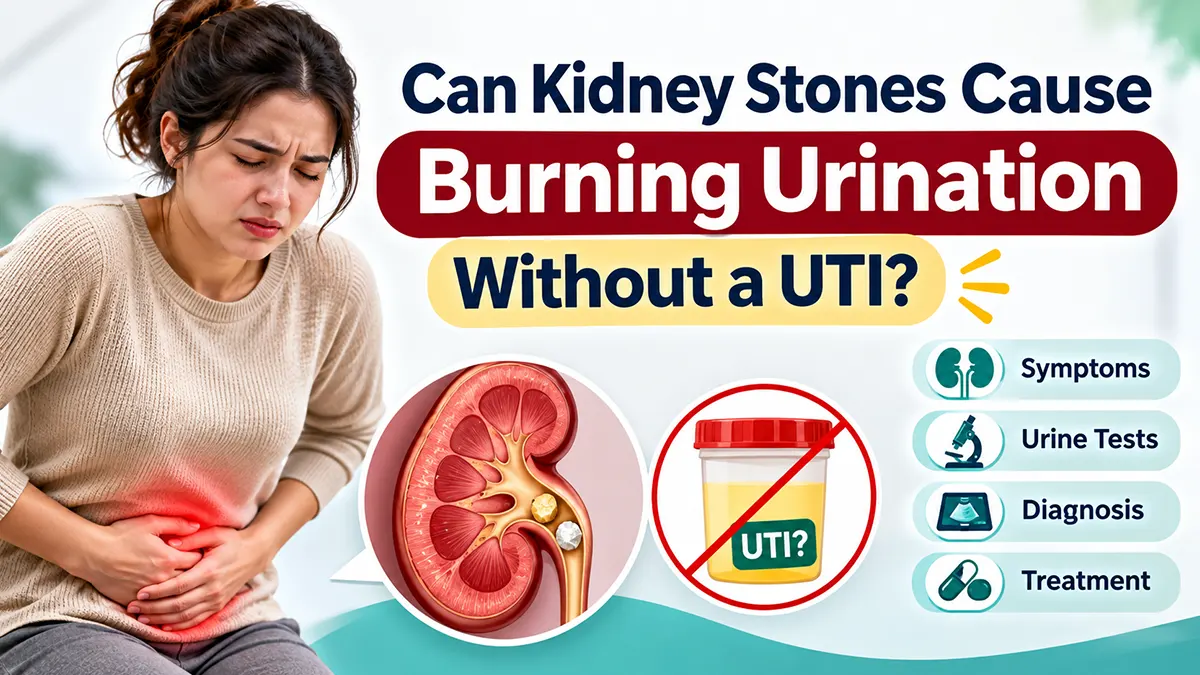
Can kidney stones cause burning urination without a UTI? Yes. A kidney stone can cause pain or burning when you urinate even when a urinary tract infection (UTI) is not present. But burning urination—also called dysuria—has several possible causes, and symptoms alone cannot reliably tell you whether you have a stone, an infection, or another condition.
If you have new or persistent burning when you pee, contact a healthcare professional for assessment. Seek emergency care for fever or chills with suspected kidney stone symptoms, inability to urinate, uncontrolled pain, or repeated vomiting. A blocked urinary tract with infection can become dangerous quickly.
Quick Answer: Kidney Stone Burning Urination Without UTI
A stone moving through the urinary tract may irritate nearby tissues and cause painful urination, urinary urgency, or blood in the urine. A UTI can cause many of the same symptoms. A urine test may help identify signs of infection or blood, while imaging may be needed if a stone is suspected. A negative urine culture does not, by itself, prove that a kidney stone is the cause.
How Can a Kidney Stone Cause Burning When You Pee?
Kidney stones form when certain minerals crystallize in the urine. Some stay in the kidney without symptoms. Others enter the ureter—the tube connecting the kidney to the bladder—and may cause pain, irritation, or blockage. As a stone travels lower in the urinary tract, a person may notice frequent urination, urgency, discomfort in the lower abdomen, or pain while urinating.
Burning does not necessarily mean the stone is about to pass, and the intensity of burning cannot establish stone size or location. A clinician may need urine testing and imaging to determine what is happening.
Kidney Stone vs. UTI: How Do Symptoms Compare?
These patterns can offer clues, but they overlap substantially. You cannot safely rule out infection based on symptoms alone.
| Symptom or finding | Kidney stone | UTI |
|---|---|---|
| Burning during urination | Possible | Common |
| Frequent or urgent urination | Possible, especially with a lower urinary tract stone | Common |
| Severe, wave-like pain in the side or back | More suggestive of a moving ureteral stone | Less typical of a simple bladder UTI; can occur with kidney infection |
| Blood in urine | Possible | Possible |
| Fever or chills | Concerning for associated infection or another illness | Can indicate a kidney infection or more serious infection |
| Urine culture | May be negative if no bacterial infection is present | May identify bacteria; results must be interpreted with symptoms and other tests |
| Imaging | May reveal a stone or obstruction | Not routinely needed for every simple bladder infection; may be used when complications are suspected |
Other Causes of Burning Urination When a UTI Test Is Negative
A negative UTI test does not automatically mean kidney stones. Depending on your symptoms and medical history, a clinician may consider:
- Urethral irritation or inflammation
- Sexually transmitted infections (STIs), including urethritis
- Vaginal irritation or infections
- Prostate-related inflammation in some patients
- Bladder pain syndrome or other bladder conditions
- Concentrated urine or irritation from certain personal-care products
Tell your healthcare professional about any discharge, genital sores, pelvic pain, recent sexual exposure, pregnancy, or recurring symptoms. These details can change which tests are appropriate.
Symptoms That May Raise Suspicion for a Kidney Stone
- Sharp pain in the side, back, lower abdomen, or groin
- Pain that comes and goes in waves
- Pink, red, or brown urine
- Frequent urge to urinate or passing small amounts
- Nausea or vomiting with urinary symptoms
Some small stones cause few or no symptoms. Conversely, the absence of visible blood does not rule out a stone. If symptoms are significant, do not wait for every symptom on this list to appear.
How Doctors Tell a Kidney Stone From a UTI
1. Medical history and examination
A clinician asks where the pain occurs, whether it comes in waves, how long burning has lasted, and whether you have fever, vomiting, prior stones, pregnancy, or risk factors for infection.
2. Urinalysis and, when appropriate, urine culture
Urinalysis can detect blood and findings that suggest inflammation or infection. A urine culture can help identify bacteria and guide antibiotic choices when a bacterial UTI is suspected. Neither test alone confirms or excludes every kidney stone or infection.
3. Imaging when a stone is suspected
Depending on the situation, clinicians may use ultrasound or a noncontrast CT scan to look for a stone and assess possible blockage. The best test depends on symptoms, age, pregnancy status, radiation considerations, and the clinician’s assessment.
4. Additional testing for other causes
STI testing, genital examination, or other investigations may be appropriate when urine results do not explain the symptoms.
What Helps If a Kidney Stone Is Causing Burning Urination?
Treatment depends on the stone’s size and location, whether urine is draining normally, your kidney function, pain severity, and whether infection is present. Options may include monitoring a stone likely to pass, clinician-recommended pain relief, selected prescription medicines that may aid passage of some ureteral stones, or a procedure such as ureteroscopy or shock-wave lithotripsy.
Drink fluids regularly if you can tolerate them and your clinician has not restricted fluids, but do not force large amounts of water to try to push out a blocked stone. Avoid starting leftover antibiotics: antibiotics treat bacterial infection, not a stone itself. If infection and obstruction occur together, urgent hospital treatment may be required.
When Is Burning Urination With a Possible Kidney Stone an Emergency?
Go to an emergency department now if you suspect a stone and have fever or shaking chills, cannot urinate, have severe or uncontrolled pain, repeated vomiting that prevents drinking, or feel faint, confused, or very unwell. A urinary blockage combined with infection is a urologic emergency and may require urgent drainage and antibiotics.
Seek prompt medical advice for visible blood in the urine, new persistent burning, recurrent symptoms, or symptoms during pregnancy. People with one kidney, known kidney disease, or reduced immune function should have a lower threshold for urgent assessment.
Frequently Asked Questions
Can a kidney stone feel exactly like a UTI?
Yes. Both can cause burning, urgency, frequent urination, and blood in the urine. Urine testing and sometimes imaging help distinguish them.
Can I have a kidney stone with a negative urine culture?
Yes. A stone does not require a bacterial infection. However, a negative culture does not prove a stone is present or explain all urinary symptoms.
Does burning mean a kidney stone is coming out?
Not necessarily. Burning can occur with a stone in the urinary tract, but it does not reliably predict when or whether the stone will pass.
Can kidney stones and a UTI happen at the same time?
Yes. Stones and infection can coexist. Infection behind a urinary blockage is especially dangerous and needs urgent evaluation.
Can you have a kidney stone without back pain?
Yes. Some stones cause little or no pain, while others produce discomfort in the lower abdomen or groin. The absence of back pain does not establish a diagnosis.
Will drinking more water stop the burning?
Staying appropriately hydrated may help prevent dehydration, but water does not reliably stop burning or treat an infection or obstruction. Persistent symptoms need evaluation.
Do I need antibiotics for a kidney stone?
Not for an uncomplicated stone alone. Antibiotics may be needed when a bacterial infection is present; a clinician should decide based on the assessment and testing.
Key Takeaways
- Kidney stones can cause burning urination without a UTI.
- UTIs and several noninfectious conditions can cause similar symptoms.
- Urine tests and sometimes imaging are needed to identify the cause.
- Fever, inability to urinate, uncontrolled pain, or persistent vomiting with suspected stones requires emergency care.
Medical Sources
- NIDDK: Symptoms & Causes of Kidney Stones
- NIDDK: Bladder Infection (UTI) in Adults
- MedlinePlus: Kidney Stones
- European Association of Urology: Urolithiasis Guidelines
Medical disclaimer: This article provides general health education and is not a diagnosis or a substitute for individualized medical advice. If you have symptoms, consult a qualified healthcare professional. Do not delay emergency care for warning signs.