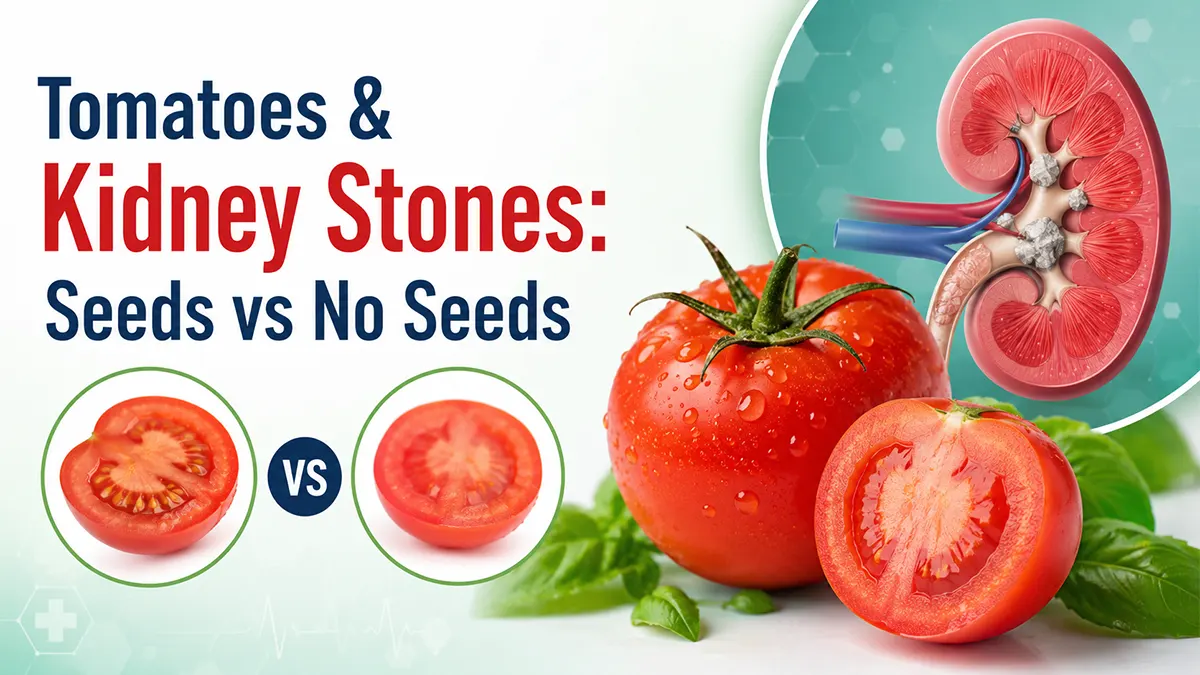
“Are tomatoes bad for kidney stones?” is one of the most frequently asked questions in urology clinics.
Many people avoid tomatoes after being diagnosed with kidney stones because they believe tomato seeds get trapped in the kidneys and form stones. This belief has been passed down for decades, but modern medical research tells a different story.
In reality, tomatoes and kidney stones have a more complex relationship. Tomatoes contain vitamins, antioxidants, potassium, and small amounts of oxalates. Whether they should be limited depends on your stone type, medical history, kidney function, and overall dietary pattern—not simply whether the tomato has seeds.
This article explains the science behind tomato seeds and kidney stones, compares seeded versus seedless tomatoes, discusses tomato oxalate content, and provides practical dietary advice from kidney stone specialists.
Table of Contents
What Are Kidney Stones?
Kidney stones are hard mineral deposits that develop inside the urinary tract when minerals become highly concentrated in urine.
The most common types include:
| Stone Type | Percentage | Dietary Considerations |
|---|---|---|
| Calcium oxalate | 75–80% | Monitor oxalate intake if advised |
| Calcium phosphate | 10–15% | Maintain urine balance |
| Uric acid | 5–10% | Reduce excess animal protein |
| Struvite | Infection-related | Treat urinary infections |
| Cystine | Rare genetic disorder | Specialized treatment |
Most dietary discussions about tomatoes focus on calcium oxalate stones, the most common variety.
Exercises to Pass Kidney Stone: Best Yoga Poses and Movements for Faster Relief
Are Tomatoes Bad for Kidney Stones?
The simple answer is No—not for most people.
Current evidence shows that:
- Tomatoes are not considered high-oxalate foods
- Tomato seeds have not been proven to cause kidney stones
- Moderate tomato intake is usually safe
- Hydration has a much greater impact on stone prevention than avoiding tomatoes
Many patients unnecessarily eliminate nutritious foods due to common myths. Instead, doctors recommend identifying the exact stone type before making major dietary restrictions.
Is Black Tea or Green Tea Bad for Kidney Stones? The Daily Habit You Must Watch
Do Tomato Seeds Cause Kidney Stones?
The Myth
Many people believe:
- Tomato seeds enter the kidneys.
- Seeds stick inside the urinary tract.
- Seeds gradually become kidney stones.
This is not how kidney stones form.
The Medical Reality
Kidney stones develop because of changes in urine chemistry—not because seeds travel into the kidneys.
After digestion:
- Tomato seeds pass through the digestive system.
- Nutrients are absorbed.
- Waste leaves through stool.
- Seeds do not travel from the intestines into the kidneys.
There is no strong scientific evidence proving that tomato seeds directly cause kidney stones.
Seeds vs. No Seeds: Does It Matter?
| Feature | Tomatoes with Seeds | Tomatoes without Seeds |
|---|---|---|
| Oxalate content | Slightly higher | Slightly lower |
| Stone risk | Minimal difference | Minimal difference |
| Nutritional value | Excellent | Excellent |
| Fiber | Slightly higher | Slightly lower |
| Medical recommendation | Usually safe | Optional if advised |
Removing tomato seeds may slightly reduce oxalate intake, but the reduction is generally too small to significantly lower kidney stone risk.
Are Tomatoes High in Oxalates?
People often ask:
“Are tomatoes high in oxalates?”
No.
Compared with foods such as spinach, beet greens, almonds, rhubarb, and Swiss chard, tomatoes contain relatively low oxalate levels.
Approximate Oxalate Comparison
| Food | Oxalate Level |
|---|---|
| Spinach | Very High |
| Rhubarb | Very High |
| Beet greens | Very High |
| Almonds | High |
| Sweet potatoes | Moderate |
| Tomatoes | Low to Moderate |
| Cucumbers | Low |
| Mushrooms | Low |
Tomatoes are generally acceptable on most kidney stone diets unless your doctor recommends stricter oxalate restriction.
Kidney Stones During Pregnancy: Safe Treatments and Pain Management
Tomatoes and Calcium Oxalate Stones
People with calcium oxalate stones often wonder if tomatoes should be avoided.
Current dietary guidance suggests:
✔ Eat tomatoes in moderation.
✔ Pair tomatoes with calcium-containing foods when appropriate.
✔ Drink enough water throughout the day.
✔ Reduce excessive sodium intake.
✔ Limit foods that are truly high in oxalates if advised by your doctor.
Completely avoiding tomatoes is usually unnecessary.
Is the Pain of Passing a Kidney Stone Worse for Men Than Women?
Raw Tomatoes vs Cooked Tomatoes
| Raw Tomatoes | Cooked Tomatoes |
|---|---|
| Higher vitamin C | Higher lycopene availability |
| Refreshing hydration | Easier digestion for some people |
| Similar oxalate content | Similar oxalate content |
| Good for salads | Good in soups and curries |
Cooking does not significantly increase oxalate levels.
Is Tomato Juice Bad for Kidney Stones?
Tomato juice can usually be consumed in moderation.
However, choose wisely.
Better Choices
- Fresh homemade tomato juice
- Low-sodium tomato juice
- No added sugar
Limit
- Packaged tomato juice with excess sodium
- Highly processed vegetable drinks
Too much sodium increases urinary calcium, which may increase stone risk.
Coconut Water for Kidney Stones: How Much Should You Drink Daily?
Does Tomato Paste Cause Kidney Stones?
Tomato paste is more concentrated than fresh tomatoes.
Although the nutrients become concentrated, moderate use is generally acceptable for most people.
Watch for:
- Added salt
- Processed sauces
- Excess serving sizes
Large amounts of processed tomato products may contribute more sodium than oxalates.
The 1-Gallon Rule: Exactly How Much Water You Need to Drink Daily to Prevent Kidney Stone Recurrence
Nightshades and Kidney Stones
Tomatoes belong to the nightshade vegetable family, along with:
- Potatoes
- Eggplants
- Bell peppers
There is no scientific evidence showing that nightshade vegetables increase kidney stone formation simply because they are nightshades.
Causes of Kidney Stones
Kidney stones usually develop because of:
- Low water intake
- High sodium diet
- Excess animal protein
- Family history
- Obesity
- Diabetes
- Certain digestive disorders
- Recurrent urinary infections
- Some medications
Tomatoes alone are rarely the cause.
Symptoms
Symptoms may include:
- Severe flank pain
- Blood in urine
- Burning while urinating
- Frequent urination
- Nausea
- Vomiting
- Fever (medical emergency if associated with infection)
Risk Factors
People at higher risk include those with:
- Previous kidney stones
- Family history
- Obesity
- Chronic dehydration
- High-salt diet
- Low urine volume
- Metabolic disorders
- Inflammatory bowel disease
- Bariatric surgery history
Diagnosis
A urologist may recommend:
- Urine analysis
- Blood tests
- Stone analysis
- Ultrasound
- CT scan
- 24-hour urine collection
Knowing the stone composition helps create an appropriate diet plan.
Treatment Options
Treatment depends on stone size and location.
Small stones may pass naturally with:
- Increased water intake
- Pain medication
- Medical expulsive therapy
Larger stones may require:
- Shock wave lithotripsy (ESWL)
- Ureteroscopy with laser treatment
- Percutaneous nephrolithotomy (PCNL)
- Rarely, surgery
Prevention Tips
To reduce future kidney stone risk:
✅ Drink enough water to produce at least 2–2.5 liters of urine daily.
✅ Reduce salt intake.
✅ Maintain a healthy weight.
✅ Eat adequate dietary calcium.
✅ Limit excessive animal protein.
✅ Avoid unnecessary restriction of nutritious vegetables.
✅ Follow a personalized kidney stone diet based on stone analysis.
Real Patient Insights from My Health Hospitals
Our urology specialists frequently meet patients who stop eating tomatoes completely after hearing that tomato seeds cause kidney stones. After evaluating their stone type and dietary habits, many discover that dehydration, excess salt, or inadequate fluid intake—not tomatoes—were the more significant contributors.
A personalized nutrition plan based on urine testing and stone analysis often helps patients prevent recurrence while maintaining a balanced diet that includes nutrient-rich vegetables like tomatoes when appropriate.
When to See a Doctor
Consult a urologist immediately if you experience:
- Severe back or side pain
- Fever with urinary symptoms
- Persistent vomiting
- Difficulty passing urine
- Blood in urine
- Recurrent kidney stones
- Pain lasting more than several hours
Comparison Table: Common Tomato Products
| Food | Safe for Most Kidney Stone Patients? | Notes |
|---|---|---|
| Fresh tomatoes | ✅ Yes | Moderate portions |
| Seeded tomatoes | ✅ Yes | No proven increased risk |
| Seedless tomatoes | ✅ Yes | Slightly lower oxalates |
| Tomato soup | ✅ Yes | Choose low-sodium versions |
| Tomato juice | ✅ Yes | Prefer fresh, low salt |
| Tomato paste | ✅ Moderate | Watch sodium and serving size |
| Tomato ketchup | ⚠ Limit | Often high in sugar and sodium |
Are tomatoes bad for kidney stones?
No. Most people with kidney stones can safely eat tomatoes in moderation. Tomatoes are not considered a high-oxalate food, and there is no strong evidence that they directly increase kidney stone formation. Your overall diet, hydration, and stone type are more important.
Do tomato seeds cause kidney stones?
No scientific evidence shows that tomato seeds directly cause kidney stones. Stones form because of mineral imbalances in urine rather than seeds traveling to the kidneys. Removing seeds is optional and usually unnecessary.
Can I eat tomatoes if I have calcium oxalate stones?
Yes. Most patients with calcium oxalate stones can include tomatoes in moderation as part of a balanced diet. Your healthcare provider may recommend dietary changes based on a 24-hour urine analysis and stone composition.
Are raw tomatoes worse than cooked tomatoes?
No. Raw and cooked tomatoes have similar oxalate levels. Cooking increases the availability of lycopene, a beneficial antioxidant, but does not significantly increase kidney stone risk.
Is tomato juice bad for kidney stones?
Fresh, low-sodium tomato juice is generally safe. Limit processed tomato juices with added salt, as excess sodium can increase the risk of calcium-based kidney stones.
Should I remove tomato seeds if I have kidney stones?
Removing tomato seeds slightly lowers oxalate intake, but the difference is minimal. Most people do not need to remove seeds unless advised by their doctor or dietitian.
Does tomato paste increase kidney stone risk?
Tomato paste itself is not known to cause kidney stones. However, processed tomato products often contain higher amounts of sodium, so consume them in moderation and check nutrition labels.
Are tomatoes high in oxalates?
No. Tomatoes are considered low to moderate in oxalates compared with foods like spinach, rhubarb, and almonds. They are generally compatible with many kidney stone prevention diets.
Which foods should kidney stone patients avoid instead?
People prone to calcium oxalate stones may need to limit high-oxalate foods such as spinach, beet greens, rhubarb, almonds, and excessive sodium. Recommendations should always be individualized based on stone type and medical advice.
What is the best diet for preventing kidney stones?
A kidney-friendly diet emphasizes adequate hydration, moderate calcium intake from food, reduced sodium, balanced protein consumption, fruits, vegetables, and personalized dietary guidance based on laboratory testing and stone analysis.
Key Takeaways
- Tomatoes are not bad for kidney stones for most people.
- Tomato seeds have not been proven to cause kidney stones.
- Tomatoes contain low to moderate oxalate levels.
- Hydration and sodium reduction are far more important than avoiding tomatoes.
- A personalized kidney stone diet based on stone type offers the best prevention strategy.
- Consult a urologist or nephrologist before making major dietary restrictions.
Conclusion
If you’ve been wondering “Are tomatoes bad for kidney stones?”, current medical evidence provides reassuring news. For most individuals, eating tomatoes with kidney stones is safe when consumed in moderation, and there is no convincing evidence that tomato seeds cause kidney stones. Instead of eliminating tomatoes, focus on proven prevention strategies such as drinking enough water, limiting excess sodium, maintaining a balanced diet, and following recommendations based on your specific stone type. If you experience recurrent stones or have questions about your diet, seek guidance from a qualified urologist or renal dietitian for personalized advice.
Medical Expert Review
Dr. Jayanth Reddy
Consultant Urologist | My Health Hospitals, Hyderabad
This content has undergone medical review to ensure it reflects current clinical evidence, accepted urological practices, and patient-centered healthcare guidance.
Author
Yamanandan Reddy
Health Content Writer & Frontend Developer
Yamanandan Reddy is a health content writer and frontend developer with over 4 years of experience in website design and digital content creation. He writes research-based health articles to help readers understand symptoms, causes, treatments, and prevention methods related to common health conditions.
His articles are written using information from trusted medical sources such as the World Health Organization (WHO), Mayo Clinic, and the Centers for Disease Control and Prevention (CDC).
Sources
The information in this article is researched and verified using trusted medical resources, including:
• World Health Organization (WHO)
• Mayo Clinic
• National Institutes of Health (NIH)
• Centers for Disease Control and Prevention
⚠️ Medical Disclaimer
This content is for informational purposes only and does not replace professional medical advice. Always consult a qualified healthcare provider for diagnosis and treatment.
1 thought on “Are Tomatoes Bad for Kidney Stones? 7 Expert Facts (Seeds vs. No Seeds)”