
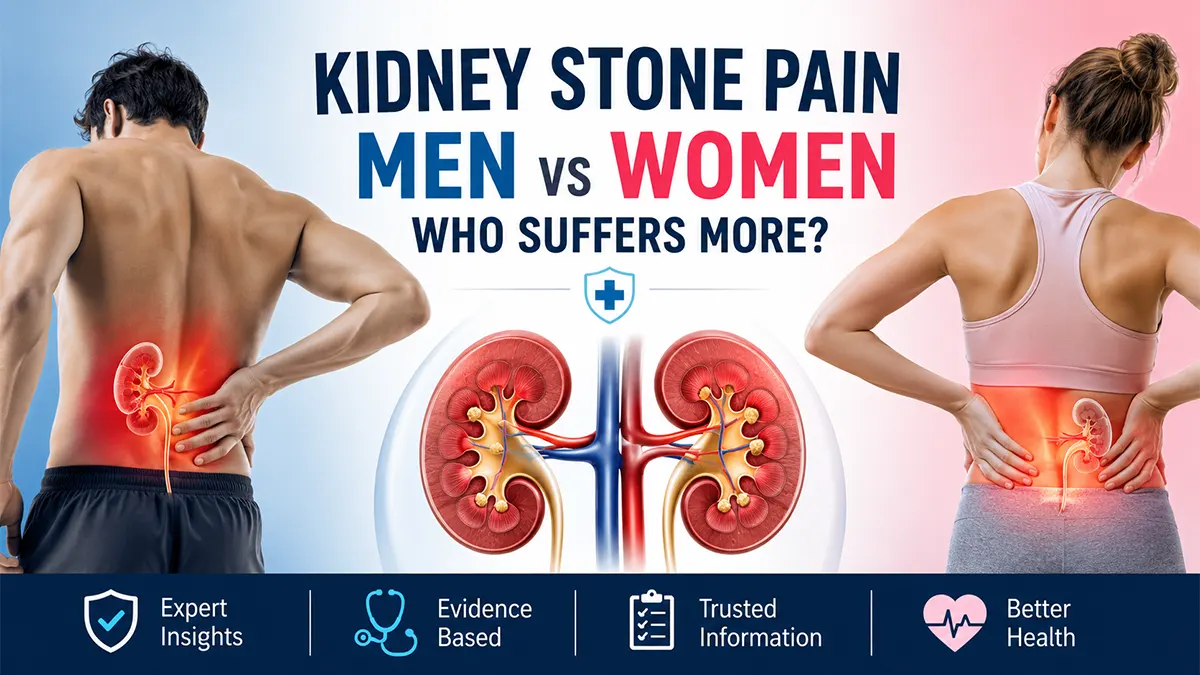
Kidney stones are among the most painful urological conditions. Many patients ask whether passing a kidney stone is worse for men than women and whether gender affects the experience.
The short answer is that both men and women can experience extremely severe pain, often rated among the highest pain levels in medicine. However, differences in anatomy, hormone levels, pain perception, and urinary tract structure can influence how symptoms are felt and where the pain occurs.
Understanding kidney stone pain gender differences can help patients recognize symptoms early and seek appropriate treatment.
Table of Contents
What Is a Kidney Stone?
A kidney stone is a hard deposit made of minerals and salts that forms inside the kidneys. These stones can travel through the urinary tract and may become lodged in the ureter, causing intense pain known as renal colic.
Common types include:
- Calcium oxalate stones
- Calcium phosphate stones
- Uric acid stones
- Struvite stones
- Cystine stones
Early Warning Signs of Kidney Stones You Should Never Ignore (Doctor Explains 2026)
Understanding Kidney Stone Pain Male vs Female
Why Is Passing a Kidney Stone So Painful?
Pain occurs when a stone blocks urine flow.
This blockage causes:
- Increased pressure inside the kidney
- Stretching of urinary tract tissues
- Ureter spasms
- Inflammation and swelling
The resulting pain can radiate from the back to the groin and is often described as sharp, cramping, and unbearable.
Many patients compare kidney stone pain to:
- Labor pain
- Major fractures
- Gallbladder attacks
- Surgical pain
Kidney Stone Pain Without Blood in Urine – Possible?
Does Gender Affect Kidney Stone Pain?
Kidney Stone Pain Level in Men
Men often report:
- Severe flank pain
- Pain radiating into the testicles
- Burning urination
- Pain when the stone enters the urethra
Because the male urethra is approximately 18–22 cm long, stones passing through this channel may cause additional discomfort.
Kidney Stone Pain Level in Women
Women commonly experience:
- Flank pain
- Lower abdominal pain
- Pelvic pressure
- Urinary urgency
Symptoms may sometimes mimic:
- Urinary tract infections (UTIs)
- Ovarian conditions
- Menstrual pain
This can occasionally delay diagnosis.
Kidney Stone Pain Relief Positions That Work Fast (2026 Guide)
Male vs Female Kidney Stone Passage
Passing a Kidney Stone: Male Anatomy
The urinary tract pathway in men includes:
Kidney → Ureter → Bladder → Long Urethra → Outside Body
Male Urethra Length and Kidney Stones
A longer urethra means:
- More distance for the stone to travel
- Potential irritation during passage
- Increased discomfort near the tip of the penis
Large stones can occasionally become stuck in the male urethra.
Kidney Stone Stuck in Male Urethra
Symptoms may include:
- Sudden inability to urinate
- Severe penile pain
- Blood in urine
- Weak urine stream
This is a medical emergency requiring immediate evaluation by a urologist.
Female Anatomy Passing a Kidney Stone
The female urinary pathway is:
Kidney → Ureter → Bladder → Short Urethra → Outside Body
Because the female urethra is much shorter (about 4 cm), stones generally spend less time in the urethral passage.
However, women still experience severe pain when stones move through the ureter, which is typically where most kidney stone pain originates.
Comparison Table: Male vs Female Kidney Stone Passage
| Feature | Men | Women |
|---|---|---|
| Overall Pain Severity | Very High | Very High |
| Ureter Pain | Similar | Similar |
| Urethra Length | Longer | Shorter |
| Groin Pain | Common | Less Common |
| Pelvic Pressure | Less Common | Common |
| Diagnostic Confusion | Lower | Higher |
| Stone Stuck in Urethra | More Likely | Less Likely |
| Childbirth Comparison | Cannot Compare Directly | Frequently Compared |
Is Kidney Stone Pain Worse Than Childbirth?
One of the most searched questions is:
Is Kidney Stone Pain Worse Than Childbirth?
There is no definitive medical answer because pain is subjective.
However:
- Some women who have experienced both childbirth and kidney stones report kidney stones as more painful.
- Others report labor pain as worse because it lasts longer.
- Kidney stone pain often arrives suddenly and unpredictably.
Medical experts generally agree that both rank among the most severe pain experiences.
7 Morning Habits for Kidney Health: Your 2026 Daily Reset Guide
Why Are Kidney Stones More Common in Men?
Historically, men developed kidney stones more frequently than women.
Reasons include:
- Higher dietary salt intake
- Increased animal protein consumption
- Lower fluid intake
- Occupational dehydration
- Metabolic differences
Recent studies show the gap is narrowing as kidney stone rates increase among women.
Symptoms of Kidney Stones
Where Does a Kidney Stone Hurt for a Man?
Men commonly feel pain in:
- Side of the abdomen
- Lower back
- Groin
- Testicles
- Penis
Pain often shifts location as the stone moves.
Symptoms of Kidney Stones in Females
Women may experience:
- Back pain
- Pelvic pain
- Lower abdominal pain
- Frequent urination
- Painful urination
- Nausea and vomiting
Symptoms can resemble urinary tract infections or gynecological conditions.
Risk Factors
Several factors increase stone risk regardless of gender:
Medical Conditions
- Obesity
- Diabetes
- Hyperparathyroidism
- Gout
- Recurrent urinary tract infections
Lifestyle Factors
- Dehydration
- High-sodium diet
- Excess animal protein
- High oxalate intake
- Sedentary lifestyle
Family History
A family history of kidney stones significantly increases risk.
Diagnosis
A urologist may recommend:
Physical Examination
Assessment of pain location and severity.
Urine Tests
To detect:
- Blood
- Infection
- Crystals
Blood Tests
To evaluate:
- Kidney function
- Calcium levels
- Uric acid levels
Imaging Studies
- CT scan
- Ultrasound
- X-ray
CT scans remain the most accurate method for detecting stones.
Treatment Options
Treatment depends on stone size and location.
Small Stones
Many stones pass naturally with:
- Increased hydration
- Pain medications
- Alpha blockers such as tamsulosin
Larger Stones
Patients may require:
Extracorporeal Shock Wave Lithotripsy (ESWL)
Uses sound waves to break stones.
Ureteroscopy
A thin scope removes or fragments stones.
Percutaneous Nephrolithotomy (PCNL)
Recommended for very large stones.
Male Kidney Stone Pain Relief
Options include:
- Hydration
- Prescription pain relief
- Warm compresses
- Medical expulsive therapy
Female Kidney Stone Pain Relief
Treatment is similar and may include:
- Pain medications
- Hydration
- Anti-nausea medicines
- Urology consultation
Prevention Tips
To reduce future kidney stone risk:
- Drink 2.5–3 liters of water daily.
- Limit excess salt intake.
- Moderate animal protein consumption.
- Maintain a healthy weight.
- Follow stone-specific dietary advice.
- Increase citrus intake if recommended.
- Complete metabolic evaluation after recurrent stones.
When to See a Doctor
Seek immediate medical care if you experience:
- Fever with kidney stone symptoms
- Inability to urinate
- Severe uncontrolled pain
- Persistent vomiting
- Blood in urine
- Single functioning kidney
- Pregnancy with stone symptoms
Consult a urologist as soon as possible for evaluation.
1. Do kidney stones hurt more for guys?
Not necessarily. Both men and women can experience extremely severe pain. Men may notice more discomfort as a stone passes through the longer urethra, while women may experience more pelvic pressure. Overall pain severity is generally similar.
2. Do women pass kidney stones easier?
Women may have an advantage because the urethra is shorter. However, most kidney stone pain occurs in the ureter, meaning both genders can experience similar levels of discomfort during stone passage.
3. Why are kidney stones worse for men?
Kidney stones are not always worse for men. Men may experience additional pain in the penis, testicles, and longer urethral pathway, but overall stone pain largely depends on stone size, location, and obstruction.
4. Does gender affect kidney stone pain?
Gender can influence symptom patterns and pain location. However, the intensity of pain is primarily determined by urinary tract obstruction rather than biological sex alone.
5. Where does a kidney stone hurt in men?
Men often feel pain in the side, lower back, groin, testicles, and penis. The location frequently changes as the stone travels through the urinary tract.
6. What are symptoms of kidney stones in females?
Women commonly experience flank pain, pelvic discomfort, urinary urgency, painful urination, nausea, and blood in the urine. Symptoms can sometimes resemble urinary tract infections.
7. Can a kidney stone get stuck in the male urethra?
Yes. Although uncommon, stones can become lodged in the male urethra, causing urinary blockage, severe pain, and difficulty urinating. Immediate medical attention is required.
8. Is kidney stone pain worse than childbirth?
Pain experiences vary. Some women who have experienced both conditions report kidney stone pain as worse, while others find childbirth more intense. Both are among the most severe pain experiences reported in medicine.
9. How can men pass a kidney stone faster?
Hydration, prescribed alpha-blockers, physical activity, and following a urologist’s recommendations may help small stones pass more efficiently. Large stones often require medical treatment.
10. Do men get kidney stones more than women?
Historically yes, but the difference is decreasing. Kidney stone rates are rising among women due to changes in diet, obesity rates, and lifestyle factors.
Key Takeaways
✅ Kidney stone pain is severe in both men and women.
✅ The ureter is responsible for most kidney stone pain.
✅ Men may experience extra discomfort because of a longer urethra.
✅ Women often experience pelvic symptoms that mimic other conditions.
✅ Stone size and location matter more than gender.
✅ Early diagnosis and treatment can prevent complications.
Conclusion
When comparing kidney stone pain male vs female, current medical evidence suggests that both genders can experience equally intense pain. While male vs female kidney stone passage differs because of anatomical differences, the severity of pain is primarily determined by stone size, location, and urinary obstruction rather than sex alone. If you experience symptoms of a kidney stone, seek prompt evaluation from a urologist to prevent complications and receive appropriate treatment.
Medical Expert Review
Dr. Jayanth Reddy
Consultant Urologist | My Health Hospitals, Hyderabad
This content has undergone medical review to ensure it reflects current clinical evidence, accepted urological practices, and patient-centered healthcare guidance.
Author
Yamanandan Reddy
Health Content Writer & Frontend Developer
Yamanandan Reddy is a health content writer and frontend developer with over 4 years of experience in website design and digital content creation. He writes research-based health articles to help readers understand symptoms, causes, treatments, and prevention methods related to common health conditions.
His articles are written using information from trusted medical sources such as the World Health Organization (WHO), Mayo Clinic, and the Centers for Disease Control and Prevention (CDC).
Sources
The information in this article is researched and verified using trusted medical resources, including:
• World Health Organization (WHO)
• Mayo Clinic
• National Institutes of Health (NIH)
• Centers for Disease Control and Prevention
⚠️ Medical Disclaimer
This content is for informational purposes only and does not replace professional medical advice. Always consult a qualified healthcare provider for diagnosis and treatment.
2 thoughts on “Is the Pain of Passing a Kidney Stone Worse for Men Than Women?”