
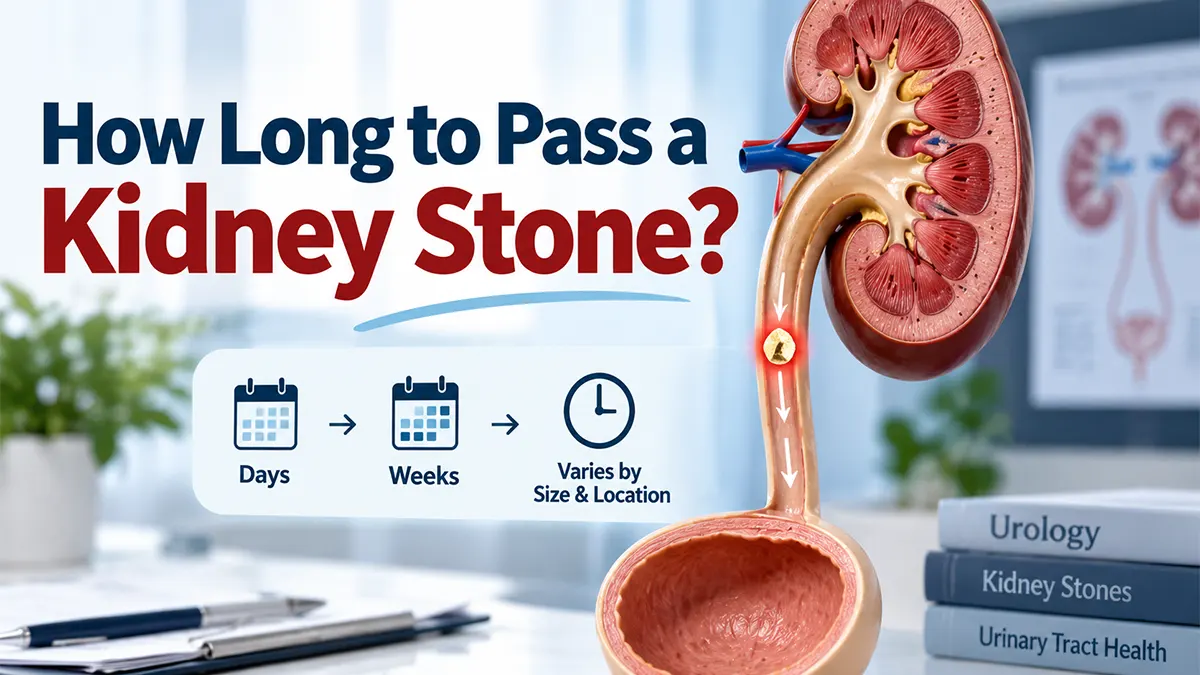
How Long Does It Take to Pass a Kidney Stone? A small stone that has moved into the ureter may pass naturally within a few days to several weeks, but the timing varies based on the stone’s size, location, and whether it is blocking urine flow. European Association of Urology guidance cites an average spontaneous-passage time of about 17 days, with reported ranges of 6–29 days in the evidence it reviewed.
Smaller stones are more likely to pass without a procedure, while larger stones—especially those causing significant obstruction, persistent pain, infection, or kidney-function problems—may require medical treatment.
Key Takeaways
- A small kidney stone may pass naturally within days to several weeks.
- Stone size and location are two of the biggest factors affecting passage.
- Stones already in the ureter are the ones that can pass into the bladder and out through urine.
- Stones smaller than 5 mm generally have a higher chance of passing spontaneously than larger stones.
- Distal ureter stones, closer to the bladder, are more likely to pass than stones higher in the ureter.
- An average passage time of about 17 days has been reported in EAU-reviewed evidence, but individual experiences vary.
- Severe pain, fever/chills, vomiting with dehydration, difficulty urinating, or other concerning symptoms require medical evaluation.
- Drinking enough fluid may support urine flow, but forcing excessive amounts of water does not guarantee faster stone passage.
- A stone that does not pass or causes obstruction may need medication or a procedure.
Table of Contents
How Long Does It Take to Pass a Kidney Stone?
There is no single number of days that applies to everyone.
Some very small stones pass without treatment and may cause little or no discomfort. Others can remain in the urinary tract for weeks or become stuck and require treatment. NIDDK states that healthcare professionals generally consider stone size, location, and composition when deciding how a kidney stone should be managed.
For ureteral stones being managed conservatively, EAU guidance reports an average time to spontaneous passage of approximately 17 days, with a reported range of 6 to 29 days in the studies reviewed.
That number should be viewed as a general evidence-based estimate—not a deadline for an individual patient.
What Determines How Fast a Kidney Stone Passes?
Several factors can influence how quickly a stone travels through the urinary tract.
What Should I Drink to Prevent Kidney Stones?
1. Stone Size
Size is one of the most important factors.
Smaller stones have more room to move through the ureter and are more likely to pass naturally. As stone size increases, spontaneous passage becomes less likely.
EAU evidence reports spontaneous passage for approximately:
- 75% of stones smaller than 5 mm
- 62% of stones 5 mm or larger
These figures are population-level estimates and do not predict exactly what will happen to one person.
What about a 4 mm stone?
A 4 mm ureteral stone has a relatively good chance of passing naturally, although its location matters.
What about a 5 mm stone?
A 5 mm stone may still pass on its own, but the chance is lower than for a smaller stone.
What about a 6–8 mm stone?
Larger stones are less likely to pass without assistance and may require closer follow-up or active treatment depending on their location and symptoms.
2. Where Is the Stone Located?
The location of the stone can make a major difference.
A kidney stone sitting inside the kidney isn’t necessarily in the process of passing.
Once it enters the ureter, the narrow tube connecting the kidney to the bladder, it can travel downward.
The ureter is commonly divided into:
- Upper ureter
- Middle ureter
- Lower or distal ureter
EAU guidance reports higher spontaneous-passage rates for stones in the distal ureter than for stones in the upper ureter. For stones smaller than 5 mm, the cited passage rate was approximately 89% in the distal ureter compared with about 71% in the upper ureter.
So a 4 mm stone near the bladder and a 4 mm stone near the kidney may not behave the same way.
Popping Ibuprofen for Every Ache? What It’s Secretly Doing to Your Kidneys
3. The Shape of the Stone Matters
Kidney stones aren’t all perfectly round.
They can be:
- Smooth
- Jagged
- Irregular
- Hard or dense
- Different in composition
NIDDK describes kidney stones as varying considerably in size and shape.
A stone’s shape and physical characteristics may affect how easily it moves through the ureter.
4. Whether the Stone Is Blocking Urine
A stone can become lodged in the ureter and interfere with urine flow.
This can cause:
- Severe or colicky pain
- Blood in urine
- Nausea or vomiting
- Urinary symptoms
- Swelling of the urinary tract
A blockage becomes more concerning when it occurs alongside infection or impaired kidney function. NIDDK notes that larger stones or stones blocking the urinary tract may require treatment.
How Long Does a 4 mm Kidney Stone Take to Pass?
A 4 mm stone in the ureter may pass naturally, particularly if it is located closer to the bladder.
However, there is no guaranteed timeframe.
Some people pass a stone relatively quickly, while others may experience symptoms for several weeks.
EAU guidance reports that stones under 5 mm have a substantially higher spontaneous-passage rate than larger stones, particularly when they are located in the distal ureter.
The 3 Worst Sleeping Positions When You’re Trying to Pass a Kidney Stone
How Long Does a 5 mm Kidney Stone Take to Pass?
A 5 mm stone may pass naturally, but the probability is lower than for smaller stones.
The actual likelihood depends heavily on its location.
A 5 mm stone near the bladder may have a better chance of passing than one higher in the ureter.
If pain continues, the stone remains obstructed, or complications develop, your healthcare professional may recommend treatment rather than waiting indefinitely.
How Long Does a 6 mm Kidney Stone Take to Pass?
A 6 mm stone is more difficult to pass naturally than a smaller stone.
It may still pass in some people, but the likelihood decreases as stone size increases. The decision to continue observation depends on factors such as:
- Exact stone location
- Pain severity
- Urine flow
- Infection
- Kidney function
- Changes seen on follow-up imaging
- Your overall health
Your urologist may recommend observation or active treatment based on these factors.
How Long Does an 8 mm Kidney Stone Take to Pass?
An 8 mm stone is considerably less likely to pass naturally than a very small stone.
Waiting may not be appropriate if the stone is causing persistent obstruction, severe pain, infection, or deterioration of kidney function.
Depending on the circumstances, a urologist may consider procedures such as:
- Shock wave lithotripsy
- Ureteroscopy
- Other stone-removal procedures
NIDDK describes these treatments as options for stones that are too large to pass, block the urinary tract, or cause significant symptoms.
You’re Drinking Water Wrong: The Hydration Mistake That Can Harm Your Kidneys
Does Kidney Stone Pain Mean the Stone Is Moving?
Not necessarily.
Kidney stone pain often occurs when the stone moves through or obstructs the ureter, but pain severity does not provide a reliable measurement of stone movement.
Pain can:
- Come and go
- Move from the back toward the abdomen or groin
- Become severe suddenly
- Improve temporarily
- Return later
A person can also have a small stone with relatively little pain.
NIDDK notes that small stones may pass with little or no pain, while stones that become stuck can cause severe pain or bleeding.
Where Does the Pain Go When a Kidney Stone Is Passing?
Pain may occur in the:
- Side or flank
- Lower abdomen
- Groin
As a stone moves down the ureter, the location of discomfort can change.
Some people experience severe pain that comes in waves rather than constant pain.
However, pain location alone cannot confirm that a kidney stone is passing. Other conditions can cause similar symptoms.
How Do You Know When a Kidney Stone Has Passed?
You may notice:
- A sudden reduction in stone-related pain
- A stone or small fragment in your urine
- Changes in urinary symptoms
But feeling better does not always prove that the stone has completely passed.
If your healthcare professional wants confirmation, follow-up imaging or another test may be recommended.
If you actually see the stone, your doctor may ask you to collect it so that it can be analyzed. NIDDK notes that stone analysis can help determine what type of stone you formed and guide prevention.
Can Drinking Water Make a Kidney Stone Pass Faster?
Adequate hydration is important, but more water does not necessarily mean faster passage.
Healthcare professionals may advise you to drink enough fluid to maintain urine flow while a small stone is passing, provided you do not have a condition requiring fluid restriction.
The goal is appropriate hydration—not forcing very large amounts of water in a short period.
Important
If you’re vomiting, severely dehydrated, unable to keep fluids down, or have been told to restrict fluids, speak with a healthcare professional rather than trying to increase your water intake yourself.
Can Lemon Water Help a Kidney Stone Pass?
Lemon water is not a guaranteed way to push an existing kidney stone through the urinary tract.
Citrus drinks contain citrate, which may help prevent certain stones, but that is different from proving that lemon water will make an existing stone pass faster.
For active stone passage, your treatment plan should be based on the stone’s size, location, symptoms, and your medical situation.
NIDDK notes that citrus drinks may help with prevention because of their citrate content.
Do Medicines Help Kidney Stones Pass?
Sometimes.
A healthcare professional may prescribe medications to control pain, nausea, or, in selected patients, help facilitate stone passage.
One commonly discussed medication is an alpha-blocker such as tamsulosin.
However, it isn’t appropriate for everyone with a kidney stone. EAU guidance says medical expulsive therapy should be used in appropriately selected patients when active stone removal is not indicated, and treatment should stop if complications such as infection, uncontrolled pain, or worsening kidney function develop.
Do not start tamsulosin or another prescription medicine on your own.
How Long Should You Wait for a Kidney Stone to Pass?
There isn’t one universal waiting period.
Observation may be reasonable for a small ureteral stone when:
- Pain is controlled
- There is no infection
- Kidney function is stable
- Urine is able to drain
- Your healthcare professional considers observation appropriate
But waiting becomes less appropriate when complications develop.
NIDDK states that larger stones or stones that block the urinary tract or cause significant pain may require treatment.
Your urologist may recommend follow-up imaging to determine whether the stone has moved or remains obstructed.
When Does a Kidney Stone Need Treatment?
A kidney stone may need active treatment when it:
- Is unlikely to pass naturally
- Causes persistent or severe pain
- Blocks urine flow
- Causes infection
- Causes deterioration of kidney function
- Remains in place during follow-up
- Is too large to pass safely
Treatment options can include shock wave lithotripsy, ureteroscopy, or percutaneous nephrolithotomy, depending on the stone and clinical circumstances.
What Happens If a Kidney Stone Does Not Pass?
A stone that remains stuck can continue causing symptoms and may obstruct urine.
A blocked urinary tract can also increase the risk of infection. NHS guidance notes that a blocked ureter can contribute to kidney infection, particularly when bacteria become trapped behind the blockage.
If a stone isn’t progressing, your healthcare professional may use imaging to reassess:
- Stone size
- Stone location
- Degree of obstruction
- Kidney swelling
- Other urinary tract findings
Treatment can then be adjusted accordingly.
Can a Kidney Stone Stay in the Kidney for Months?
Yes.
A stone located inside the kidney is different from a stone actively traveling through the ureter.
Some small, non-obstructing kidney stones may be monitored rather than immediately removed. EAU guidance notes that the natural history of asymptomatic kidney stones varies and that follow-up decisions depend on factors such as stone size, location, growth and symptoms.
So “How long does a kidney stone take to pass?” really depends on whether the stone has entered the ureter.
What Should You Do While Waiting for a Small Stone to Pass?
If your healthcare professional has advised observation:
Stay appropriately hydrated
Drink enough fluid unless you have been given a fluid restriction.
Follow your pain-management plan
Use medications exactly as directed.
Take prescribed medicines correctly
If your clinician has prescribed an alpha-blocker or another medication, follow their instructions.
Watch for warning signs
Pay attention to fever, chills, worsening pain, vomiting, or difficulty urinating.
Follow up when advised
Imaging may be necessary to confirm that the stone has moved or passed.
Collect the stone if instructed
Stone analysis can help identify its composition and guide future prevention.
When Is Kidney Stone Pain an Emergency?
Seek urgent medical care if you have kidney-stone symptoms together with:
- Fever or chills
- Severe or worsening pain
- Persistent vomiting or inability to keep fluids down
- Difficulty passing urine
- Significant blood in urine
- Feeling very weak or seriously unwell
A stone causing obstruction together with infection can be particularly serious.
NIDDK advises seeking care for kidney-stone symptoms such as severe pain or bleeding, while NHS guidance specifically recommends urgent assessment for severe pain or fever/chills.
Kidney Stone Passage Time by Size
| Approximate stone size | General expectation |
|---|---|
| <4 mm | Often has a good chance of passing naturally |
| 4–5 mm | May pass naturally; location matters |
| 5–6 mm | Passage becomes less predictable |
| 6–8 mm | Less likely to pass without treatment |
| >8 mm | Often requires urologic assessment for active treatment |
These are general categories, not guarantees. Stone location, obstruction, symptoms, and individual circumstances can substantially change the outcome. EAU data show that spontaneous passage decreases as stone size increases.
Kidney Stone Passage: Size vs Location
| Factor | Effect on natural passage |
|---|---|
| Smaller stone | Generally more likely to pass |
| Larger stone | Generally less likely to pass |
| Distal ureter | Generally higher passage rate |
| Upper ureter | Generally lower passage rate |
| No obstruction | More suitable for observation |
| Significant obstruction | May require treatment |
| Controlled pain | Observation may be possible |
| Severe persistent pain | May require intervention |
| No infection | Safer setting for observation |
| Infection + obstruction | Urgent medical concern |
How long does it take to pass a kidney stone?
A small ureteral stone may pass within days to several weeks. EAU-reviewed evidence reports an average passage time of about 17 days, with a reported range of 6–29 days, but individual timing varies.
Can a 4 mm kidney stone pass naturally?
Yes. A 4 mm ureteral stone often has a reasonable chance of passing naturally, particularly when it is located near the bladder. However, no individual passage can be guaranteed.
Can a 5 mm kidney stone pass without surgery?
Yes, some 5 mm stones pass naturally. The chance depends heavily on location, symptoms and whether the stone is obstructing urine flow.
Can a 6 mm kidney stone pass naturally?
It can, but the chance is lower than for smaller stones. A urologist may recommend observation or treatment depending on the stone’s location and your symptoms.
How long does an 8 mm kidney stone take to pass?
An 8 mm stone is less likely to pass naturally than a smaller stone. Depending on its location and symptoms, active treatment may be considered.
How do I know if my kidney stone has passed?
A reduction in pain and seeing a stone in your urine may suggest passage, but symptoms alone cannot always confirm that the entire stone has passed. Follow-up testing may be needed.
Does drinking water make kidney stones pass faster?
Adequate hydration may help maintain urine flow, but forcing excessive amounts of water does not guarantee faster stone passage. Follow your healthcare professional’s fluid recommendations.
Does walking help pass a kidney stone?
Normal movement may be comfortable for some people, but there is not a guaranteed exercise that will make a kidney stone pass. Your stone’s size and location are more important factors.
Can a kidney stone get stuck?
Yes. A larger stone can become lodged in the ureter and block urine flow, potentially causing severe pain and other complications.
What happens if a kidney stone does not pass?
Your healthcare professional may monitor it with imaging or recommend treatment depending on its size, location, symptoms, obstruction, infection and kidney function.
Can a kidney stone cause fever?
A kidney stone itself can cause pain and urinary symptoms, but fever or chills can indicate infection, particularly if the ureter is blocked. This requires prompt medical assessment.
When should I go to the hospital for a kidney stone?
Seek urgent medical care for severe or worsening pain, fever or chills, persistent vomiting/dehydration, difficulty urinating, or other symptoms suggesting obstruction or infection.
Bottom Line
How Long Does It Take to Pass a Kidney Stone? For a small stone that is already in the ureter, passage may take several days to several weeks. The EAU reports an average of about 17 days in the evidence it reviewed, but size and location can make the actual timeframe very different from person to person.
The most important question isn’t simply “How many days should I wait?” It is whether the stone is small enough and positioned safely enough to observe without causing obstruction, infection, uncontrolled pain, or kidney problems.
Medical Disclaimer
This article is for general educational purposes and does not replace diagnosis or individualized medical advice. If you have severe pain, fever/chills, persistent vomiting, difficulty urinating, or known urinary obstruction, seek prompt medical evaluation.
Medical Review
Dr. Jayanth Reddy – Consultant Urologist
My Health Hospitals, Hyderabad
This content has been medically reviewed for accuracy, safety, and reliability based on current urology treatment guidelines and patient education standards.
According to the National Health Service kidney stone symptoms guidance, severe flank pain may worsen during rest or nighttime and should never be ignored if accompanied by fever, vomiting, or difficulty urinating.
Author
Yamanandan Reddy
Health Content Writer & Frontend Developer
Yamanandan Reddy is a health content writer and frontend developer with over 4 years of experience in website design and digital content creation. He writes research-based health articles to help readers understand symptoms, causes, treatments, and prevention methods related to common health conditions.
His articles are written using information from trusted medical sources such as the World Health Organization (WHO), Mayo Clinic, and the Centers for Disease Control and Prevention (CDC).
Sources
The information in this article is researched and verified using trusted medical resources, including:
• World Health Organization (WHO)
• Mayo Clinic
• National Institutes of Health (NIH)
• Centers for Disease Control and Prevention